

326
J. A. Delgado and C. Godard
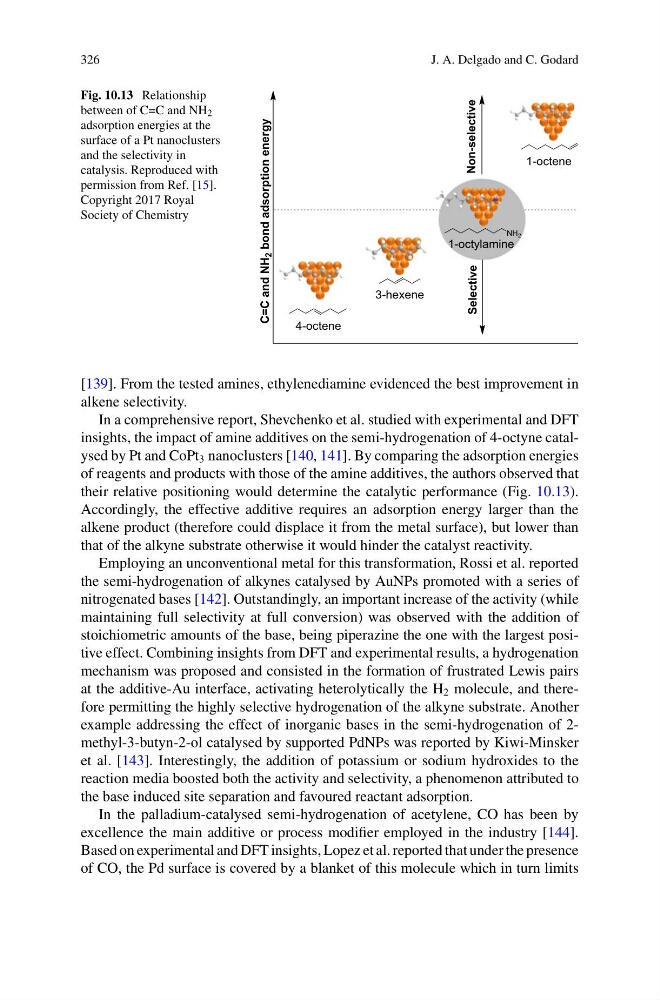
Fig. 10.13 Relationship
between of C=C and NH 2
adsorption energies at the
surface of a Pt nanoclusters
and the selectivity in
catalysis. Reproduced with
permission from Ref. [15].
Copyright 2017 Royal
Society of Chemistry
4-octene
3-hexene
1-octene
C=C and NH
2 bond adsorption energy
Non-selective
Selective
NH 2
1-octylamine
[139]. From the tested amines, ethylenediamine evidenced the best improvement in
alkene selectivity.
In a comprehensive report, Shevchenko et al. studied with experimental and DFT
insights, the impact of amine additives on the semi-hydrogenation of 4-octyne catalysed by Pt and CoPt 3 nanoclusters [140, 141]. By comparing the adsorption energies
of reagents and products with those of the amine additives, the authors observed that
their relative positioning would determine the catalytic performance (Fig. 10.13).
Accordingly, the effective additive requires an adsorption energy larger than the
alkene product (therefore could displace it from the metal surface), but lower than
that of the alkyne substrate otherwise it would hinder the catalyst reactivity.
Employing an unconventional metal for this transformation, Rossi et al. reported
the semi-hydrogenation of alkynes catalysed by AuNPs promoted with a series of
nitrogenated bases [142]. Outstandingly, an important increase of the activity (while
maintaining full selectivity at full conversion) was observed with the addition of
stoichiometric amounts of the base, being piperazine the one with the largest positive effect. Combining insights from DFT and experimental results, a hydrogenation
mechanism was proposed and consisted in the formation of frustrated Lewis pairs
at the additive-Au interface, activating heterolytically the H 2 molecule, and therefore permitting the highly selective hydrogenation of the alkyne substrate. Another
example addressing the effect of inorganic bases in the semi-hydrogenation of 2methyl-3-butyn-2-ol catalysed by supported PdNPs was reported by Kiwi-Minsker
et al. [143]. Interestingly, the addition of potassium or sodium hydroxides to the
reaction media boosted both the activity and selectivity, a phenomenon attributed to
the base induced site separation and favoured reactant adsorption.
In the palladium-catalysed semi-hydrogenation of acetylene, CO has been by
excellence the main additive or process modifier employed in the industry [144].
Based on experimental and DFT insights, Lopez et al. reported that under the presence
of CO, the Pd surface is covered by a blanket of this molecule which in turn limits
J. A. Delgado and C. Godard
Fig. 10.13 Relationship
between of C=C and NH 2
adsorption energies at the
surface of a Pt nanoclusters
and the selectivity in
catalysis. Reproduced with
permission from Ref. [15].
Copyright 2017 Royal
Society of Chemistry
4-octene
3-hexene
1-octene
C=C and NH
2 bond adsorption energy
Non-selective
Selective
NH 2
1-octylamine
[139]. From the tested amines, ethylenediamine evidenced the best improvement in
alkene selectivity.
In a comprehensive report, Shevchenko et al. studied with experimental and DFT
insights, the impact of amine additives on the semi-hydrogenation of 4-octyne catalysed by Pt and CoPt 3 nanoclusters [140, 141]. By comparing the adsorption energies
of reagents and products with those of the amine additives, the authors observed that
their relative positioning would determine the catalytic performance (Fig. 10.13).
Accordingly, the effective additive requires an adsorption energy larger than the
alkene product (therefore could displace it from the metal surface), but lower than
that of the alkyne substrate otherwise it would hinder the catalyst reactivity.
Employing an unconventional metal for this transformation, Rossi et al. reported
the semi-hydrogenation of alkynes catalysed by AuNPs promoted with a series of
nitrogenated bases [142]. Outstandingly, an important increase of the activity (while
maintaining full selectivity at full conversion) was observed with the addition of
stoichiometric amounts of the base, being piperazine the one with the largest positive effect. Combining insights from DFT and experimental results, a hydrogenation
mechanism was proposed and consisted in the formation of frustrated Lewis pairs
at the additive-Au interface, activating heterolytically the H 2 molecule, and therefore permitting the highly selective hydrogenation of the alkyne substrate. Another
example addressing the effect of inorganic bases in the semi-hydrogenation of 2methyl-3-butyn-2-ol catalysed by supported PdNPs was reported by Kiwi-Minsker
et al. [143]. Interestingly, the addition of potassium or sodium hydroxides to the
reaction media boosted both the activity and selectivity, a phenomenon attributed to
the base induced site separation and favoured reactant adsorption.
In the palladium-catalysed semi-hydrogenation of acetylene, CO has been by
excellence the main additive or process modifier employed in the industry [144].
Based on experimental and DFT insights, Lopez et al. reported that under the presence
of CO, the Pd surface is covered by a blanket of this molecule which in turn limits