

1 Ligand-Free Sub-Nanometer Metal Clusters in Catalysis
21
Me
O
OMe
O
[Au] (0.02 mol %)
DCM, 35 ºC, 20 h
O
Me
O
MeO
11
12
AuPPh 3 Cl + AgOTf
AuCl or AuCl 3
HOTf (0.2 mol%)
AuCl 3 + HOTf (0.2 mol%)
AuCl + HOTf (0.2 mol%)
a 3 mol%,
b 10 mol%
0% (>99%)
a
0% (~30%)
b
0%
52%
76%
a
0
50
100
150
200
0
0 , 2
0 , 4
0 , 6
initial rate / h -1
AuCl treated with HOTf
/ mol%
c
0
200
400
600
800
0
0 , 5
1
initial rate / h -1
AuPPh 3 OTf / mol%
b
0
0 . 5
1
0
0 . 2
0 . 4
0 . 6
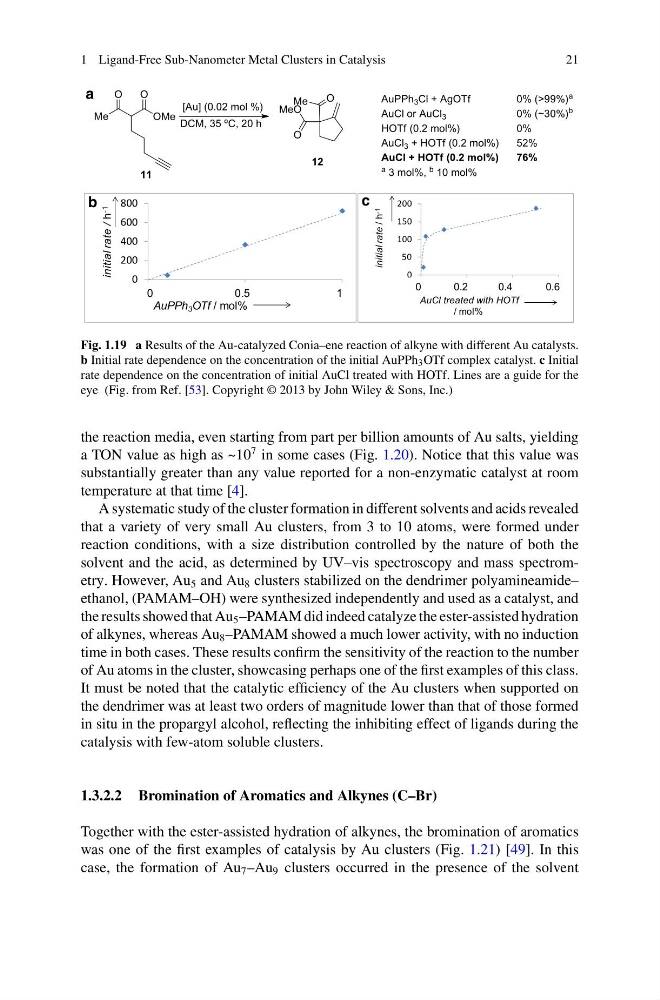
Fig. 1.19 a Results of the Au-catalyzed Conia–ene reaction of alkyne with different Au catalysts.
b Initial rate dependence on the concentration of the initial AuPPh 3 OTf complex catalyst. c Initial
rate dependence on the concentration of initial AuCl treated with HOTf. Lines are a guide for the
eye (Fig. from Ref. [53]. Copyright © 2013 by John Wiley & Sons, Inc.)
the reaction media, even starting from part per billion amounts of Au salts, yielding
a TON value as high as ~10
7 in some cases (Fig. 1.20). Notice that this value was
substantially greater than any value reported for a non-enzymatic catalyst at room
temperature at that time [4].
A systematic study of the cluster formation in different solvents and acids revealed
that a variety of very small Au clusters, from 3 to 10 atoms, were formed under
reaction conditions, with a size distribution controlled by the nature of both the
solvent and the acid, as determined by UV–vis spectroscopy and mass spectrometry. However, Au 5 and Au 8 clusters stabilized on the dendrimer polyamineamide–
ethanol, (PAMAM–OH) were synthesized independently and used as a catalyst, and
the results showed that Au 5 –PAMAM did indeed catalyze the ester-assisted hydration
of alkynes, whereas Au 8 –PAMAM showed a much lower activity, with no induction
time in both cases. These results confirm the sensitivity of the reaction to the number
of Au atoms in the cluster, showcasing perhaps one of the first examples of this class.
It must be noted that the catalytic efficiency of the Au clusters when supported on
the dendrimer was at least two orders of magnitude lower than that of those formed
in situ in the propargyl alcohol, reflecting the inhibiting effect of ligands during the
catalysis with few-atom soluble clusters.
1.3.2.2 Bromination of Aromatics and Alkynes (C–Br)
Together with the ester-assisted hydration of alkynes, the bromination of aromatics
was one of the first examples of catalysis by Au clusters (Fig. 1.21) [49]. In this
case, the formation of Au 7 –Au 9 clusters occurred in the presence of the solvent
21
Me
O
OMe
O
[Au] (0.02 mol %)
DCM, 35 ºC, 20 h
O
Me
O
MeO
11
12
AuPPh 3 Cl + AgOTf
AuCl or AuCl 3
HOTf (0.2 mol%)
AuCl 3 + HOTf (0.2 mol%)
AuCl + HOTf (0.2 mol%)
a 3 mol%,
b 10 mol%
0% (>99%)
a
0% (~30%)
b
0%
52%
76%
a
0
50
100
150
200
0
0 , 2
0 , 4
0 , 6
initial rate / h -1
AuCl treated with HOTf
/ mol%
c
0
200
400
600
800
0
0 , 5
1
initial rate / h -1
AuPPh 3 OTf / mol%
b
0
0 . 5
1
0
0 . 2
0 . 4
0 . 6
Fig. 1.19 a Results of the Au-catalyzed Conia–ene reaction of alkyne with different Au catalysts.
b Initial rate dependence on the concentration of the initial AuPPh 3 OTf complex catalyst. c Initial
rate dependence on the concentration of initial AuCl treated with HOTf. Lines are a guide for the
eye (Fig. from Ref. [53]. Copyright © 2013 by John Wiley & Sons, Inc.)
the reaction media, even starting from part per billion amounts of Au salts, yielding
a TON value as high as ~10
7 in some cases (Fig. 1.20). Notice that this value was
substantially greater than any value reported for a non-enzymatic catalyst at room
temperature at that time [4].
A systematic study of the cluster formation in different solvents and acids revealed
that a variety of very small Au clusters, from 3 to 10 atoms, were formed under
reaction conditions, with a size distribution controlled by the nature of both the
solvent and the acid, as determined by UV–vis spectroscopy and mass spectrometry. However, Au 5 and Au 8 clusters stabilized on the dendrimer polyamineamide–
ethanol, (PAMAM–OH) were synthesized independently and used as a catalyst, and
the results showed that Au 5 –PAMAM did indeed catalyze the ester-assisted hydration
of alkynes, whereas Au 8 –PAMAM showed a much lower activity, with no induction
time in both cases. These results confirm the sensitivity of the reaction to the number
of Au atoms in the cluster, showcasing perhaps one of the first examples of this class.
It must be noted that the catalytic efficiency of the Au clusters when supported on
the dendrimer was at least two orders of magnitude lower than that of those formed
in situ in the propargyl alcohol, reflecting the inhibiting effect of ligands during the
catalysis with few-atom soluble clusters.
1.3.2.2 Bromination of Aromatics and Alkynes (C–Br)
Together with the ester-assisted hydration of alkynes, the bromination of aromatics
was one of the first examples of catalysis by Au clusters (Fig. 1.21) [49]. In this
case, the formation of Au 7 –Au 9 clusters occurred in the presence of the solvent