

10 Progress in the Selective Semi-hydrogenation of Alkynes …
315
10.3.3 Borides, Phosphides and Nitrides
In a series of early contributions, Brown et al. reported the preparation of nickel boride
Ni 2 B colloids and its application in the semi-hydrogenation of alkynes [88, 89]. The
NPs were prepared by chemical reduction of nickel salts using sodium borohydride
in ethanol or water. Interestingly, differences in the reactivity were detected as a
function of the reaction solvent, and those prepared in ethanol exhibited the highest
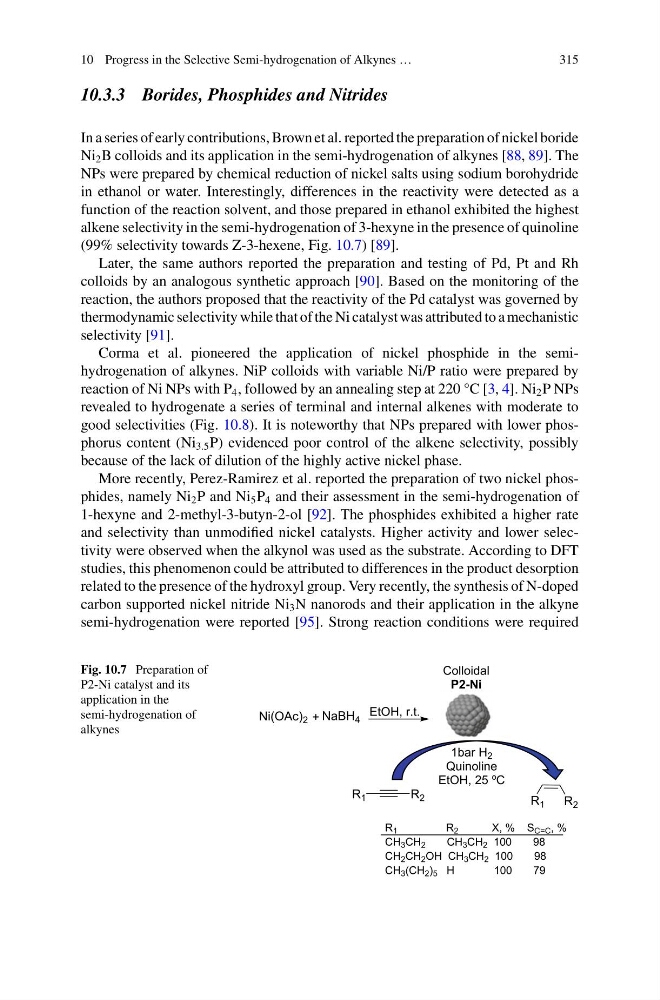
alkene selectivity in the semi-hydrogenation of 3-hexyne in the presence of quinoline
(99% selectivity towards Z-3-hexene, Fig. 10.7) [89].
Later, the same authors reported the preparation and testing of Pd, Pt and Rh
colloids by an analogous synthetic approach [90]. Based on the monitoring of the
reaction, the authors proposed that the reactivity of the Pd catalyst was governed by
thermodynamic selectivity while that of the Ni catalyst was attributed to a mechanistic
selectivity [91].
Corma et al. pioneered the application of nickel phosphide in the semihydrogenation of alkynes. NiP colloids with variable Ni/P ratio were prepared by
reaction of Ni NPs with P 4 , followed by an annealing step at 220 °C [3, 4]. Ni 2 P NPs
revealed to hydrogenate a series of terminal and internal alkenes with moderate to
good selectivities (Fig. 10.8). It is noteworthy that NPs prepared with lower phosphorus content (Ni 3.5 P) evidenced poor control of the alkene selectivity, possibly
because of the lack of dilution of the highly active nickel phase.
More recently, Perez-Ramirez et al. reported the preparation of two nickel phosphides, namely Ni 2 P and Ni 5 P 4 and their assessment in the semi-hydrogenation of
1-hexyne and 2-methyl-3-butyn-2-ol [92]. The phosphides exhibited a higher rate
and selectivity than unmodified nickel catalysts. Higher activity and lower selectivity were observed when the alkynol was used as the substrate. According to DFT
studies, this phenomenon could be attributed to differences in the product desorption
related to the presence of the hydroxyl group. Very recently, the synthesis of N-doped
carbon supported nickel nitride Ni 3 N nanorods and their application in the alkyne
semi-hydrogenation were reported [95]. Strong reaction conditions were required
Fig. 10.7 Preparation of
P2-Ni catalyst and its
application in the
semi-hydrogenation of
alkynes
+
EtOH, r.t.
Colloidal
P2-Ni
R 1
R 2
1bar H 2
Quinoline
EtOH, 25 ºC
Ni(OAc) 2 NaBH 4
R 1
R 2
R 1
R 2
X, % S C=C , %
CH 3 CH 2
CH 3 CH 2 100
98
CH 2 CH 2 OH CH 3 CH 2 100
98
CH 3 (CH 2 ) 5 H
1 0 0
7 9
315
10.3.3 Borides, Phosphides and Nitrides
In a series of early contributions, Brown et al. reported the preparation of nickel boride
Ni 2 B colloids and its application in the semi-hydrogenation of alkynes [88, 89]. The
NPs were prepared by chemical reduction of nickel salts using sodium borohydride
in ethanol or water. Interestingly, differences in the reactivity were detected as a
function of the reaction solvent, and those prepared in ethanol exhibited the highest
alkene selectivity in the semi-hydrogenation of 3-hexyne in the presence of quinoline
(99% selectivity towards Z-3-hexene, Fig. 10.7) [89].
Later, the same authors reported the preparation and testing of Pd, Pt and Rh
colloids by an analogous synthetic approach [90]. Based on the monitoring of the
reaction, the authors proposed that the reactivity of the Pd catalyst was governed by
thermodynamic selectivity while that of the Ni catalyst was attributed to a mechanistic
selectivity [91].
Corma et al. pioneered the application of nickel phosphide in the semihydrogenation of alkynes. NiP colloids with variable Ni/P ratio were prepared by
reaction of Ni NPs with P 4 , followed by an annealing step at 220 °C [3, 4]. Ni 2 P NPs
revealed to hydrogenate a series of terminal and internal alkenes with moderate to
good selectivities (Fig. 10.8). It is noteworthy that NPs prepared with lower phosphorus content (Ni 3.5 P) evidenced poor control of the alkene selectivity, possibly
because of the lack of dilution of the highly active nickel phase.
More recently, Perez-Ramirez et al. reported the preparation of two nickel phosphides, namely Ni 2 P and Ni 5 P 4 and their assessment in the semi-hydrogenation of
1-hexyne and 2-methyl-3-butyn-2-ol [92]. The phosphides exhibited a higher rate
and selectivity than unmodified nickel catalysts. Higher activity and lower selectivity were observed when the alkynol was used as the substrate. According to DFT
studies, this phenomenon could be attributed to differences in the product desorption
related to the presence of the hydroxyl group. Very recently, the synthesis of N-doped
carbon supported nickel nitride Ni 3 N nanorods and their application in the alkyne
semi-hydrogenation were reported [95]. Strong reaction conditions were required
Fig. 10.7 Preparation of
P2-Ni catalyst and its
application in the
semi-hydrogenation of
alkynes
+
EtOH, r.t.
Colloidal
P2-Ni
R 1
R 2
1bar H 2
Quinoline
EtOH, 25 ºC
Ni(OAc) 2 NaBH 4
R 1
R 2
R 1
R 2
X, % S C=C , %
CH 3 CH 2
CH 3 CH 2 100
98
CH 2 CH 2 OH CH 3 CH 2 100
98
CH 3 (CH 2 ) 5 H
1 0 0
7 9