

250
M. Camats et al.
8.1 Introduction
In the 1990s, a ground-breaking movement concerning the Earth preservation for
future generations has appeared. In Chemistry, these actions led to the Green Chemistry concept [7, 128] articulated through the 12 Green Chemistry Principles [6];
shortly after, the Sandestin declaration established the bases of the Green Engineering Principles [8]. Notably, catalysis is one of the most important pillars of
Green approaches [9]. Analyzing the evolution of metal-based catalysis, involving homogeneous and heterogeneous systems, it is evident to conclude that definitely the twentieth century has been the century of “heavy” metal-based catalysts, i.e., catalytic processes concerning 4d and 5d metals (such as Mo, Ru, Rh,
Ir, Pd, Pt, Au …), as internationally acknowledged by the Nobel Prizes in 2005 (Y.
Chauvin, R. H. Grubbs and R. R. Schrock) and 2010 (R. F. Heck, E.-i. Negishi
and A. Suzuki) for the development of metathesis processes (mainly Mo- and
Ru-based catalysts) and Pd-catalyzed couplings in organic synthesis, respectively
(www.nobelprize.org/prizes/chemistry/2005/summary; www.nobelprize.org/prizes/
chemistry/2010/summary). Nevertheless, nature has exploited earth abundant 3d
metals (Fe, Ni, Cu, Zn …), leading to metalloenzymes which exhibit a prominent
specificity [16]. In coherence to a sustainable development, researches on the design
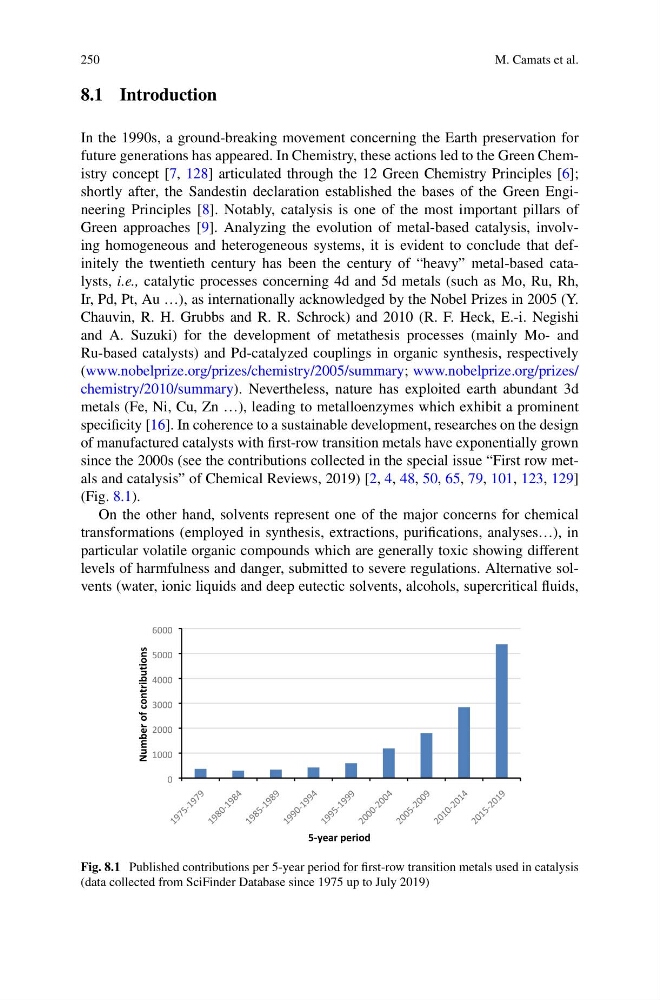
of manufactured catalysts with first-row transition metals have exponentially grown
since the 2000s (see the contributions collected in the special issue “First row metals and catalysis” of Chemical Reviews, 2019) [2, 4, 48, 50, 65, 79, 101, 123, 129]
(Fig. 8.1).
On the other hand, solvents represent one of the major concerns for chemical
transformations (employed in synthesis, extractions, purifications, analyses…), in
particular volatile organic compounds which are generally toxic showing different
levels of harmfulness and danger, submitted to severe regulations. Alternative solvents (water, ionic liquids and deep eutectic solvents, alcohols, supercritical fluids,
0
1000
2000
3000
4000
5000
6000
1 9 7 5 - 1 9 7 9
1 9 8 0 - 1 9 8 4
1 9 8 5 - 1 9 8 9
1 9 9 0 - 1 9 9 4
1 9 9 5 - 1 9 9 9
2 0 0 0 - 2 0 0 4
2 0 0 5 - 2 0 0 9
2 0 1 0 - 2 0 1 4
2 0 1 5 - 2 0 1 9
5-year period
Number of contributions
Fig. 8.1 Published contributions per 5-year period for first-row transition metals used in catalysis
(data collected from SciFinder Database since 1975 up to July 2019)
M. Camats et al.
8.1 Introduction
In the 1990s, a ground-breaking movement concerning the Earth preservation for
future generations has appeared. In Chemistry, these actions led to the Green Chemistry concept [7, 128] articulated through the 12 Green Chemistry Principles [6];
shortly after, the Sandestin declaration established the bases of the Green Engineering Principles [8]. Notably, catalysis is one of the most important pillars of
Green approaches [9]. Analyzing the evolution of metal-based catalysis, involving homogeneous and heterogeneous systems, it is evident to conclude that definitely the twentieth century has been the century of “heavy” metal-based catalysts, i.e., catalytic processes concerning 4d and 5d metals (such as Mo, Ru, Rh,
Ir, Pd, Pt, Au …), as internationally acknowledged by the Nobel Prizes in 2005 (Y.
Chauvin, R. H. Grubbs and R. R. Schrock) and 2010 (R. F. Heck, E.-i. Negishi
and A. Suzuki) for the development of metathesis processes (mainly Mo- and
Ru-based catalysts) and Pd-catalyzed couplings in organic synthesis, respectively
(www.nobelprize.org/prizes/chemistry/2005/summary; www.nobelprize.org/prizes/
chemistry/2010/summary). Nevertheless, nature has exploited earth abundant 3d
metals (Fe, Ni, Cu, Zn …), leading to metalloenzymes which exhibit a prominent
specificity [16]. In coherence to a sustainable development, researches on the design
of manufactured catalysts with first-row transition metals have exponentially grown
since the 2000s (see the contributions collected in the special issue “First row metals and catalysis” of Chemical Reviews, 2019) [2, 4, 48, 50, 65, 79, 101, 123, 129]
(Fig. 8.1).
On the other hand, solvents represent one of the major concerns for chemical
transformations (employed in synthesis, extractions, purifications, analyses…), in
particular volatile organic compounds which are generally toxic showing different
levels of harmfulness and danger, submitted to severe regulations. Alternative solvents (water, ionic liquids and deep eutectic solvents, alcohols, supercritical fluids,
0
1000
2000
3000
4000
5000
6000
1 9 7 5 - 1 9 7 9
1 9 8 0 - 1 9 8 4
1 9 8 5 - 1 9 8 9
1 9 9 0 - 1 9 9 4
1 9 9 5 - 1 9 9 9
2 0 0 0 - 2 0 0 4
2 0 0 5 - 2 0 0 9
2 0 1 0 - 2 0 1 4
2 0 1 5 - 2 0 1 9
5-year period
Number of contributions
Fig. 8.1 Published contributions per 5-year period for first-row transition metals used in catalysis
(data collected from SciFinder Database since 1975 up to July 2019)