

10
J. Oliver–Meseguer and A. Leyva–Pérez
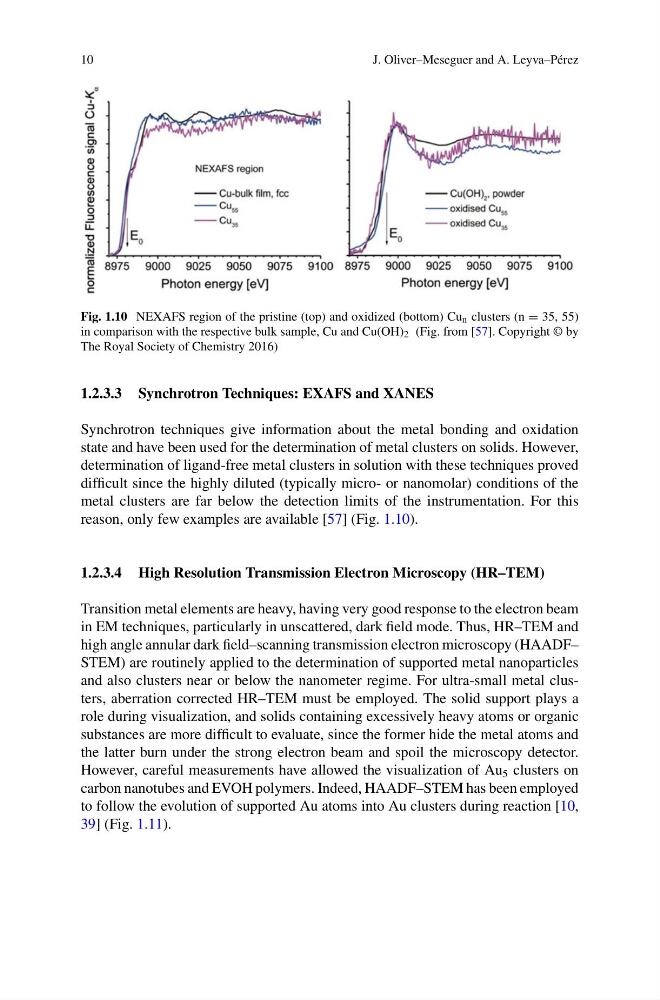
Fig. 1.10 NEXAFS region of the pristine (top) and oxidized (bottom) Cu n clusters (n = 35, 55)
in comparison with the respective bulk sample, Cu and Cu(OH) 2 (Fig. from [57]. Copyright © by
The Royal Society of Chemistry 2016)
1.2.3.3 Synchrotron Techniques: EXAFS and XANES
Synchrotron techniques give information about the metal bonding and oxidation
state and have been used for the determination of metal clusters on solids. However,
determination of ligand-free metal clusters in solution with these techniques proved
difficult since the highly diluted (typically micro- or nanomolar) conditions of the
metal clusters are far below the detection limits of the instrumentation. For this
reason, only few examples are available [57] (Fig. 1.10).
1.2.3.4 High Resolution Transmission Electron Microscopy (HR–TEM)
Transition metal elements are heavy, having very good response to the electron beam
in EM techniques, particularly in unscattered, dark field mode. Thus, HR–TEM and
high angle annular dark field–scanning transmission electron microscopy (HAADF–
STEM) are routinely applied to the determination of supported metal nanoparticles
and also clusters near or below the nanometer regime. For ultra-small metal clusters, aberration corrected HR–TEM must be employed. The solid support plays a
role during visualization, and solids containing excessively heavy atoms or organic
substances are more difficult to evaluate, since the former hide the metal atoms and
the latter burn under the strong electron beam and spoil the microscopy detector.
However, careful measurements have allowed the visualization of Au 5 clusters on
carbon nanotubes and EVOH polymers. Indeed, HAADF–STEM has been employed
to follow the evolution of supported Au atoms into Au clusters during reaction [10,
39] (Fig. 1.11).
J. Oliver–Meseguer and A. Leyva–Pérez
Fig. 1.10 NEXAFS region of the pristine (top) and oxidized (bottom) Cu n clusters (n = 35, 55)
in comparison with the respective bulk sample, Cu and Cu(OH) 2 (Fig. from [57]. Copyright © by
The Royal Society of Chemistry 2016)
1.2.3.3 Synchrotron Techniques: EXAFS and XANES
Synchrotron techniques give information about the metal bonding and oxidation
state and have been used for the determination of metal clusters on solids. However,
determination of ligand-free metal clusters in solution with these techniques proved
difficult since the highly diluted (typically micro- or nanomolar) conditions of the
metal clusters are far below the detection limits of the instrumentation. For this
reason, only few examples are available [57] (Fig. 1.10).
1.2.3.4 High Resolution Transmission Electron Microscopy (HR–TEM)
Transition metal elements are heavy, having very good response to the electron beam
in EM techniques, particularly in unscattered, dark field mode. Thus, HR–TEM and
high angle annular dark field–scanning transmission electron microscopy (HAADF–
STEM) are routinely applied to the determination of supported metal nanoparticles
and also clusters near or below the nanometer regime. For ultra-small metal clusters, aberration corrected HR–TEM must be employed. The solid support plays a
role during visualization, and solids containing excessively heavy atoms or organic
substances are more difficult to evaluate, since the former hide the metal atoms and
the latter burn under the strong electron beam and spoil the microscopy detector.
However, careful measurements have allowed the visualization of Au 5 clusters on
carbon nanotubes and EVOH polymers. Indeed, HAADF–STEM has been employed
to follow the evolution of supported Au atoms into Au clusters during reaction [10,
39] (Fig. 1.11).