

184
Y. Min et al.
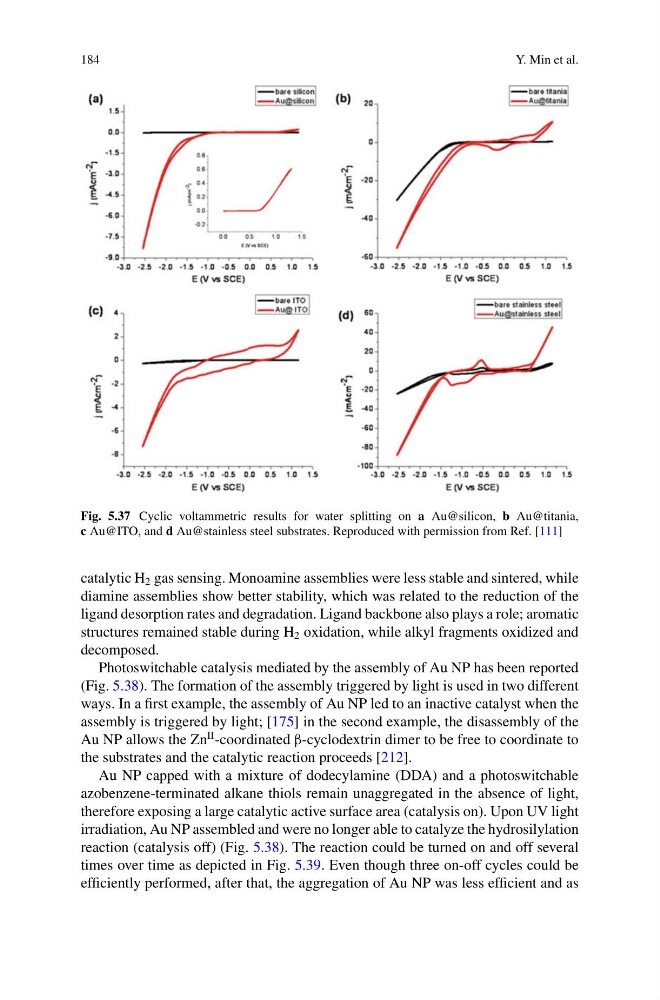
Fig. 5.37 Cyclic voltammetric results for water splitting on a Au@silicon, b Au@titania,
c Au@ITO, and d Au@stainless steel substrates. Reproduced with permission from Ref. [111]
catalytic H 2 gas sensing. Monoamine assemblies were less stable and sintered, while
diamine assemblies show better stability, which was related to the reduction of the
ligand desorption rates and degradation. Ligand backbone also plays a role; aromatic
structures remained stable during H 2 oxidation, while alkyl fragments oxidized and
decomposed.
Photoswitchable catalysis mediated by the assembly of Au NP has been reported
(Fig. 5.38). The formation of the assembly triggered by light is used in two different
ways. In a first example, the assembly of Au NP led to an inactive catalyst when the
assembly is triggered by light; [175] in the second example, the disassembly of the
Au NP allows the Zn
II -coordinated β-cyclodextrin dimer to be free to coordinate to
the substrates and the catalytic reaction proceeds [212].
Au NP capped with a mixture of dodecylamine (DDA) and a photoswitchable
azobenzene-terminated alkane thiols remain unaggregated in the absence of light,
therefore exposing a large catalytic active surface area (catalysis on). Upon UV light
irradiation, Au NP assembled and were no longer able to catalyze the hydrosilylation
reaction (catalysis off) (Fig. 5.38). The reaction could be turned on and off several
times over time as depicted in Fig. 5.39. Even though three on-off cycles could be
efficiently performed, after that, the aggregation of Au NP was less efficient and as
Y. Min et al.
Fig. 5.37 Cyclic voltammetric results for water splitting on a Au@silicon, b Au@titania,
c Au@ITO, and d Au@stainless steel substrates. Reproduced with permission from Ref. [111]
catalytic H 2 gas sensing. Monoamine assemblies were less stable and sintered, while
diamine assemblies show better stability, which was related to the reduction of the
ligand desorption rates and degradation. Ligand backbone also plays a role; aromatic
structures remained stable during H 2 oxidation, while alkyl fragments oxidized and
decomposed.
Photoswitchable catalysis mediated by the assembly of Au NP has been reported
(Fig. 5.38). The formation of the assembly triggered by light is used in two different
ways. In a first example, the assembly of Au NP led to an inactive catalyst when the
assembly is triggered by light; [175] in the second example, the disassembly of the
Au NP allows the Zn
II -coordinated β-cyclodextrin dimer to be free to coordinate to
the substrates and the catalytic reaction proceeds [212].
Au NP capped with a mixture of dodecylamine (DDA) and a photoswitchable
azobenzene-terminated alkane thiols remain unaggregated in the absence of light,
therefore exposing a large catalytic active surface area (catalysis on). Upon UV light
irradiation, Au NP assembled and were no longer able to catalyze the hydrosilylation
reaction (catalysis off) (Fig. 5.38). The reaction could be turned on and off several
times over time as depicted in Fig. 5.39. Even though three on-off cycles could be
efficiently performed, after that, the aggregation of Au NP was less efficient and as