

5 Covalent Assemblies of Metal Nanoparticles—Strategies …
181
Oxidation Reactions
A three-step process was used to synthesize catalytically active super-lattices of
Au NP, which consisted of: (i) adsorption of citrate-capped Au NP on thiol-DNA,
followed by the formation of body-centered cubic (bcc) super-lattices by addition
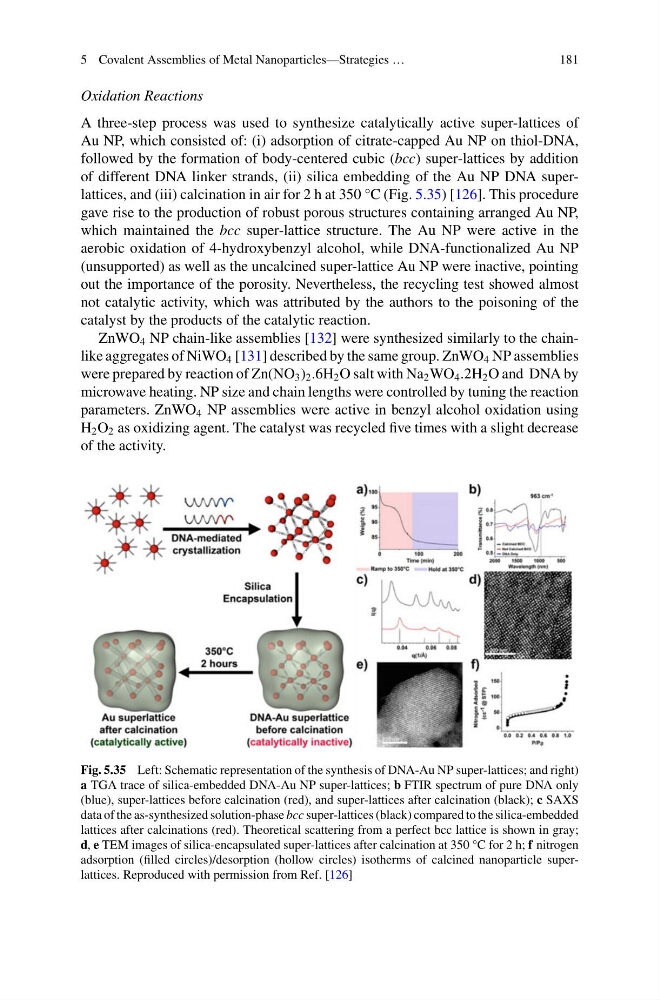
of different DNA linker strands, (ii) silica embedding of the Au NP DNA superlattices, and (iii) calcination in air for 2 h at 350 °C (Fig. 5.35) [126]. This procedure
gave rise to the production of robust porous structures containing arranged Au NP,
which maintained the bcc super-lattice structure. The Au NP were active in the
aerobic oxidation of 4-hydroxybenzyl alcohol, while DNA-functionalized Au NP
(unsupported) as well as the uncalcined super-lattice Au NP were inactive, pointing
out the importance of the porosity. Nevertheless, the recycling test showed almost
not catalytic activity, which was attributed by the authors to the poisoning of the
catalyst by the products of the catalytic reaction.
ZnWO 4 NP chain-like assemblies [132] were synthesized similarly to the chainlike aggregates of NiWO 4 [131] described by the same group. ZnWO 4 NP assemblies
were prepared by reaction of Zn(NO 3 ) 2 .6H 2 O salt with Na 2 WO 4 .2H 2 O and DNA by
microwave heating. NP size and chain lengths were controlled by tuning the reaction
parameters. ZnWO 4 NP assemblies were active in benzyl alcohol oxidation using
H 2 O 2 as oxidizing agent. The catalyst was recycled five times with a slight decrease
of the activity.
Fig. 5.35 Left: Schematic representation of the synthesis of DNA-Au NP super-lattices; and right)
a TGA trace of silica-embedded DNA-Au NP super-lattices; b FTIR spectrum of pure DNA only
(blue), super-lattices before calcination (red), and super-lattices after calcination (black); c SAXS
data of the as-synthesized solution-phase bcc super-lattices (black) compared to the silica-embedded
lattices after calcinations (red). Theoretical scattering from a perfect bcc lattice is shown in gray;
d, e TEM images of silica-encapsulated super-lattices after calcination at 350 °C for 2 h; f nitrogen
adsorption (filled circles)/desorption (hollow circles) isotherms of calcined nanoparticle superlattices. Reproduced with permission from Ref. [126]
181
Oxidation Reactions
A three-step process was used to synthesize catalytically active super-lattices of
Au NP, which consisted of: (i) adsorption of citrate-capped Au NP on thiol-DNA,
followed by the formation of body-centered cubic (bcc) super-lattices by addition
of different DNA linker strands, (ii) silica embedding of the Au NP DNA superlattices, and (iii) calcination in air for 2 h at 350 °C (Fig. 5.35) [126]. This procedure
gave rise to the production of robust porous structures containing arranged Au NP,
which maintained the bcc super-lattice structure. The Au NP were active in the
aerobic oxidation of 4-hydroxybenzyl alcohol, while DNA-functionalized Au NP
(unsupported) as well as the uncalcined super-lattice Au NP were inactive, pointing
out the importance of the porosity. Nevertheless, the recycling test showed almost
not catalytic activity, which was attributed by the authors to the poisoning of the
catalyst by the products of the catalytic reaction.
ZnWO 4 NP chain-like assemblies [132] were synthesized similarly to the chainlike aggregates of NiWO 4 [131] described by the same group. ZnWO 4 NP assemblies
were prepared by reaction of Zn(NO 3 ) 2 .6H 2 O salt with Na 2 WO 4 .2H 2 O and DNA by
microwave heating. NP size and chain lengths were controlled by tuning the reaction
parameters. ZnWO 4 NP assemblies were active in benzyl alcohol oxidation using
H 2 O 2 as oxidizing agent. The catalyst was recycled five times with a slight decrease
of the activity.
Fig. 5.35 Left: Schematic representation of the synthesis of DNA-Au NP super-lattices; and right)
a TGA trace of silica-embedded DNA-Au NP super-lattices; b FTIR spectrum of pure DNA only
(blue), super-lattices before calcination (red), and super-lattices after calcination (black); c SAXS
data of the as-synthesized solution-phase bcc super-lattices (black) compared to the silica-embedded
lattices after calcinations (red). Theoretical scattering from a perfect bcc lattice is shown in gray;
d, e TEM images of silica-encapsulated super-lattices after calcination at 350 °C for 2 h; f nitrogen
adsorption (filled circles)/desorption (hollow circles) isotherms of calcined nanoparticle superlattices. Reproduced with permission from Ref. [126]