

5 Covalent Assemblies of Metal Nanoparticles—Strategies …
155
5.2.2.2 Covalent Coupling Reactions
In addition to click reactions, diverse organic transformations have been used to
connect metal NP into 1-D, 2-D, or 3-D assemblies. An amide-coupling reaction
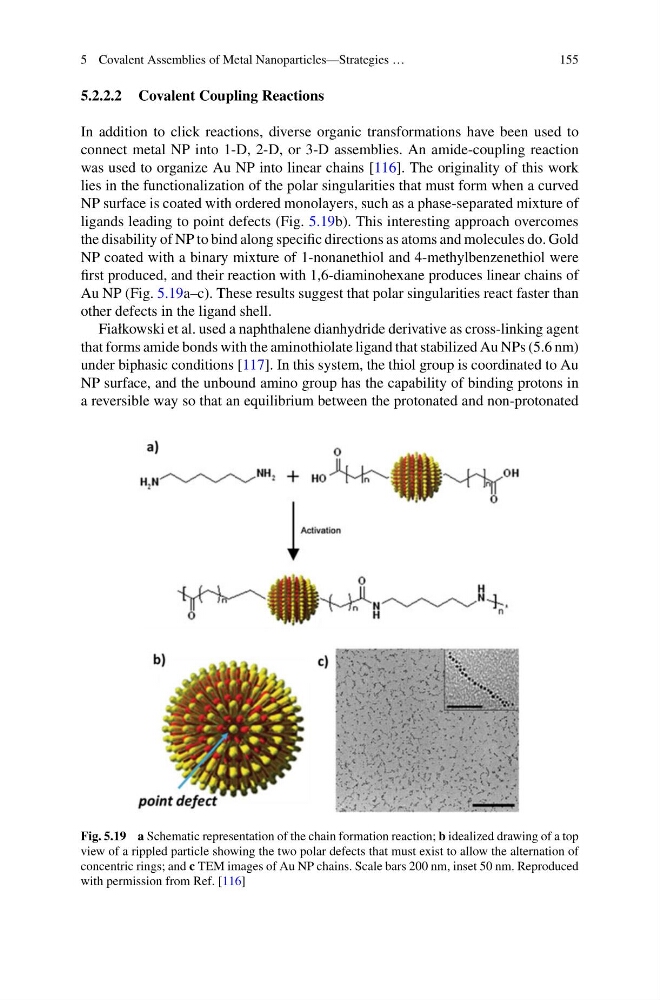
was used to organize Au NP into linear chains [116]. The originality of this work
lies in the functionalization of the polar singularities that must form when a curved
NP surface is coated with ordered monolayers, such as a phase-separated mixture of
ligands leading to point defects (Fig. 5.19b). This interesting approach overcomes
the disability of NP to bind along specific directions as atoms and molecules do. Gold
NP coated with a binary mixture of 1-nonanethiol and 4-methylbenzenethiol were
first produced, and their reaction with 1,6-diaminohexane produces linear chains of
Au NP (Fig. 5.19a–c). These results suggest that polar singularities react faster than
other defects in the ligand shell.
Fiałkowski et al. used a naphthalene dianhydride derivative as cross-linking agent
that forms amide bonds with the aminothiolate ligand that stabilized Au NPs (5.6 nm)
under biphasic conditions [117]. In this system, the thiol group is coordinated to Au
NP surface, and the unbound amino group has the capability of binding protons in
a reversible way so that an equilibrium between the protonated and non-protonated
Fig. 5.19 a Schematic representation of the chain formation reaction; b idealized drawing of a top
view of a rippled particle showing the two polar defects that must exist to allow the alternation of
concentric rings; and c TEM images of Au NP chains. Scale bars 200 nm, inset 50 nm. Reproduced
with permission from Ref. [116]
155
5.2.2.2 Covalent Coupling Reactions
In addition to click reactions, diverse organic transformations have been used to
connect metal NP into 1-D, 2-D, or 3-D assemblies. An amide-coupling reaction
was used to organize Au NP into linear chains [116]. The originality of this work
lies in the functionalization of the polar singularities that must form when a curved
NP surface is coated with ordered monolayers, such as a phase-separated mixture of
ligands leading to point defects (Fig. 5.19b). This interesting approach overcomes
the disability of NP to bind along specific directions as atoms and molecules do. Gold
NP coated with a binary mixture of 1-nonanethiol and 4-methylbenzenethiol were
first produced, and their reaction with 1,6-diaminohexane produces linear chains of
Au NP (Fig. 5.19a–c). These results suggest that polar singularities react faster than
other defects in the ligand shell.
Fiałkowski et al. used a naphthalene dianhydride derivative as cross-linking agent
that forms amide bonds with the aminothiolate ligand that stabilized Au NPs (5.6 nm)
under biphasic conditions [117]. In this system, the thiol group is coordinated to Au
NP surface, and the unbound amino group has the capability of binding protons in
a reversible way so that an equilibrium between the protonated and non-protonated
Fig. 5.19 a Schematic representation of the chain formation reaction; b idealized drawing of a top
view of a rippled particle showing the two polar defects that must exist to allow the alternation of
concentric rings; and c TEM images of Au NP chains. Scale bars 200 nm, inset 50 nm. Reproduced
with permission from Ref. [116]