

150
Y. Min et al.
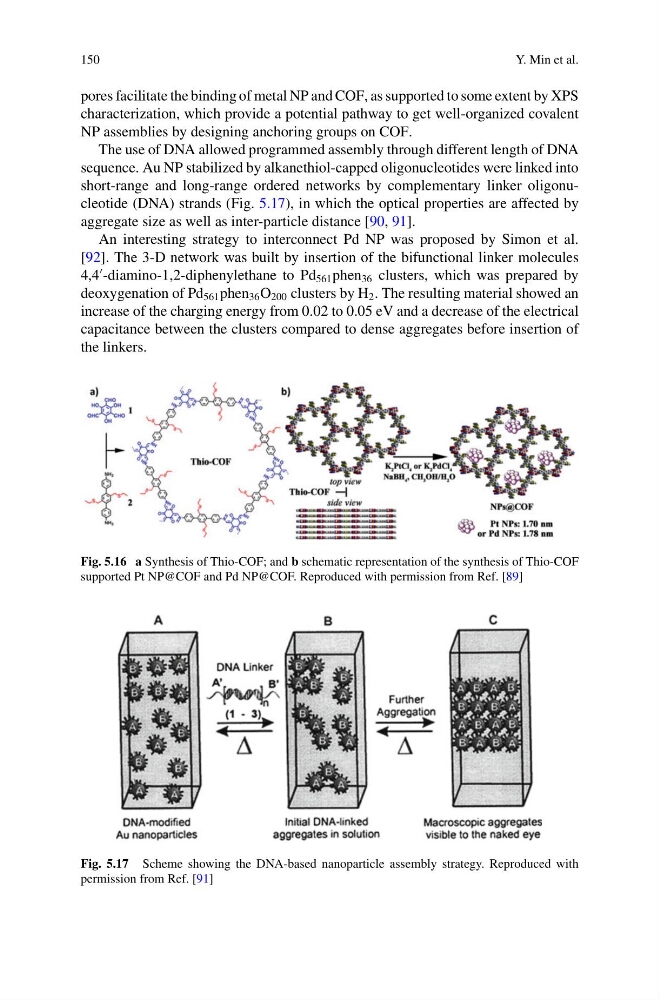
pores facilitate the binding of metal NP and COF, as supported to some extent by XPS
characterization, which provide a potential pathway to get well-organized covalent
NP assemblies by designing anchoring groups on COF.
The use of DNA allowed programmed assembly through different length of DNA
sequence. Au NP stabilized by alkanethiol-capped oligonucleotides were linked into
short-range and long-range ordered networks by complementary linker oligonucleotide (DNA) strands (Fig. 5.17), in which the optical properties are affected by
aggregate size as well as inter-particle distance [90, 91].
An interesting strategy to interconnect Pd NP was proposed by Simon et al.
[92]. The 3-D network was built by insertion of the bifunctional linker molecules
4,4
-diamino-1,2-diphenylethane to Pd 561 phen 36 clusters, which was prepared by
deoxygenation of Pd 561 phen 36 O 200 clusters by H 2 . The resulting material showed an
increase of the charging energy from 0.02 to 0.05 eV and a decrease of the electrical
capacitance between the clusters compared to dense aggregates before insertion of
the linkers.
Fig. 5.16 a Synthesis of Thio-COF; and b schematic representation of the synthesis of Thio-COF
supported Pt NP@COF and Pd NP@COF. Reproduced with permission from Ref. [89]
Fig. 5.17 Scheme showing the DNA-based nanoparticle assembly strategy. Reproduced with
permission from Ref. [91]
Y. Min et al.
pores facilitate the binding of metal NP and COF, as supported to some extent by XPS
characterization, which provide a potential pathway to get well-organized covalent
NP assemblies by designing anchoring groups on COF.
The use of DNA allowed programmed assembly through different length of DNA
sequence. Au NP stabilized by alkanethiol-capped oligonucleotides were linked into
short-range and long-range ordered networks by complementary linker oligonucleotide (DNA) strands (Fig. 5.17), in which the optical properties are affected by
aggregate size as well as inter-particle distance [90, 91].
An interesting strategy to interconnect Pd NP was proposed by Simon et al.
[92]. The 3-D network was built by insertion of the bifunctional linker molecules
4,4
-diamino-1,2-diphenylethane to Pd 561 phen 36 clusters, which was prepared by
deoxygenation of Pd 561 phen 36 O 200 clusters by H 2 . The resulting material showed an
increase of the charging energy from 0.02 to 0.05 eV and a decrease of the electrical
capacitance between the clusters compared to dense aggregates before insertion of
the linkers.
Fig. 5.16 a Synthesis of Thio-COF; and b schematic representation of the synthesis of Thio-COF
supported Pt NP@COF and Pd NP@COF. Reproduced with permission from Ref. [89]
Fig. 5.17 Scheme showing the DNA-based nanoparticle assembly strategy. Reproduced with
permission from Ref. [91]