

148
Y. Min et al.
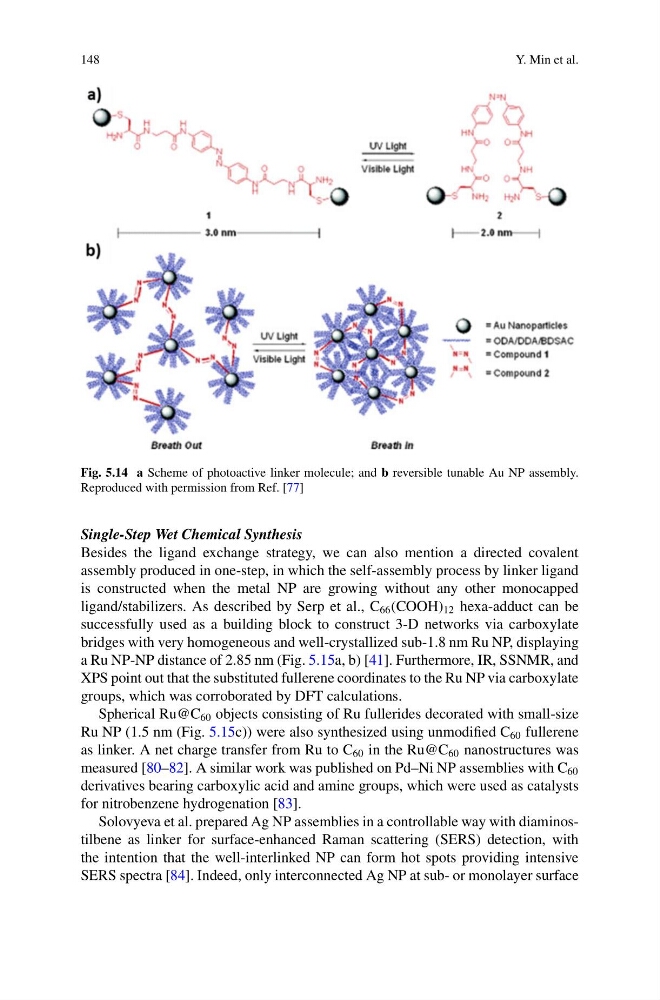
Fig. 5.14 a Scheme of photoactive linker molecule; and b reversible tunable Au NP assembly.
Reproduced with permission from Ref. [77]
Single-Step Wet Chemical Synthesis
Besides the ligand exchange strategy, we can also mention a directed covalent
assembly produced in one-step, in which the self-assembly process by linker ligand
is constructed when the metal NP are growing without any other monocapped
ligand/stabilizers. As described by Serp et al., C 66 (COOH) 12 hexa-adduct can be
successfully used as a building block to construct 3-D networks via carboxylate
bridges with very homogeneous and well-crystallized sub-1.8 nm Ru NP, displaying
a Ru NP-NP distance of 2.85 nm (Fig. 5.15a, b) [41]. Furthermore, IR, SSNMR, and
XPS point out that the substituted fullerene coordinates to the Ru NP via carboxylate
groups, which was corroborated by DFT calculations.
Spherical Ru@C 60 objects consisting of Ru fullerides decorated with small-size
Ru NP (1.5 nm (Fig. 5.15c)) were also synthesized using unmodified C 60 fullerene
as linker. A net charge transfer from Ru to C 60 in the Ru@C 60 nanostructures was
measured [80–82]. A similar work was published on Pd–Ni NP assemblies with C 60
derivatives bearing carboxylic acid and amine groups, which were used as catalysts
for nitrobenzene hydrogenation [83].
Solovyeva et al. prepared Ag NP assemblies in a controllable way with diaminostilbene as linker for surface-enhanced Raman scattering (SERS) detection, with
the intention that the well-interlinked NP can form hot spots providing intensive
SERS spectra [84]. Indeed, only interconnected Ag NP at sub- or monolayer surface
Y. Min et al.
Fig. 5.14 a Scheme of photoactive linker molecule; and b reversible tunable Au NP assembly.
Reproduced with permission from Ref. [77]
Single-Step Wet Chemical Synthesis
Besides the ligand exchange strategy, we can also mention a directed covalent
assembly produced in one-step, in which the self-assembly process by linker ligand
is constructed when the metal NP are growing without any other monocapped
ligand/stabilizers. As described by Serp et al., C 66 (COOH) 12 hexa-adduct can be
successfully used as a building block to construct 3-D networks via carboxylate
bridges with very homogeneous and well-crystallized sub-1.8 nm Ru NP, displaying
a Ru NP-NP distance of 2.85 nm (Fig. 5.15a, b) [41]. Furthermore, IR, SSNMR, and
XPS point out that the substituted fullerene coordinates to the Ru NP via carboxylate
groups, which was corroborated by DFT calculations.
Spherical Ru@C 60 objects consisting of Ru fullerides decorated with small-size
Ru NP (1.5 nm (Fig. 5.15c)) were also synthesized using unmodified C 60 fullerene
as linker. A net charge transfer from Ru to C 60 in the Ru@C 60 nanostructures was
measured [80–82]. A similar work was published on Pd–Ni NP assemblies with C 60
derivatives bearing carboxylic acid and amine groups, which were used as catalysts
for nitrobenzene hydrogenation [83].
Solovyeva et al. prepared Ag NP assemblies in a controllable way with diaminostilbene as linker for surface-enhanced Raman scattering (SERS) detection, with
the intention that the well-interlinked NP can form hot spots providing intensive
SERS spectra [84]. Indeed, only interconnected Ag NP at sub- or monolayer surface