

138
Y. Min et al.
5.2.1.2 Two-Phase Method
In the method of Brust’s two-phase synthesis [53, 54], the linker is added to a solution
of the metal precursor with phase transfer molecules, and reduction afforded NP selfassemblies [26]. This two-phase method is called mediator–template strategy [27], as
the transfer molecule capped with hydrophobic chain works like a template between
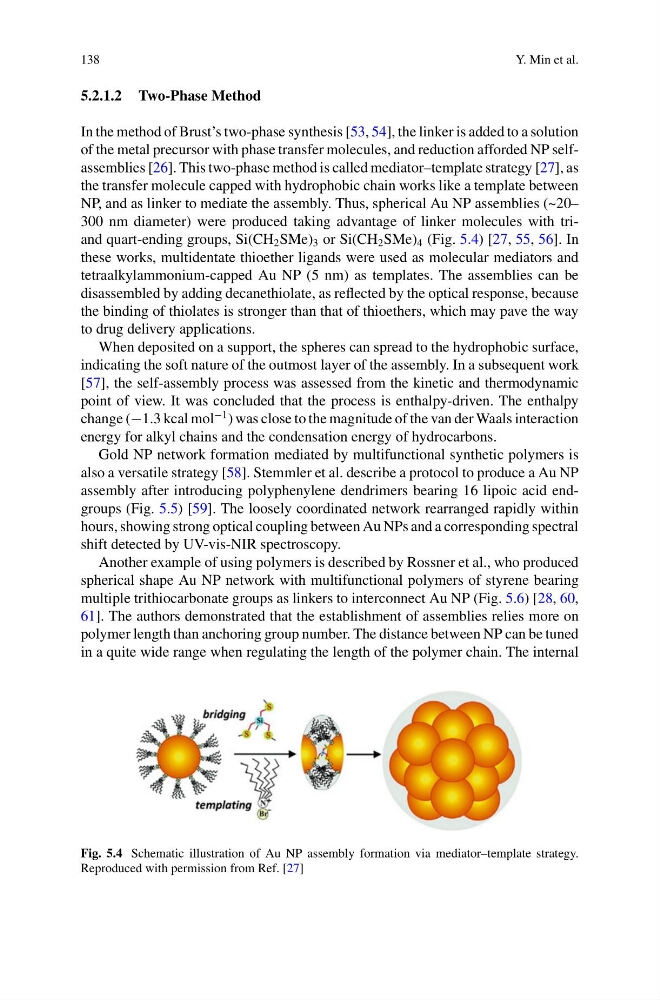
NP, and as linker to mediate the assembly. Thus, spherical Au NP assemblies (~20–
300 nm diameter) were produced taking advantage of linker molecules with triand quart-ending groups, Si(CH 2 SMe) 3 or Si(CH 2 SMe) 4 (Fig. 5.4) [27, 55, 56]. In
these works, multidentate thioether ligands were used as molecular mediators and
tetraalkylammonium-capped Au NP (5 nm) as templates. The assemblies can be
disassembled by adding decanethiolate, as reflected by the optical response, because
the binding of thiolates is stronger than that of thioethers, which may pave the way
to drug delivery applications.
When deposited on a support, the spheres can spread to the hydrophobic surface,
indicating the soft nature of the outmost layer of the assembly. In a subsequent work
[57], the self-assembly process was assessed from the kinetic and thermodynamic
point of view. It was concluded that the process is enthalpy-driven. The enthalpy
change (−1.3 kcal mol
−1 ) was close to the magnitude of the van der Waals interaction
energy for alkyl chains and the condensation energy of hydrocarbons.
Gold NP network formation mediated by multifunctional synthetic polymers is
also a versatile strategy [58]. Stemmler et al. describe a protocol to produce a Au NP
assembly after introducing polyphenylene dendrimers bearing 16 lipoic acid endgroups (Fig. 5.5) [59]. The loosely coordinated network rearranged rapidly within
hours, showing strong optical coupling between Au NPs and a corresponding spectral
shift detected by UV-vis-NIR spectroscopy.
Another example of using polymers is described by Rossner et al., who produced
spherical shape Au NP network with multifunctional polymers of styrene bearing
multiple trithiocarbonate groups as linkers to interconnect Au NP (Fig. 5.6) [28, 60,
61]. The authors demonstrated that the establishment of assemblies relies more on
polymer length than anchoring group number. The distance between NP can be tuned
in a quite wide range when regulating the length of the polymer chain. The internal
Fig. 5.4 Schematic illustration of Au NP assembly formation via mediator–template strategy.
Reproduced with permission from Ref. [27]
Y. Min et al.
5.2.1.2 Two-Phase Method
In the method of Brust’s two-phase synthesis [53, 54], the linker is added to a solution
of the metal precursor with phase transfer molecules, and reduction afforded NP selfassemblies [26]. This two-phase method is called mediator–template strategy [27], as
the transfer molecule capped with hydrophobic chain works like a template between
NP, and as linker to mediate the assembly. Thus, spherical Au NP assemblies (~20–
300 nm diameter) were produced taking advantage of linker molecules with triand quart-ending groups, Si(CH 2 SMe) 3 or Si(CH 2 SMe) 4 (Fig. 5.4) [27, 55, 56]. In
these works, multidentate thioether ligands were used as molecular mediators and
tetraalkylammonium-capped Au NP (5 nm) as templates. The assemblies can be
disassembled by adding decanethiolate, as reflected by the optical response, because
the binding of thiolates is stronger than that of thioethers, which may pave the way
to drug delivery applications.
When deposited on a support, the spheres can spread to the hydrophobic surface,
indicating the soft nature of the outmost layer of the assembly. In a subsequent work
[57], the self-assembly process was assessed from the kinetic and thermodynamic
point of view. It was concluded that the process is enthalpy-driven. The enthalpy
change (−1.3 kcal mol
−1 ) was close to the magnitude of the van der Waals interaction
energy for alkyl chains and the condensation energy of hydrocarbons.
Gold NP network formation mediated by multifunctional synthetic polymers is
also a versatile strategy [58]. Stemmler et al. describe a protocol to produce a Au NP
assembly after introducing polyphenylene dendrimers bearing 16 lipoic acid endgroups (Fig. 5.5) [59]. The loosely coordinated network rearranged rapidly within
hours, showing strong optical coupling between Au NPs and a corresponding spectral
shift detected by UV-vis-NIR spectroscopy.
Another example of using polymers is described by Rossner et al., who produced
spherical shape Au NP network with multifunctional polymers of styrene bearing
multiple trithiocarbonate groups as linkers to interconnect Au NP (Fig. 5.6) [28, 60,
61]. The authors demonstrated that the establishment of assemblies relies more on
polymer length than anchoring group number. The distance between NP can be tuned
in a quite wide range when regulating the length of the polymer chain. The internal
Fig. 5.4 Schematic illustration of Au NP assembly formation via mediator–template strategy.
Reproduced with permission from Ref. [27]