

4 MNP Catalysis in Ionic Liquids
117
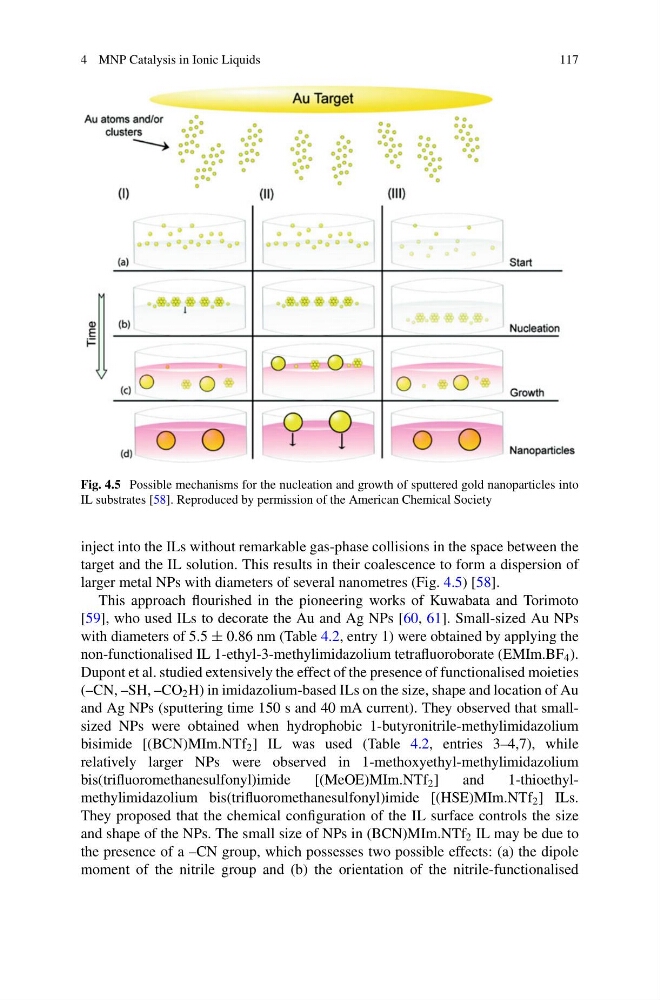
Fig. 4.5 Possible mechanisms for the nucleation and growth of sputtered gold nanoparticles into
IL substrates [58]. Reproduced by permission of the American Chemical Society
inject into the ILs without remarkable gas-phase collisions in the space between the
target and the IL solution. This results in their coalescence to form a dispersion of
larger metal NPs with diameters of several nanometres (Fig. 4.5) [58].
This approach flourished in the pioneering works of Kuwabata and Torimoto
[59], who used ILs to decorate the Au and Ag NPs [60, 61]. Small-sized Au NPs
with diameters of 5.5 ± 0.86 nm (Table 4.2, entry 1) were obtained by applying the
non-functionalised IL 1-ethyl-3-methylimidazolium tetrafluoroborate (EMIm.BF 4 ).
Dupont et al. studied extensively the effect of the presence of functionalised moieties
(–CN, –SH, –CO 2 H) in imidazolium-based ILs on the size, shape and location of Au
and Ag NPs (sputtering time 150 s and 40 mA current). They observed that smallsized NPs were obtained when hydrophobic 1-butyronitrile-methylimidazolium
bisimide [(BCN)MIm.NTf 2 ] IL was used (Table 4.2, entries 3–4,7), while
relatively larger NPs were observed in 1-methoxyethyl-methylimidazolium
bis(trifluoromethanesulfonyl)imide
[(MeOE)MIm.NTf 2 ]
and
1-thioethylmethylimidazolium bis(trifluoromethanesulfonyl)imide [(HSE)MIm.NTf 2 ] ILs.
They proposed that the chemical configuration of the IL surface controls the size
and shape of the NPs. The small size of NPs in (BCN)MIm.NTf 2 IL may be due to
the presence of a –CN group, which possesses two possible effects: (a) the dipole
moment of the nitrile group and (b) the orientation of the nitrile-functionalised
117
Fig. 4.5 Possible mechanisms for the nucleation and growth of sputtered gold nanoparticles into
IL substrates [58]. Reproduced by permission of the American Chemical Society
inject into the ILs without remarkable gas-phase collisions in the space between the
target and the IL solution. This results in their coalescence to form a dispersion of
larger metal NPs with diameters of several nanometres (Fig. 4.5) [58].
This approach flourished in the pioneering works of Kuwabata and Torimoto
[59], who used ILs to decorate the Au and Ag NPs [60, 61]. Small-sized Au NPs
with diameters of 5.5 ± 0.86 nm (Table 4.2, entry 1) were obtained by applying the
non-functionalised IL 1-ethyl-3-methylimidazolium tetrafluoroborate (EMIm.BF 4 ).
Dupont et al. studied extensively the effect of the presence of functionalised moieties
(–CN, –SH, –CO 2 H) in imidazolium-based ILs on the size, shape and location of Au
and Ag NPs (sputtering time 150 s and 40 mA current). They observed that smallsized NPs were obtained when hydrophobic 1-butyronitrile-methylimidazolium
bisimide [(BCN)MIm.NTf 2 ] IL was used (Table 4.2, entries 3–4,7), while
relatively larger NPs were observed in 1-methoxyethyl-methylimidazolium
bis(trifluoromethanesulfonyl)imide
[(MeOE)MIm.NTf 2 ]
and
1-thioethylmethylimidazolium bis(trifluoromethanesulfonyl)imide [(HSE)MIm.NTf 2 ] ILs.
They proposed that the chemical configuration of the IL surface controls the size
and shape of the NPs. The small size of NPs in (BCN)MIm.NTf 2 IL may be due to
the presence of a –CN group, which possesses two possible effects: (a) the dipole
moment of the nitrile group and (b) the orientation of the nitrile-functionalised