

4 MNP Catalysis in Ionic Liquids
109
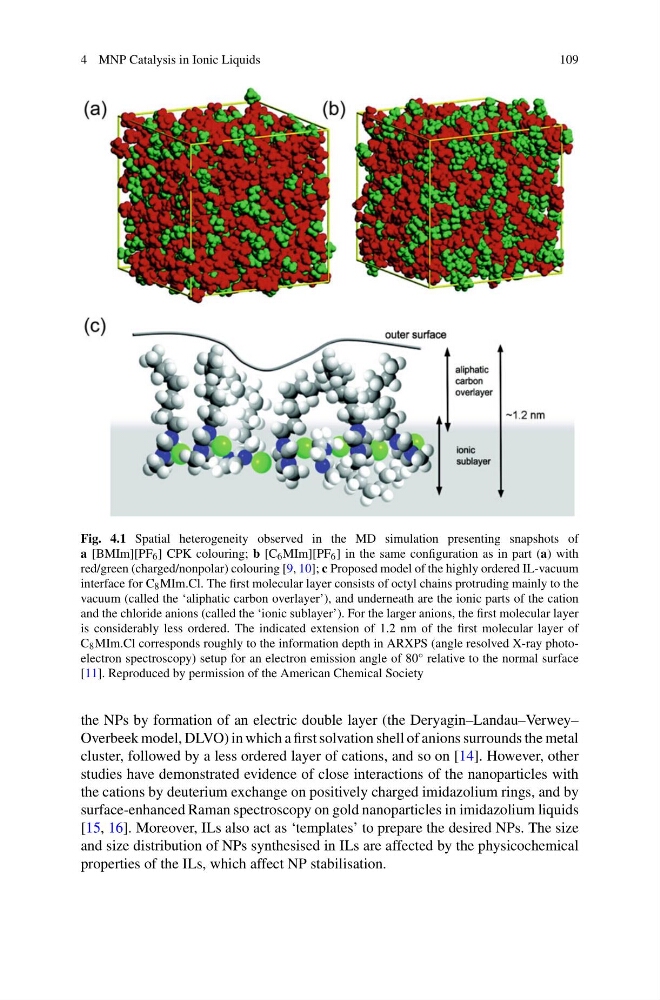
Fig. 4.1 Spatial heterogeneity observed in the MD simulation presenting snapshots of
a [BMIm][PF 6 ] CPK colouring; b [C 6 MIm][PF 6 ] in the same configuration as in part (a) with
red/green (charged/nonpolar) colouring [9, 10]; c Proposed model of the highly ordered IL-vacuum
interface for C 8 MIm.Cl. The first molecular layer consists of octyl chains protruding mainly to the
vacuum (called the ‘aliphatic carbon overlayer’), and underneath are the ionic parts of the cation
and the chloride anions (called the ‘ionic sublayer’). For the larger anions, the first molecular layer
is considerably less ordered. The indicated extension of 1.2 nm of the first molecular layer of
C 8 MIm.Cl corresponds roughly to the information depth in ARXPS (angle resolved X-ray photoelectron spectroscopy) setup for an electron emission angle of 80° relative to the normal surface
[11]. Reproduced by permission of the American Chemical Society
the NPs by formation of an electric double layer (the Deryagin–Landau–Verwey–
Overbeek model, DLVO) in which a first solvation shell of anions surrounds the metal
cluster, followed by a less ordered layer of cations, and so on [14]. However, other
studies have demonstrated evidence of close interactions of the nanoparticles with
the cations by deuterium exchange on positively charged imidazolium rings, and by
surface-enhanced Raman spectroscopy on gold nanoparticles in imidazolium liquids
[15, 16]. Moreover, ILs also act as ‘templates’ to prepare the desired NPs. The size
and size distribution of NPs synthesised in ILs are affected by the physicochemical
properties of the ILs, which affect NP stabilisation.
109
Fig. 4.1 Spatial heterogeneity observed in the MD simulation presenting snapshots of
a [BMIm][PF 6 ] CPK colouring; b [C 6 MIm][PF 6 ] in the same configuration as in part (a) with
red/green (charged/nonpolar) colouring [9, 10]; c Proposed model of the highly ordered IL-vacuum
interface for C 8 MIm.Cl. The first molecular layer consists of octyl chains protruding mainly to the
vacuum (called the ‘aliphatic carbon overlayer’), and underneath are the ionic parts of the cation
and the chloride anions (called the ‘ionic sublayer’). For the larger anions, the first molecular layer
is considerably less ordered. The indicated extension of 1.2 nm of the first molecular layer of
C 8 MIm.Cl corresponds roughly to the information depth in ARXPS (angle resolved X-ray photoelectron spectroscopy) setup for an electron emission angle of 80° relative to the normal surface
[11]. Reproduced by permission of the American Chemical Society
the NPs by formation of an electric double layer (the Deryagin–Landau–Verwey–
Overbeek model, DLVO) in which a first solvation shell of anions surrounds the metal
cluster, followed by a less ordered layer of cations, and so on [14]. However, other
studies have demonstrated evidence of close interactions of the nanoparticles with
the cations by deuterium exchange on positively charged imidazolium rings, and by
surface-enhanced Raman spectroscopy on gold nanoparticles in imidazolium liquids
[15, 16]. Moreover, ILs also act as ‘templates’ to prepare the desired NPs. The size
and size distribution of NPs synthesised in ILs are affected by the physicochemical
properties of the ILs, which affect NP stabilisation.