

383
A zirconium catalyst ((n-BuCp) 2 ZrCl 2 ) supported on PMHS-modified silica was
used for the polymerization of ethylene. Its catalytic activity was three times higher
than for the same catalyst supported on nonmodified silica (Greco et al. 2003).
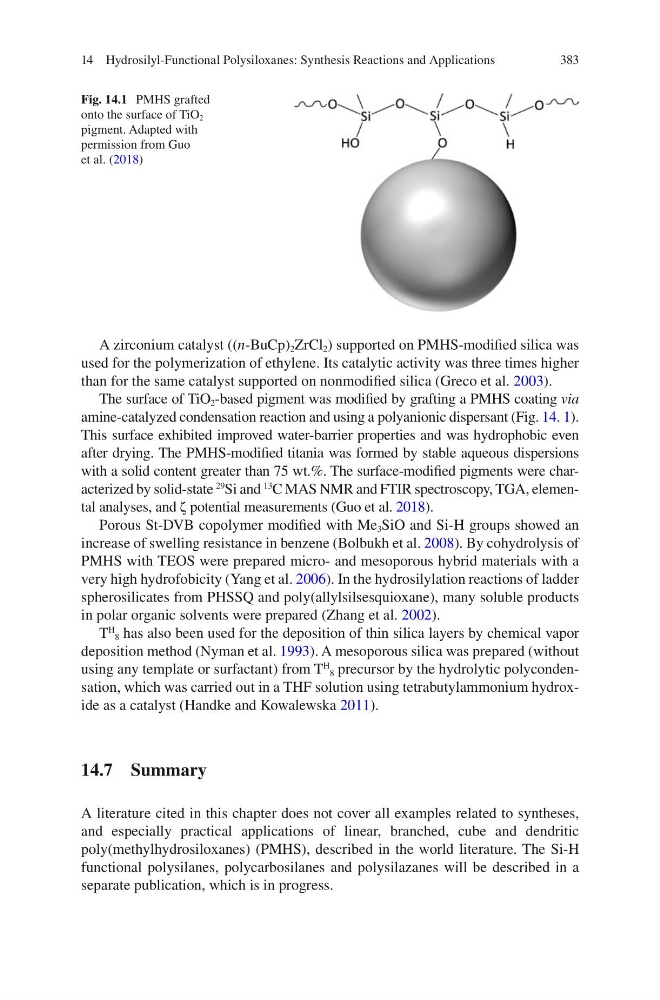
The surface of TiO 2 -based pigment was modified by grafting a PMHS coating via
amine-catalyzed condensation reaction and using a polyanionic dispersant (Fig. 14. 1).
This surface exhibited improved water-barrier properties and was hydrophobic even
after drying. The PMHS-modified titania was formed by stable aqueous dispersions
with a solid content greater than 75 wt.%. The surface- modified pigments were characterized by solid-state
29
Si and
13
C MAS NMR and FTIR spectroscopy, TGA, elemental analyses, and ζ potential measurements (Guo et al. 2018).
Porous St-DVB copolymer modified with Me 3 SiO and Si-H groups showed an
increase of swelling resistance in benzene (Bolbukh et al. 2008). By cohydrolysis of
PMHS with TEOS were prepared micro- and mesoporous hybrid materials with a
very high hydrofobicity (Yang et al. 2006). In the hydrosilylation reactions of ladder
spherosilicates from PHSSQ and poly(allylsilsesquioxane), many soluble products
in polar organic solvents were prepared (Zhang et al. 2002).
T
H 8 has also been used for the deposition of thin silica layers by chemical vapor
deposition method (Nyman et al. 1993). A mesoporous silica was prepared (without
using any template or surfactant) from T
H 8 precursor by the hydrolytic polycondensation, which was carried out in a THF solution using tetrabutylammonium hydroxide as a catalyst (Handke and Kowalewska 2011).
14.7 Summary
A literature cited in this chapter does not cover all examples related to syntheses,
and especially practical applications of linear, branched, cube and dendritic
poly(methylhydrosiloxanes) (PMHS), described in the world literature. The Si-H
functional polysilanes, polycarbosilanes and polysilazanes will be described in a
separate publication, which is in progress.
Fig. 14.1 PMHS grafted
onto the surface of TiO 2
pigment. Adapted with
permission from Guo
et al. (2018)
14 Hydrosilyl-Functional Polysiloxanes: Synthesis Reactions and Applications