

381
Crosslinked optically clear hybrids can be applied for high-brightness LED packaging (Pavlyuchenko et al. 2009).
New silicone hydrogels such as IPN with PVA were prepared by crosslinking of
α,ω-divinylpoly(dimethyl-co-trifluoropropyl)siloxanes, and photopolymerization
of vinyl acetate (in situ), followed by hydrolysis of acetate groups, thus showing
good transparency (90–92%) and better water absorption (20–39%), which may be
useful for the manufacture of soft contact lenses (Boileau et al. 1998).
The properties of PU foams (PUF) have also been modified with silicones and
flame retardants (FR). With this in mind, mixtures of commercial
poly(dimethylsiloxane- α,ω-diols) and commercial polyols (containing some water)
and carbofuntional α,ω-bis-(γ-hydroxypropyl)-PDMS were crosslinked and foamed
with PMDI and branched PMHS, or PMHBS of random structures. The elastic
PU-siloxane foams prepared with the addition of 40 wt.% of FR exhibited selfextinguishing properties: similar TS compared to PU foams containing the same FR
content, but without the addition of silicones (Table 14.4) (Chruściel et al. 2012).
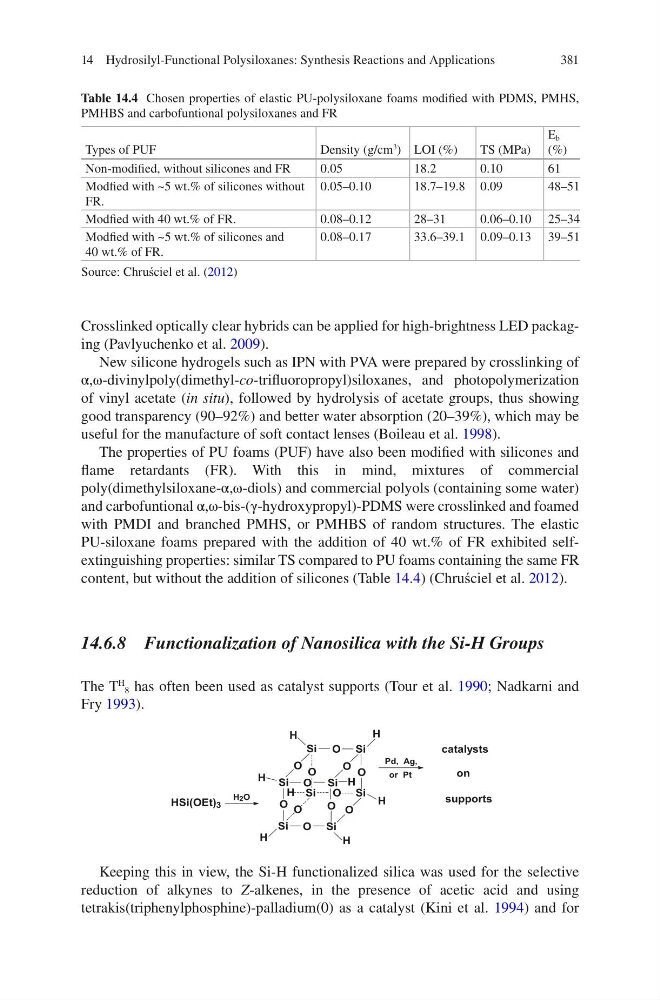
14.6.8 Functionalization of Nanosilica with the Si-H Groups
The T
H 8 has often been used as catalyst supports (Tour et al. 1990; Nadkarni and
Fry 1993).
Si
Si
O
Si
Si
O
O
O
O
Si O Si
O O
Si
O
O
Si
O
O
H
H
H
H
H
H
H
H
HSi(OEt) 3
H2O
Pd, Ag,
or Pt
catalysts
on
supports
Keeping this in view, the Si-H functionalized silica was used for the selective
reduction of alkynes to Z-alkenes, in the presence of acetic acid and using
tetrakis(triphenylphosphine)-palladium(0) as a catalyst (Kini et al. 1994) and for
Table 14.4 Chosen properties of elastic PU-polysiloxane foams modified with PDMS, PMHS,
PMHBS and carbofuntional polysiloxanes and FR
Types of PUF
Density (g/cm
3
) LOI (%)
TS (MPa)
E b
(%)
Non-modified, without silicones and FR
0.05
18.2
0.10
61
Modfied with ~5 wt.% of silicones without
FR.
0.05–0.10
18.7–19.8 0.09
48–51
Modfied with 40 wt.% of FR.
0.08–0.12
28–31
0.06–0.10 25–34
Modfied with ~5 wt.% of silicones and
40 wt.% of FR.
0.08–0.17
33.6–39.1 0.09–0.13 39–51
Source: Chruściel et al. (2012)
14 Hydrosilyl-Functional Polysiloxanes: Synthesis Reactions and Applications