

379
where
A
B
( ) =
=
=
=
( ) =
=
=
=
x
y
M
M
x
y
M
M
w
n
w
n
66
10
12200
4260
22
10
9100
2750
,
;
,
;
,
;
,
; ;
,
:
C
CH
CH Me SiO Si
2
2
x
( )
(
)
(
)(
)
α ω − divinyl polydimethylsiloxane
= =
M Me CH CH
2
2
= =
(
),
where x
M
M
w
n
:
,
,
,
.
= =
=
45
9640
3 280
For NBR-polysiloxane vulcanizates were observed (Chruściel et al. 2006):
• Decreased decomposition rate and increased residue after thermal
decomposition,
• Decrease of flammability (increase of LOI from 28.5% up to 36.5%):
1. As a result of the formation of insulation silica layer on the surface (during
burning), thus increasing thermal resistance,
2. Due to elimination of liquid products of thermal decomposition,
3. As a result of the surface modification (by swelling with silicones in the presence of AIBN), giving the possibility for preparing self-extinguishing
samples,
• Increased resistance aging, as a result of the migration of polysiloxane molecules
towards the surface and the formation of a protective layer,
• Decrease of T g .
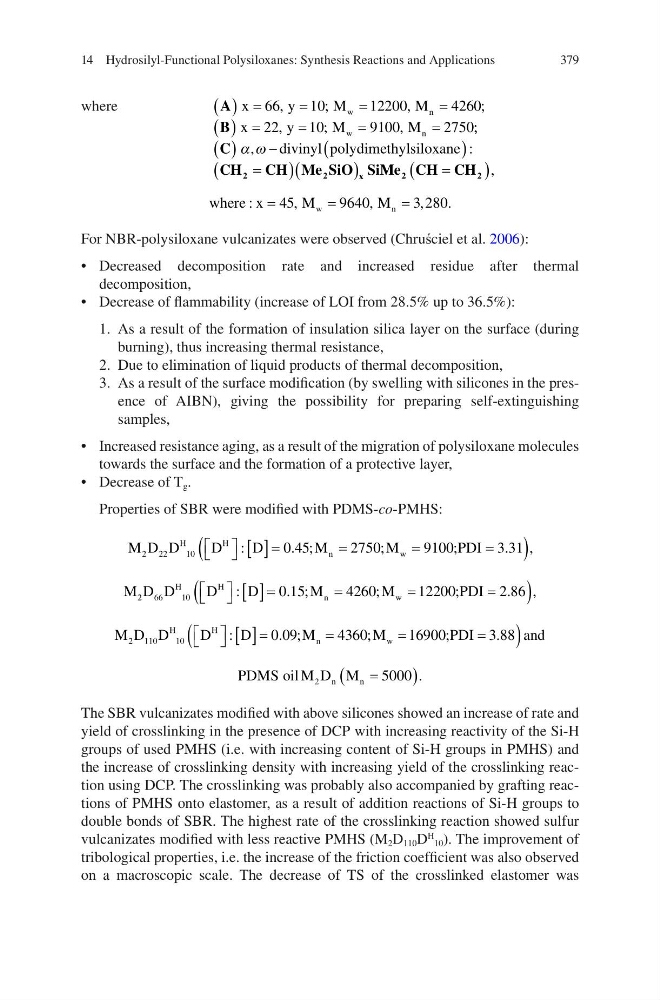
Properties of SBR were modified with PDMS-co-PMHS:
M D D
D
D
M
M
; PDI
,
H
H
n
w
2 22
1 0
0 45
2750
9100
3 31
[ ]=
=
=
=
(
)
:
. ;
;
.
M D D
D
D
M
M
; PDI
,
H
H
n
w
2 66
1 0
0 15
4260
12200
2 86
[ ]=
=
=
=
(
)
:
. ;
;
.
M D D
D
D
M
M
; PDI
a nd
H
H
n
w
2 110
10
0 09
4360
16900
3 88
[ ]=
=
=
=
(
)
:
. ;
;
.
PDMS oil M D M
.
n
n
2
5000
=
(
)
The SBR vulcanizates modified with above silicones showed an increase of rate and
yield of crosslinking in the presence of DCP with increasing reactivity of the Si-H
groups of used PMHS (i.e. with increasing content of Si-H groups in PMHS) and
the increase of crosslinking density with increasing yield of the crosslinking reaction using DCP. The crosslinking was probably also accompanied by grafting reactions of PMHS onto elastomer, as a result of addition reactions of Si-H groups to
double bonds of SBR. The highest rate of the crosslinking reaction showed sulfur
vulcanizates modified with less reactive PMHS (M 2 D 110 D
H 10 ). The improvement of
tribological properties, i.e. the increase of the friction coefficient was also observed
on a macroscopic scale. The decrease of TS of the crosslinked elastomer was
14 Hydrosilyl-Functional Polysiloxanes: Synthesis Reactions and Applications