

376
modification method of these thermoplastics, e.g. with a Si-H end-capped
PDMS. The hydrosilylation reaction was catalyzed by the catalyst Pt 2 [(ViSiMe 2 ) 2 O] 3
in the melt phase (Malz and Tzoganakis 1998; Long et al. 2003, 2004). A positive
effect of a PDMS-modified polyolefin was observed on the processing and surface
properties of linear low-density polyethylene (LLDPE) (Zhu et al. 2007). The surface properties of hydrosilylated polyolefins were further modified by annealing
under supercritical CO 2 atmosphere conditions (Zhu and Tzoganakis 2008).
Poly(propylene) has been modified in solution or in the melt with mono- or dihydrosiloxanes and a transition metal catalyst or by free radicals (Malz and Tzoganakis
1998; Long et al. 2003). Monohydrosilylation was achieved with a large excess of
H-siloxane, using Pt 2 [(ViSiMe 2 ) 2 O] 3 as a catalyst and a peroxide as the co- catalyst.
Silylated PEs were also prepared (Lipponen et al. 2007). Poly(butadiene) (PB),
poly(isobutylene) and poly(isoprene) were also modified via hydrosilylation reactions (Chauhan and Balagam 2006; Wurm et al. 2008). Silylated PB were obtained
by the hydrosilylation of PB with H-silanes and Pt and Rh catalysts or Pt-nanoclusters
(Guo et al. 1990; Iraqi et al. 1992; Chauhan and Balagam 2006; Chauhan et al. 2008).
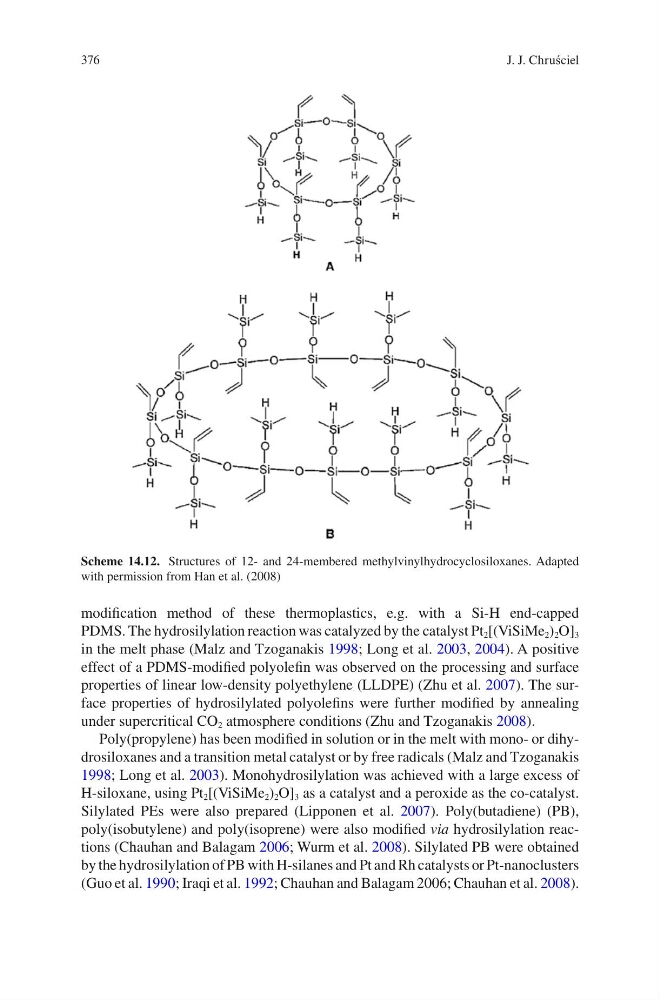
Scheme 14.12. Structures of 12- and 24-membered methylvinylhydrocyclosiloxanes. Adapted
with permission from Han et al. (2008)
J. J. Chruściel