

356
process of additive polysiloxanes catalyzed by Ir-siloxide(II) and IV complexes
occured at a higher temperature (~200 °C) than with Karstedt-diallyl maleate catalyst (130 °C) (Kownacki et al. 2007).
By hydrosilylation of allyl-functionalized PEO or poly(propylene oxide) (PPO)
with PMHS have been synthesized polysiloxanes with pendant polyether chains
(Huhn and Kaufmann 1986; Rossi et al. 2005; Myers 2005). Methylsiloxane oligomers with pendant (trialkoxysilyl)ethyl groups were prepared by Mukbaniani et al.
(2007b) through hydrosilylation of PMHS with vinyl(trialkoxy)silanes: ViSi(OMe) 3
and vinyltriethoxysilane (ViSi(OEt) 3 ) in the presence of CPA, Pt 2 [(ViSiMe 2 ) 2 O] 3
and Pt/C catalysts. These materials have been recommended for fabrication of hard
silicone coatings via sol-gel processes.
The epoxy-functionalized siloxanes (and silanes) have been first prepared by
stepwise hydrosilylation of oligo(hydromethyl)siloxanes with allyl glycidylether or
1,2-epoxy-4-vinyl-cyclohexane using RhCl(PPh 3 ) 3 as a catalyst (Crivello and Lee
1990), while in the hydrosilylation of PDMS-co-PMHS with glicydyl ether using
CPA as a catalyst, reactivity of the Si-H groups into DD
H
D triads has been much
lower than in DD
H
D
H
and D
H
D
H
D
H
triads, presumably due to steric reasons
(Cancouët et al. 2000b). The hydrosilylation of M
H
2 with allyl glycidyl ether in the
presence of [Rh(OSiMe 3 )cod] gave 1,3-bis-(glycidoxypropyl)-1,1,3,3-tetramethyldisiloxane (Murias et al. 2012). A silicone oil containing epoxy groups have also
been obtained by H-silylation of glycidyl methacrylate with PMHS (Ma et al. 2007).
A viscous liquid octa(dimethylsiloxypropylglycidylether)octasiloxane have also
been prepared by the addition reaction of allyl glycidyl ether to Q 8 M
H 8 (Dias Filho
et al. 2006; Jeziórska et al. 2011).
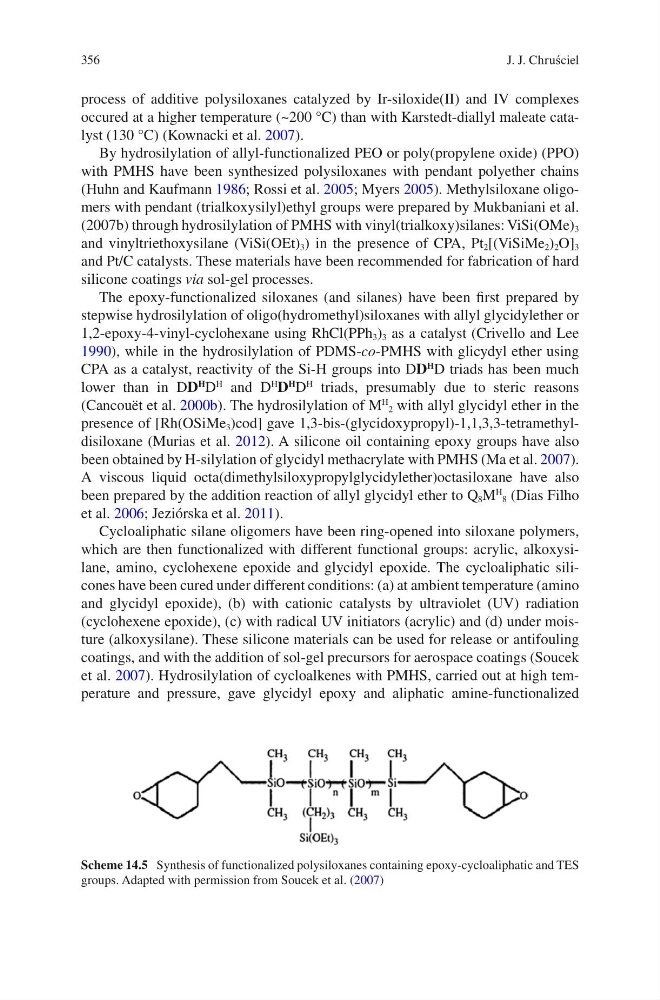
Cycloaliphatic silane oligomers have been ring-opened into siloxane polymers,
which are then functionalized with different functional groups: acrylic, alkoxysilane, amino, cyclohexene epoxide and glycidyl epoxide. The cycloaliphatic silicones have been cured under different conditions: (a) at ambient temperature (amino
and glycidyl epoxide), (b) with cationic catalysts by ultraviolet (UV) radiation
(cyclohexene epoxide), (c) with radical UV initiators (acrylic) and (d) under moisture (alkoxysilane). These silicone materials can be used for release or antifouling
coatings, and with the addition of sol-gel precursors for aerospace coatings (Soucek
et al. 2007). Hydrosilylation of cycloalkenes with PMHS, carried out at high temperature and pressure, gave glycidyl epoxy and aliphatic amine-functionalized
Scheme 14.5 Synthesis of functionalized polysiloxanes containing epoxy-cycloaliphatic and TES
groups. Adapted with permission from Soucek et al. (2007)
J. J. Chruściel