

354
14.5.2 Hydrosilylation Reactions
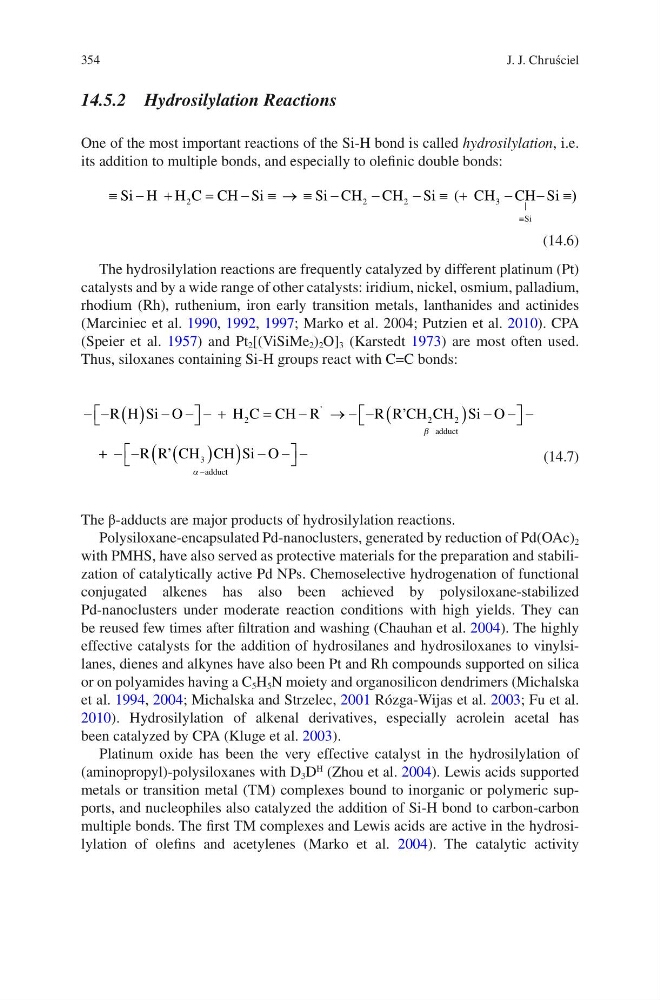
One of the most important reactions of the Si-H bond is called hydrosilylation, i.e.
its addition to multiple bonds, and especially to olefinic double bonds:
≡ −
− ≡
≡ −
−
− ≡
−
− ≡)
≡
Si H H C CH Si
S i CH CH Si
CH CH
Si
+
=
→
+
2
2
2
3
(
| |
Si
(14.6)
The hydrosilylation reactions are frequently catalyzed by different platinum (Pt)
catalysts and by a wide range of other catalysts: iridium, nickel, osmium, palladium,
rhodium (Rh), ruthenium, iron early transition metals, lanthanides and actinides
(Marciniec et al. 1990, 1992, 1997; Marko et al. 2004; Putzien et al. 2010). CPA
(Speier et al. 1957) and Pt 2 [(ViSiMe 2 ) 2 O] 3 (Karstedt 1973) are most often used.
Thus, siloxanes containing Si-H groups react with C=C bonds:
− −
− − −
−
− −
− − −
R H Si O
HC CH R
R R CH CH Si O
adduct
( )
+
=
→
(
)
2
2
2
’
’
β
+ +
( )
(
)
− −
− − −
−
R R CH CH Si O
adduct
’
3
α
(14.7)
The β-adducts are major products of hydrosilylation reactions.
Polysiloxane-encapsulated Pd-nanoclusters, generated by reduction of Pd(OAc) 2
with PMHS, have also served as protective materials for the preparation and stabilization of catalytically active Pd NPs. Chemoselective hydrogenation of functional
conjugated alkenes has also been achieved by polysiloxane-stabilized
Pd-nanoclusters under moderate reaction conditions with high yields. They can
be reused few times after filtration and washing (Chauhan et al. 2004). The highly
effective catalysts for the addition of hydrosilanes and hydrosiloxanes to vinylsilanes, dienes and alkynes have also been Pt and Rh compounds supported on silica
or on polyamides having a C 5 H 5 N moiety and organosilicon dendrimers (Michalska
et al. 1994, 2004; Michalska and Strzelec, 2001 Rózga-Wijas et al. 2003; Fu et al.
2010). Hydrosilylation of alkenal derivatives, especially acrolein acetal has
been catalyzed by CPA (Kluge et al. 2003).
Platinum oxide has been the very effective catalyst in the hydrosilylation of
(aminopropyl)-polysiloxanes with D 3 D
H
(Zhou et al. 2004). Lewis acids supported
metals or transition metal (TM) complexes bound to inorganic or polymeric supports, and nucleophiles also catalyzed the addition of Si-H bond to carbon-carbon
multiple bonds. The first TM complexes and Lewis acids are active in the hydrosilylation of olefins and acetylenes (Marko et al. 2004). The catalytic activity
J. J. Chruściel