

339
of the PHSSQ precursors prepared (the cage/network ratio, the content of Si-OH
end groups, and the MW) depended on the water:TES molar ratio and the reaction
conditions. The PHSSQ films with a higher refractive index can find applications
such as low dielectric constant materials (Liu et al. 2004).
14.2.3 Synthesis and Characterization of Random
Branched PMHS
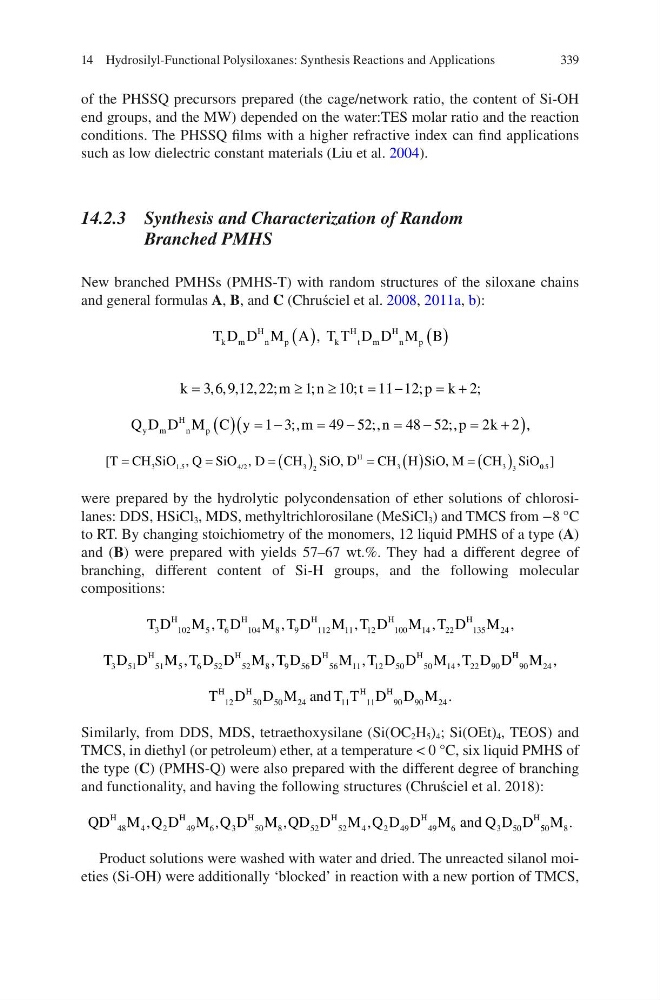
New branched PMHSs (PMHS-T) with random structures of the siloxane chains
and general formulas A, B, and C (Chruściel et al. 2008, 2011a, b):
T D D M A T T D D M B
k m
H
n
p
k
H
t m
H
n
p
( )
( )
,
k
m
n
t
p k ;
=
≥
≥
=
= +
3 6 9 12 22
1
10
11 12
2
, , , , ;
;
;
;
−
Q D D M C y
m
n
p
k
,
y m
H
n
p ( ) =
=
=
= +
(
)
1 3
49 52
48 52
2 2
−
−
−
;,
;,
;,
[T CH SiO Q SiO D CH SiO, D
CH H SiO, M CH SiO
H
=
=
= ( )
=
( )
= ( )
3
1 5
4 2
3 2
3
3 3
.
/
,
,
0 0 5
.
]
were prepared by the hydrolytic polycondensation of ether solutions of chlorosilanes: DDS, HSiCl 3 , MDS, methyltrichlorosilane (MeSiCl 3 ) and TMCS from −8 °C
to RT. By changing stoichiometry of the monomers, 12 liquid PMHS of a type (A)
and (B) were prepared with yields 57–67 wt.%. They had a different degree of
branching, different content of Si-H groups, and the following molecular
compositions:
T D M T D M T D M T D M T D M ,
H
H
H
H
H
3
102
5
6
104
8
9
112
11
12
100
14
22
135
24
,
,
,
,
T D D M T D D M T D D M T D D M T D D
H
H
H
H
3 51
5 1
5
6 52
5 2
8
9 56
5 6
11
12 50
5 0
14
2 2 90
,
,
,
,
H H M ,
90
24
T D D M and T T D D M .
H
H
H
H
12
50 50
24
11
11
90 90
24
Similarly, from DDS, MDS, tetraethoxysilane (Si(OC 2 H 5 ) 4 ; Si(OEt) 4 , TEOS) and
TMCS, in diethyl (or petroleum) ether, at a temperature < 0 °C, six liquid PMHS of
the type (C) (PMHS-Q) were also prepared with the different degree of branching
and functionality, and having the following structures (Chruściel et al. 2018):
QD M Q D M Q D M QD D M Q D D M and Q D D
H
H
H
H
H
H
48
4
2
49
6
3
50
8
5 2
5 2
4
2 49
4 9
6
3 50
,
,
,
,
5 50
8
M .
Product solutions were washed with water and dried. The unreacted silanol moieties (Si-OH) were additionally ‘blocked’ in reaction with a new portion of TMCS,
14 Hydrosilyl-Functional Polysiloxanes: Synthesis Reactions and Applications