

337
1978; Chujo et al. 1985, Richards et al. 1993; Sellinger and Laine 1996a, Klok et al.
1997, Shermann and Kennedy 1997, Servaty et al. 1998, Feng et al. 2000), acidic
salts (e.g. ammonium sulphate or dimethylsilyl sulphate (Razzano et al. 1997)), or
in the presence of protonic acid-activated clays (Crivello et al. 1986; Lewis et al.
1993). The polymerization rates and the microstructure of the polysiloxane chain in
PMHS depend strongly on the monomer structures and reaction conditions (Müller
et al. 1959; Reikhsfeld and Ivanova 1962; Rościszewski et al. 1974, 1975; Graczyk
and Lasocki 1978, 1979a; Richards et al. 1993).
An equilibration of poly(dimethylsiloxane)s (PDMS) with linear PMHS and M 2 ,
towards the phosphonitrile catalyst [Cl 3 P(NPCl 2 ) 2 PCl 3 ]
+
PCl 6
−
(LPNC) at elevated
temperature has been a very useful synthetic method of PDMS-co-PMHS (Razzano
et al. 1997; Nye et al. 1997, 1999; Liao and Nye 1998, 2008). Linear and branched
PHS, containing different substituents at silicon, e.g. vinylsilyl groups,
Me(CH 2 = CH)SiO (MeViSiO, D
Vi
) or/and ViMe 2 SiO (M
Vi
), have been synthesized
by the equilibration of siloxane substrates with LPNC at temperature 80–90 °C
(Liao and Nye 1998, 2008).
PMHS end-capped with HMe 2 SiO 0.5 (M
H
) groups have also been prepared by the
catalytic equilibration of octamethylcyclotetrasiloxane (D 4 ) with M
H 2 and 50%
H 2 SO 4 or in the presence of acid-activated clays, or by reducing telechelic dichlorosiloxanes with metal hydrides (e.g. lithium aluminohydride (LiAlH 4 ), LiH or NaH
towards triethylborane (Et 3 B)) (Greber and Metzinger 1960; Chruściel and Lasocki
1979; Chruściel 2000) or by the anionic ring-opening polymerization (ROP) of D 4
in the presence of n-butyllithium (n-BuLi), followed by the termination reaction
with DMCS (Zhang et al. 2010; Chen et al. 2010), by the heterocondensation of
DMCS with appropriate siloxanediolates of alkali metals (Andrianov et al. 1971a,
1971b) or oligosiloxane-α.ω-diols (in the presence of an amine acceptor of HCl)
(Chruściel and Lasocki 1979). Yoshino et al. (1990) prepared M
H
D n M
H
via ROP of
D n (n = 3–6) with DMCS, which was catalyzed with a silica gel.
PDMS-co-PMHS-polymethylphenylsiloxane random copolymers were synthesized by Yang et al. (2003) through ROP of cyclosiloxanes (D
H 4.5 + D 4 + D
Ph 3 + D
Ph 4 )
Si
Me
Me
O m
H
n
Si
Me
O
+
Si
Me
Me
O
H
Si
Me
O n
m
Si
Me
Me
O x
H
Si
Me
O
RMe 2 SiO
S iMe 2 R
y
R = Me, Vi, H;
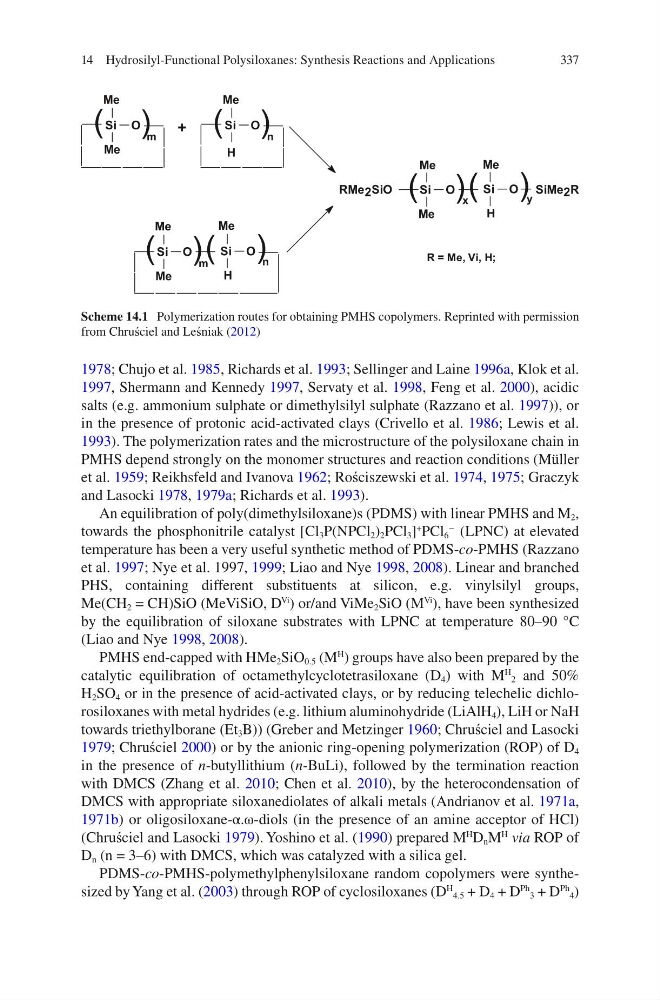
Scheme 14.1 Polymerization routes for obtaining PMHS copolymers. Reprinted with permission
from Chruściel and Leśniak (2012)
14 Hydrosilyl-Functional Polysiloxanes: Synthesis Reactions and Applications