

318
described the microwave synthesis of several superspreading gemini surfactants and
found that the inclusion of spacer groups, such as alkyl chains, decreases critical
aggregation concentrations (CAC), but also decreases the dynamic behavior. On the
other hand, increasing the hydrophilic ethylene oxide sections increases the CAC,
but also improves the dynamic behavior. Similarly, Chen et al. (2018) developed
gemini cationic surfactants, whereby the rigidity of the spacer unit also affected the
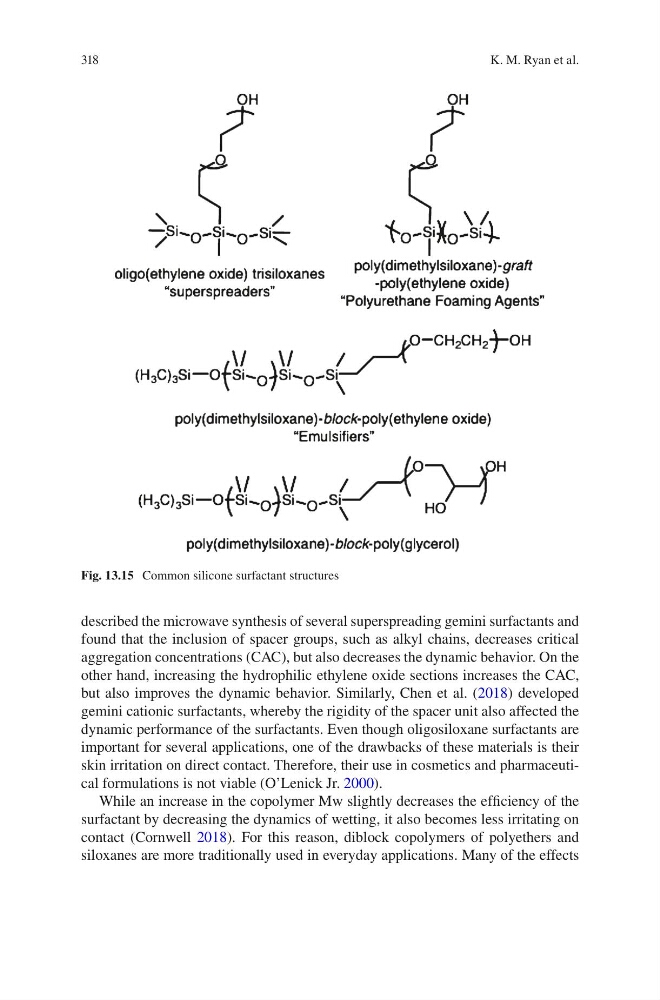
dynamic performance of the surfactants. Even though oligosiloxane surfactants are
important for several applications, one of the drawbacks of these materials is their
skin irritation on direct contact. Therefore, their use in cosmetics and pharmaceutical formulations is not viable (O’Lenick Jr. 2000).
While an increase in the copolymer Mw slightly decreases the efficiency of the
surfactant by decreasing the dynamics of wetting, it also becomes less irritating on
contact (Cornwell 2018). For this reason, diblock copolymers of polyethers and
siloxanes are more traditionally used in everyday applications. Many of the effects
Fig. 13.15 Common silicone surfactant structures
K. M. Ryan et al.