

268
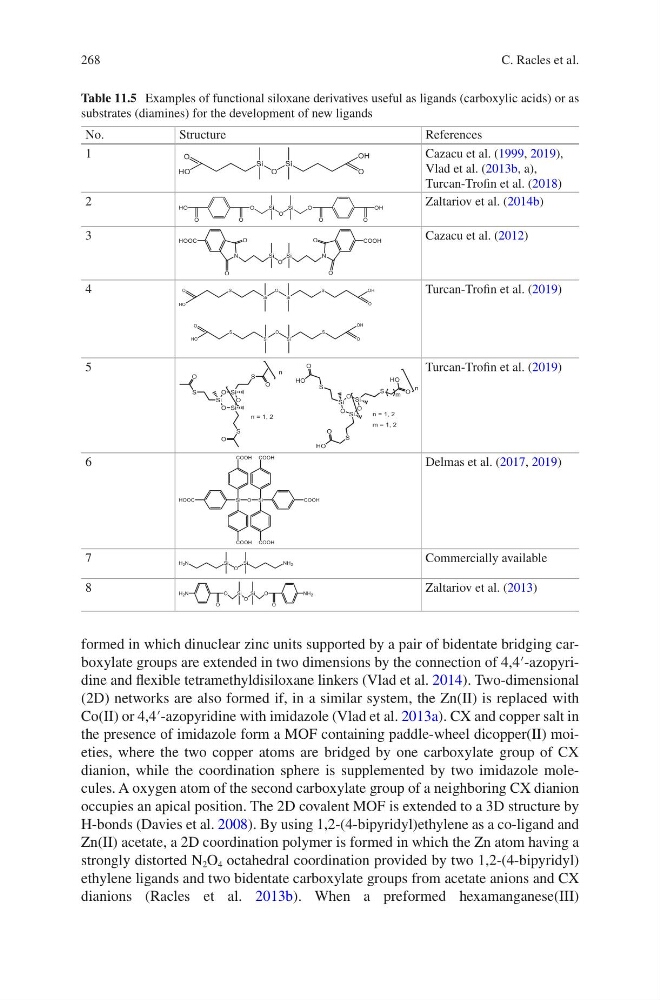
Table 11.5 Examples of functional siloxane derivatives useful as ligands (carboxylic acids) or as
substrates (diamines) for the development of new ligands
No.
Structure
References
1
Cazacu et al. (1999, 2019),
Vlad et al. (2013b, a),
Turcan-Trofin et al. (2018)
2
Zaltariov et al. (2014b)
3
Cazacu et al. (2012)
4
Turcan-Trofin et al. (2019)
5
Turcan-Trofin et al. (2019)
6
Delmas et al. (2017, 2019)
7
Commercially available
8
Zaltariov et al. (2013)
formed in which dinuclear zinc units supported by a pair of bidentate bridging carboxylate groups are extended in two dimensions by the connection of 4,4′-azopyridine and flexible tetramethyldisiloxane linkers (Vlad et al. 2014). Two-dimensional
(2D) networks are also formed if, in a similar system, the Zn(II) is replaced with
Co(II) or 4,4′-azopyridine with imidazole (Vlad et al. 2013a). CX and copper salt in
the presence of imidazole form a MOF containing paddle-wheel dicopper(II) moieties, where the two copper atoms are bridged by one carboxylate group of CX
dianion, while the coordination sphere is supplemented by two imidazole molecules. A oxygen atom of the second carboxylate group of a neighboring CX dianion
occupies an apical position. The 2D covalent MOF is extended to a 3D structure by
H-bonds (Davies et al. 2008). By using 1,2-(4-bipyridyl)ethylene as a co-ligand and
Zn(II) acetate, a 2D coordination polymer is formed in which the Zn atom having a
strongly distorted N 2 O 4 octahedral coordination provided by two 1,2-(4-bipyridyl)
ethylene ligands and two bidentate carboxylate groups from acetate anions and CX
dianions (Racles et al. 2013b). When a preformed hexamanganese(III)
C. Racles et al.
Table 11.5 Examples of functional siloxane derivatives useful as ligands (carboxylic acids) or as
substrates (diamines) for the development of new ligands
No.
Structure
References
1
Cazacu et al. (1999, 2019),
Vlad et al. (2013b, a),
Turcan-Trofin et al. (2018)
2
Zaltariov et al. (2014b)
3
Cazacu et al. (2012)
4
Turcan-Trofin et al. (2019)
5
Turcan-Trofin et al. (2019)
6
Delmas et al. (2017, 2019)
7
Commercially available
8
Zaltariov et al. (2013)
formed in which dinuclear zinc units supported by a pair of bidentate bridging carboxylate groups are extended in two dimensions by the connection of 4,4′-azopyridine and flexible tetramethyldisiloxane linkers (Vlad et al. 2014). Two-dimensional
(2D) networks are also formed if, in a similar system, the Zn(II) is replaced with
Co(II) or 4,4′-azopyridine with imidazole (Vlad et al. 2013a). CX and copper salt in
the presence of imidazole form a MOF containing paddle-wheel dicopper(II) moieties, where the two copper atoms are bridged by one carboxylate group of CX
dianion, while the coordination sphere is supplemented by two imidazole molecules. A oxygen atom of the second carboxylate group of a neighboring CX dianion
occupies an apical position. The 2D covalent MOF is extended to a 3D structure by
H-bonds (Davies et al. 2008). By using 1,2-(4-bipyridyl)ethylene as a co-ligand and
Zn(II) acetate, a 2D coordination polymer is formed in which the Zn atom having a
strongly distorted N 2 O 4 octahedral coordination provided by two 1,2-(4-bipyridyl)
ethylene ligands and two bidentate carboxylate groups from acetate anions and CX
dianions (Racles et al. 2013b). When a preformed hexamanganese(III)
C. Racles et al.