

245
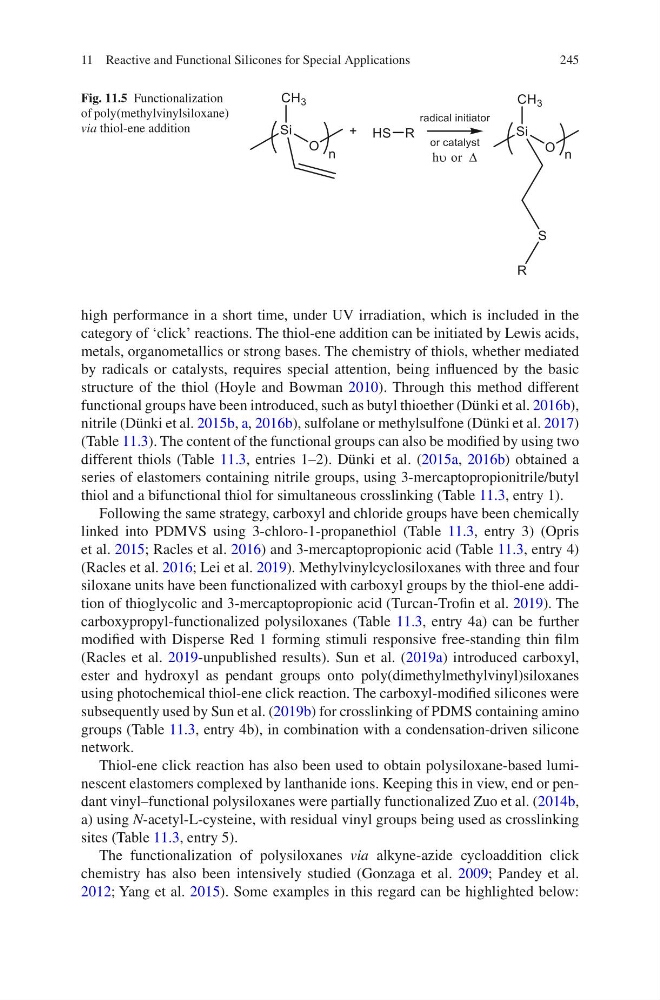
high performance in a short time, under UV irradiation, which is included in the
category of ‘click’ reactions. The thiol-ene addition can be initiated by Lewis acids,
metals, organometallics or strong bases. The chemistry of thiols, whether mediated
by radicals or catalysts, requires special attention, being influenced by the basic
structure of the thiol (Hoyle and Bowman 2010). Through this method different
functional groups have been introduced, such as butyl thioether (Dünki et al. 2016b),
nitrile (Dünki et al. 2015b, a, 2016b), sulfolane or methylsulfone (Dünki et al. 2017)
(Table 11.3). The content of the functional groups can also be modified by using two
different thiols (Table 11.3, entries 1–2). Dünki et al. (2015a, 2016b) obtained a
series of elastomers containing nitrile groups, using 3-mercaptopropionitrile/butyl
thiol and a bifunctional thiol for simultaneous crosslinking (Table 11.3, entry 1).
Following the same strategy, carboxyl and chloride groups have been chemically
linked into PDMVS using 3-chloro-1-propanethiol (Table 11.3, entry 3) (Opris
et al. 2015; Racles et al. 2016) and 3-mercaptopropionic acid (Table 11.3, entry 4)
(Racles et al. 2016; Lei et al. 2019). Methylvinylcyclosiloxanes with three and four
siloxane units have been functionalized with carboxyl groups by the thiol-ene addition of thioglycolic and 3-mercaptopropionic acid (Turcan-Trofin et al. 2019). The
carboxypropyl-functionalized polysiloxanes (Table 11.3, entry 4a) can be further
modified with Disperse Red 1 forming stimuli responsive free-standing thin film
(Racles et al. 2019-unpublished results). Sun et al. (2019a) introduced carboxyl,
ester and hydroxyl as pendant groups onto poly(dimethylmethylvinyl)siloxanes
using photochemical thiol-ene click reaction. The carboxyl-modified silicones were
subsequently used by Sun et al. (2019b) for crosslinking of PDMS containing amino
groups (Table 11.3, entry 4b), in combination with a condensation-driven silicone
network.
Thiol-ene click reaction has also been used to obtain polysiloxane-based luminescent elastomers complexed by lanthanide ions. Keeping this in view, end or pendant vinyl–functional polysiloxanes were partially functionalized Zuo et al. (2014b,
a) using N-acetyl-L-cysteine, with residual vinyl groups being used as crosslinking
sites (Table 11.3, entry 5).
The functionalization of polysiloxanes via alkyne-azide cycloaddition click
chemistry has also been intensively studied (Gonzaga et al. 2009; Pandey et al.
2012; Yang et al. 2015). Some examples in this regard can be highlighted below:
Fig. 11.5 Functionalization
of poly(methylvinylsiloxane)
via thiol-ene addition
11 Reactive and Functional Silicones for Special Applications
high performance in a short time, under UV irradiation, which is included in the
category of ‘click’ reactions. The thiol-ene addition can be initiated by Lewis acids,
metals, organometallics or strong bases. The chemistry of thiols, whether mediated
by radicals or catalysts, requires special attention, being influenced by the basic
structure of the thiol (Hoyle and Bowman 2010). Through this method different
functional groups have been introduced, such as butyl thioether (Dünki et al. 2016b),
nitrile (Dünki et al. 2015b, a, 2016b), sulfolane or methylsulfone (Dünki et al. 2017)
(Table 11.3). The content of the functional groups can also be modified by using two
different thiols (Table 11.3, entries 1–2). Dünki et al. (2015a, 2016b) obtained a
series of elastomers containing nitrile groups, using 3-mercaptopropionitrile/butyl
thiol and a bifunctional thiol for simultaneous crosslinking (Table 11.3, entry 1).
Following the same strategy, carboxyl and chloride groups have been chemically
linked into PDMVS using 3-chloro-1-propanethiol (Table 11.3, entry 3) (Opris
et al. 2015; Racles et al. 2016) and 3-mercaptopropionic acid (Table 11.3, entry 4)
(Racles et al. 2016; Lei et al. 2019). Methylvinylcyclosiloxanes with three and four
siloxane units have been functionalized with carboxyl groups by the thiol-ene addition of thioglycolic and 3-mercaptopropionic acid (Turcan-Trofin et al. 2019). The
carboxypropyl-functionalized polysiloxanes (Table 11.3, entry 4a) can be further
modified with Disperse Red 1 forming stimuli responsive free-standing thin film
(Racles et al. 2019-unpublished results). Sun et al. (2019a) introduced carboxyl,
ester and hydroxyl as pendant groups onto poly(dimethylmethylvinyl)siloxanes
using photochemical thiol-ene click reaction. The carboxyl-modified silicones were
subsequently used by Sun et al. (2019b) for crosslinking of PDMS containing amino
groups (Table 11.3, entry 4b), in combination with a condensation-driven silicone
network.
Thiol-ene click reaction has also been used to obtain polysiloxane-based luminescent elastomers complexed by lanthanide ions. Keeping this in view, end or pendant vinyl–functional polysiloxanes were partially functionalized Zuo et al. (2014b,
a) using N-acetyl-L-cysteine, with residual vinyl groups being used as crosslinking
sites (Table 11.3, entry 5).
The functionalization of polysiloxanes via alkyne-azide cycloaddition click
chemistry has also been intensively studied (Gonzaga et al. 2009; Pandey et al.
2012; Yang et al. 2015). Some examples in this regard can be highlighted below:
Fig. 11.5 Functionalization
of poly(methylvinylsiloxane)
via thiol-ene addition
11 Reactive and Functional Silicones for Special Applications