

164
hydrogen bonds, so it resists against hydrolysis and shows superior exterior durability. In polyester formulations containing NPG, the resulting polyester also shows a
lower viscosity compared to other glycols (Deligny and Tuck 2000). EG has a weak
resistance to hydrolysis because it has no steric hindrance and is mainly used to
lower the final price as well as to impart hardness to the product (Deligny and Tuck
2000). DEG and HD are flexible monomers and are used to introduce softness into
the final product. CHDM in the final product shows better mechanical and chemical
resistance properties compared to other glycols such as aromatic and linear glycols
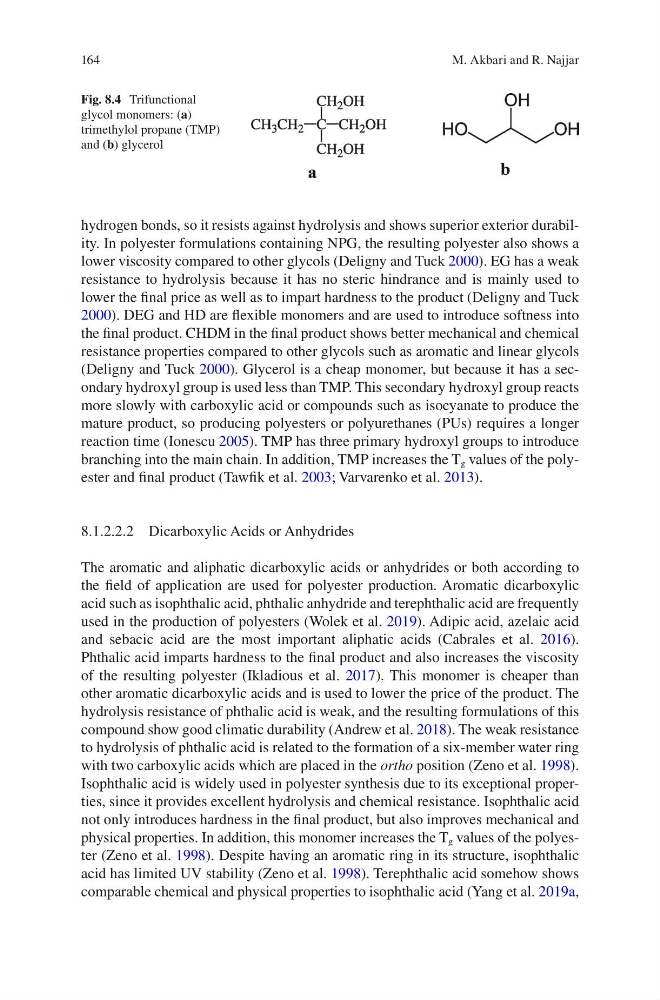
(Deligny and Tuck 2000). Glycerol is a cheap monomer, but because it has a secondary hydroxyl group is used less than TMP. This secondary hydroxyl group reacts
more slowly with carboxylic acid or compounds such as isocyanate to produce the
mature product, so producing polyesters or polyurethanes (PUs) requires a longer
reaction time (Ionescu 2005). TMP has three primary hydroxyl groups to introduce
branching into the main chain. In addition, TMP increases the T g values of the polyester and final product (Tawfik et al. 2003; Varvarenko et al. 2013).
8.1.2.2.2 Dicarboxylic Acids or Anhydrides
The aromatic and aliphatic dicarboxylic acids or anhydrides or both according to
the field of application are used for polyester production. Aromatic dicarboxylic
acid such as isophthalic acid, phthalic anhydride and terephthalic acid are frequently
used in the production of polyesters (Wolek et al. 2019). Adipic acid, azelaic acid
and sebacic acid are the most important aliphatic acids (Cabrales et al. 2016).
Phthalic acid imparts hardness to the final product and also increases the viscosity
of the resulting polyester (Ikladious et al. 2017). This monomer is cheaper than
other aromatic dicarboxylic acids and is used to lower the price of the product. The
hydrolysis resistance of phthalic acid is weak, and the resulting formulations of this
compound show good climatic durability (Andrew et al. 2018). The weak resistance
to hydrolysis of phthalic acid is related to the formation of a six-member water ring
with two carboxylic acids which are placed in the ortho position (Zeno et al. 1998).
Isophthalic acid is widely used in polyester synthesis due to its exceptional properties, since it provides excellent hydrolysis and chemical resistance. Isophthalic acid
not only introduces hardness in the final product, but also improves mechanical and
physical properties. In addition, this monomer increases the T g values of the polyester (Zeno et al. 1998). Despite having an aromatic ring in its structure, isophthalic
acid has limited UV stability (Zeno et al. 1998). Terephthalic acid somehow shows
comparable chemical and physical properties to isophthalic acid (Yang et al. 2019a,
Fig. 8.4 Trifunctional
glycol monomers: (a)
trimethylol propane (TMP)
and (b) glycerol
M. Akbari and R. Najjar
hydrogen bonds, so it resists against hydrolysis and shows superior exterior durability. In polyester formulations containing NPG, the resulting polyester also shows a
lower viscosity compared to other glycols (Deligny and Tuck 2000). EG has a weak
resistance to hydrolysis because it has no steric hindrance and is mainly used to
lower the final price as well as to impart hardness to the product (Deligny and Tuck
2000). DEG and HD are flexible monomers and are used to introduce softness into
the final product. CHDM in the final product shows better mechanical and chemical
resistance properties compared to other glycols such as aromatic and linear glycols
(Deligny and Tuck 2000). Glycerol is a cheap monomer, but because it has a secondary hydroxyl group is used less than TMP. This secondary hydroxyl group reacts
more slowly with carboxylic acid or compounds such as isocyanate to produce the
mature product, so producing polyesters or polyurethanes (PUs) requires a longer
reaction time (Ionescu 2005). TMP has three primary hydroxyl groups to introduce
branching into the main chain. In addition, TMP increases the T g values of the polyester and final product (Tawfik et al. 2003; Varvarenko et al. 2013).
8.1.2.2.2 Dicarboxylic Acids or Anhydrides
The aromatic and aliphatic dicarboxylic acids or anhydrides or both according to
the field of application are used for polyester production. Aromatic dicarboxylic
acid such as isophthalic acid, phthalic anhydride and terephthalic acid are frequently
used in the production of polyesters (Wolek et al. 2019). Adipic acid, azelaic acid
and sebacic acid are the most important aliphatic acids (Cabrales et al. 2016).
Phthalic acid imparts hardness to the final product and also increases the viscosity
of the resulting polyester (Ikladious et al. 2017). This monomer is cheaper than
other aromatic dicarboxylic acids and is used to lower the price of the product. The
hydrolysis resistance of phthalic acid is weak, and the resulting formulations of this
compound show good climatic durability (Andrew et al. 2018). The weak resistance
to hydrolysis of phthalic acid is related to the formation of a six-member water ring
with two carboxylic acids which are placed in the ortho position (Zeno et al. 1998).
Isophthalic acid is widely used in polyester synthesis due to its exceptional properties, since it provides excellent hydrolysis and chemical resistance. Isophthalic acid
not only introduces hardness in the final product, but also improves mechanical and
physical properties. In addition, this monomer increases the T g values of the polyester (Zeno et al. 1998). Despite having an aromatic ring in its structure, isophthalic
acid has limited UV stability (Zeno et al. 1998). Terephthalic acid somehow shows
comparable chemical and physical properties to isophthalic acid (Yang et al. 2019a,
Fig. 8.4 Trifunctional
glycol monomers: (a)
trimethylol propane (TMP)
and (b) glycerol
M. Akbari and R. Najjar