

149
for horticultural applications. The biopolyols derived from the fractionation of biomass show, thus, a promise in the bio-replacement of petroleum-based polyols for
the preparation of BPU materials (Hatakeyama et al. 2012; Li et al. 2017a; Li et al.
2018). Although, the foam formulation must be further optimized to obtain BPU
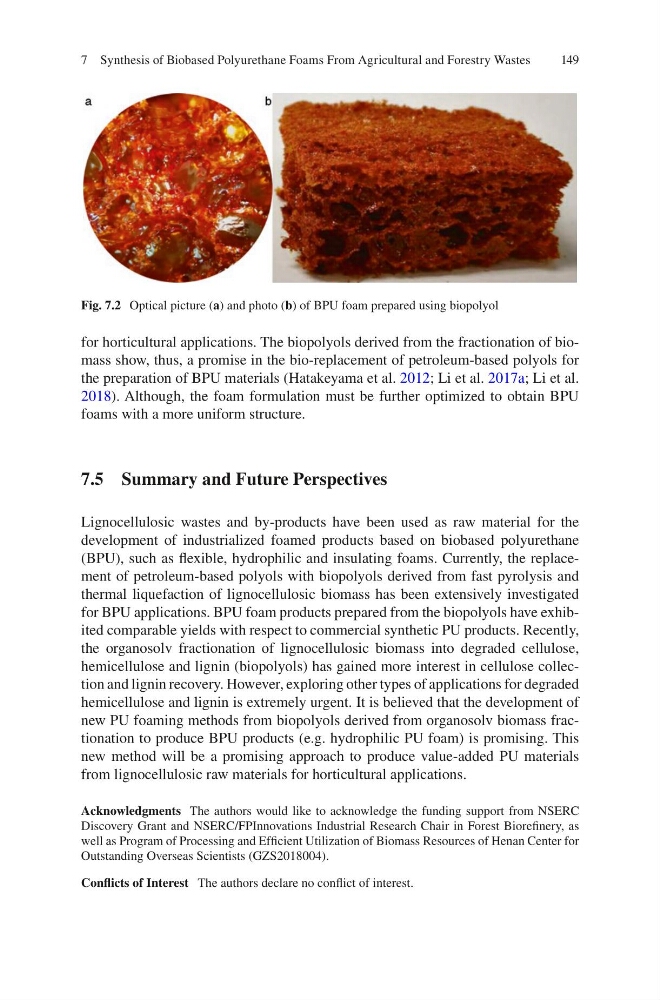
foams with a more uniform structure.
7.5 Summary and Future Perspectives
Lignocellulosic wastes and by-products have been used as raw material for the
development of industrialized foamed products based on biobased polyurethane
(BPU), such as flexible, hydrophilic and insulating foams. Currently, the replacement of petroleum-based polyols with biopolyols derived from fast pyrolysis and
thermal liquefaction of lignocellulosic biomass has been extensively investigated
for BPU applications. BPU foam products prepared from the biopolyols have exhibited comparable yields with respect to commercial synthetic PU products. Recently,
the organosolv fractionation of lignocellulosic biomass into degraded cellulose,
hemicellulose and lignin (biopolyols) has gained more interest in cellulose collection and lignin recovery. However, exploring other types of applications for degraded
hemicellulose and lignin is extremely urgent. It is believed that the development of
new PU foaming methods from biopolyols derived from organosolv biomass fractionation to produce BPU products (e.g. hydrophilic PU foam) is promising. This
new method will be a promising approach to produce value-added PU materials
from lignocellulosic raw materials for horticultural applications.
Acknowledgments The authors would like to acknowledge the funding support from NSERC
Discovery Grant and NSERC/FPInnovations Industrial Research Chair in Forest Biorefinery, as
well as Program of Processing and Efficient Utilization of Biomass Resources of Henan Center for
Outstanding Overseas Scientists (GZS2018004).
Conflicts of Interest The authors declare no conflict of interest.
Fig. 7.2 Optical picture (a) and photo (b) of BPU foam prepared using biopolyol
7 Synthesis of Biobased Polyurethane Foams From Agricultural and Forestry Wastes
for horticultural applications. The biopolyols derived from the fractionation of biomass show, thus, a promise in the bio-replacement of petroleum-based polyols for
the preparation of BPU materials (Hatakeyama et al. 2012; Li et al. 2017a; Li et al.
2018). Although, the foam formulation must be further optimized to obtain BPU
foams with a more uniform structure.
7.5 Summary and Future Perspectives
Lignocellulosic wastes and by-products have been used as raw material for the
development of industrialized foamed products based on biobased polyurethane
(BPU), such as flexible, hydrophilic and insulating foams. Currently, the replacement of petroleum-based polyols with biopolyols derived from fast pyrolysis and
thermal liquefaction of lignocellulosic biomass has been extensively investigated
for BPU applications. BPU foam products prepared from the biopolyols have exhibited comparable yields with respect to commercial synthetic PU products. Recently,
the organosolv fractionation of lignocellulosic biomass into degraded cellulose,
hemicellulose and lignin (biopolyols) has gained more interest in cellulose collection and lignin recovery. However, exploring other types of applications for degraded
hemicellulose and lignin is extremely urgent. It is believed that the development of
new PU foaming methods from biopolyols derived from organosolv biomass fractionation to produce BPU products (e.g. hydrophilic PU foam) is promising. This
new method will be a promising approach to produce value-added PU materials
from lignocellulosic raw materials for horticultural applications.
Acknowledgments The authors would like to acknowledge the funding support from NSERC
Discovery Grant and NSERC/FPInnovations Industrial Research Chair in Forest Biorefinery, as
well as Program of Processing and Efficient Utilization of Biomass Resources of Henan Center for
Outstanding Overseas Scientists (GZS2018004).
Conflicts of Interest The authors declare no conflict of interest.
Fig. 7.2 Optical picture (a) and photo (b) of BPU foam prepared using biopolyol
7 Synthesis of Biobased Polyurethane Foams From Agricultural and Forestry Wastes