

114
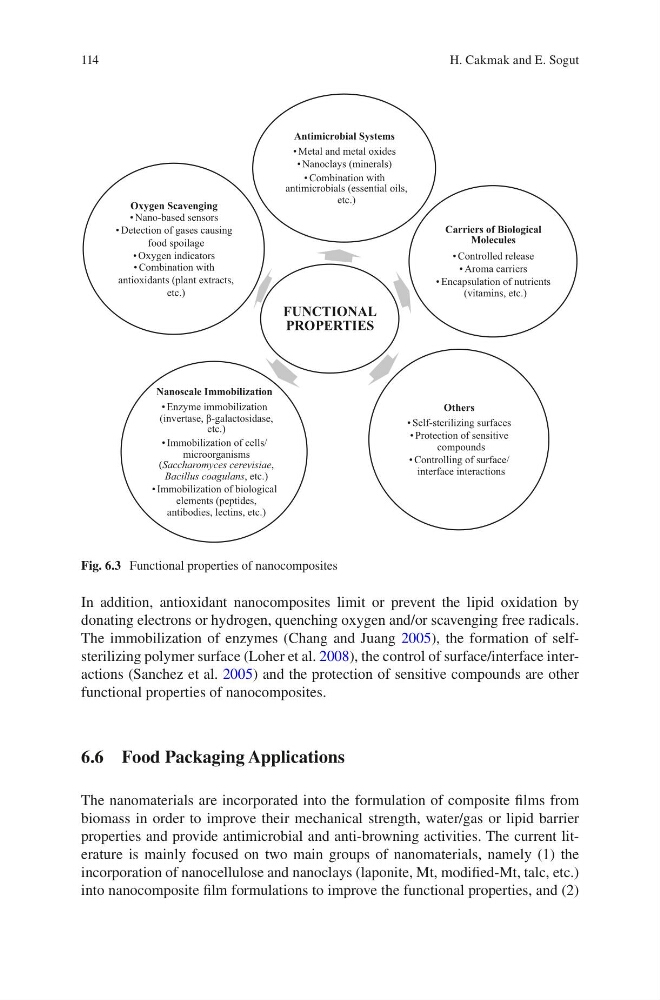
In addition, antioxidant nanocomposites limit or prevent the lipid oxidation by
donating electrons or hydrogen, quenching oxygen and/or scavenging free radicals.
The immobilization of enzymes (Chang and Juang 2005), the formation of selfsterilizing polymer surface (Loher et al. 2008), the control of surface/interface interactions (Sanchez et al. 2005) and the protection of sensitive compounds are other
functional properties of nanocomposites.
6.6 Food Packaging Applications
The nanomaterials are incorporated into the formulation of composite films from
biomass in order to improve their mechanical strength, water/gas or lipid barrier
properties and provide antimicrobial and anti-browning activities. The current literature is mainly focused on two main groups of nanomaterials, namely (1) the
incorporation of nanocellulose and nanoclays (laponite, Mt, modified-Mt, talc, etc.)
into nanocomposite film formulations to improve the functional properties, and (2)
FUNCTIONAL
PROPERTIES
Antimicrobial Systems
• Metal and metal oxides
• Nanoclays (minerals)
• Combination with
antimicrobials (essential oils,
etc.)
Oxygen Scavenging
• Nano-based sensors
• Detection of gases causing
food spoilage
• Oxygen indicators
• Combination with
antioxidants (plant extracts,
etc.)
Nanoscale Immobilization
• Enzyme immobilization
(invertase, -galactosidase,
etc.)
• Immobilization of cells/
microorganisms
(Saccharomyces cerevisiae,
Bacillus coagulans, etc.)
• Immobilization of biological
elements (peptides,
antibodies, lectins, etc.)
Carriers of Biological
Molecules
• Controlled release
• Aroma carriers
• Encapsulation of nutrients
(vitamins, etc.)
Others
• Self-sterilizing surfaces
• Protection of sensitive
compounds
• Controlling of surface/
interface interactions
Fig. 6.3 Functional properties of nanocomposites
H. Cakmak and E. Sogut
In addition, antioxidant nanocomposites limit or prevent the lipid oxidation by
donating electrons or hydrogen, quenching oxygen and/or scavenging free radicals.
The immobilization of enzymes (Chang and Juang 2005), the formation of selfsterilizing polymer surface (Loher et al. 2008), the control of surface/interface interactions (Sanchez et al. 2005) and the protection of sensitive compounds are other
functional properties of nanocomposites.
6.6 Food Packaging Applications
The nanomaterials are incorporated into the formulation of composite films from
biomass in order to improve their mechanical strength, water/gas or lipid barrier
properties and provide antimicrobial and anti-browning activities. The current literature is mainly focused on two main groups of nanomaterials, namely (1) the
incorporation of nanocellulose and nanoclays (laponite, Mt, modified-Mt, talc, etc.)
into nanocomposite film formulations to improve the functional properties, and (2)
FUNCTIONAL
PROPERTIES
Antimicrobial Systems
• Metal and metal oxides
• Nanoclays (minerals)
• Combination with
antimicrobials (essential oils,
etc.)
Oxygen Scavenging
• Nano-based sensors
• Detection of gases causing
food spoilage
• Oxygen indicators
• Combination with
antioxidants (plant extracts,
etc.)
Nanoscale Immobilization
• Enzyme immobilization
(invertase, -galactosidase,
etc.)
• Immobilization of cells/
microorganisms
(Saccharomyces cerevisiae,
Bacillus coagulans, etc.)
• Immobilization of biological
elements (peptides,
antibodies, lectins, etc.)
Carriers of Biological
Molecules
• Controlled release
• Aroma carriers
• Encapsulation of nutrients
(vitamins, etc.)
Others
• Self-sterilizing surfaces
• Protection of sensitive
compounds
• Controlling of surface/
interface interactions
Fig. 6.3 Functional properties of nanocomposites
H. Cakmak and E. Sogut