

103
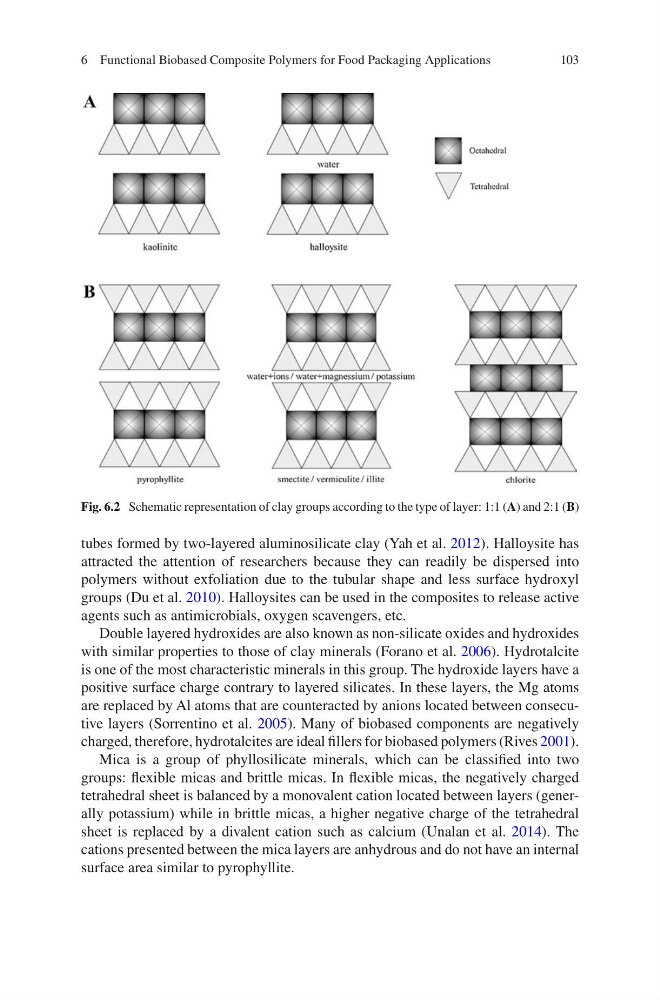
tubes formed by two-layered aluminosilicate clay (Yah et al. 2012). Halloysite has
attracted the attention of researchers because they can readily be dispersed into
polymers without exfoliation due to the tubular shape and less surface hydroxyl
groups (Du et al. 2010). Halloysites can be used in the composites to release active
agents such as antimicrobials, oxygen scavengers, etc.
Double layered hydroxides are also known as non-silicate oxides and hydroxides
with similar properties to those of clay minerals (Forano et al. 2006). Hydrotalcite
is one of the most characteristic minerals in this group. The hydroxide layers have a
positive surface charge contrary to layered silicates. In these layers, the Mg atoms
are replaced by Al atoms that are counteracted by anions located between consecutive layers (Sorrentino et al. 2005). Many of biobased components are negatively
charged, therefore, hydrotalcites are ideal fillers for biobased polymers (Rives 2001).
Mica is a group of phyllosilicate minerals, which can be classified into two
groups: flexible micas and brittle micas. In flexible micas, the negatively charged
tetrahedral sheet is balanced by a monovalent cation located between layers (generally potassium) while in brittle micas, a higher negative charge of the tetrahedral
sheet is replaced by a divalent cation such as calcium (Unalan et al. 2014). The
cations presented between the mica layers are anhydrous and do not have an internal
surface area similar to pyrophyllite.
Fig. 6.2 Schematic representation of clay groups according to the type of layer: 1:1 (A) and 2:1 (B)
6 Functional Biobased Composite Polymers for Food Packaging Applications
tubes formed by two-layered aluminosilicate clay (Yah et al. 2012). Halloysite has
attracted the attention of researchers because they can readily be dispersed into
polymers without exfoliation due to the tubular shape and less surface hydroxyl
groups (Du et al. 2010). Halloysites can be used in the composites to release active
agents such as antimicrobials, oxygen scavengers, etc.
Double layered hydroxides are also known as non-silicate oxides and hydroxides
with similar properties to those of clay minerals (Forano et al. 2006). Hydrotalcite
is one of the most characteristic minerals in this group. The hydroxide layers have a
positive surface charge contrary to layered silicates. In these layers, the Mg atoms
are replaced by Al atoms that are counteracted by anions located between consecutive layers (Sorrentino et al. 2005). Many of biobased components are negatively
charged, therefore, hydrotalcites are ideal fillers for biobased polymers (Rives 2001).
Mica is a group of phyllosilicate minerals, which can be classified into two
groups: flexible micas and brittle micas. In flexible micas, the negatively charged
tetrahedral sheet is balanced by a monovalent cation located between layers (generally potassium) while in brittle micas, a higher negative charge of the tetrahedral
sheet is replaced by a divalent cation such as calcium (Unalan et al. 2014). The
cations presented between the mica layers are anhydrous and do not have an internal
surface area similar to pyrophyllite.
Fig. 6.2 Schematic representation of clay groups according to the type of layer: 1:1 (A) and 2:1 (B)
6 Functional Biobased Composite Polymers for Food Packaging Applications