

101
hydrophobic nature (Morillon et al. 2002). Polymorphism and crystalline structure
influences the WVP of films formed by lipids and waxes (Morillon et al. 2002). The
water vapor transmission rate (WVTR) had also been comparably lower when solid
fat is used as a layer in the case of lipids in bilayer films (Debeaufort et al. 2000).
6.3 Nanoreinforcement
There are three types of biobased nanocomposite configurations: phase-separated
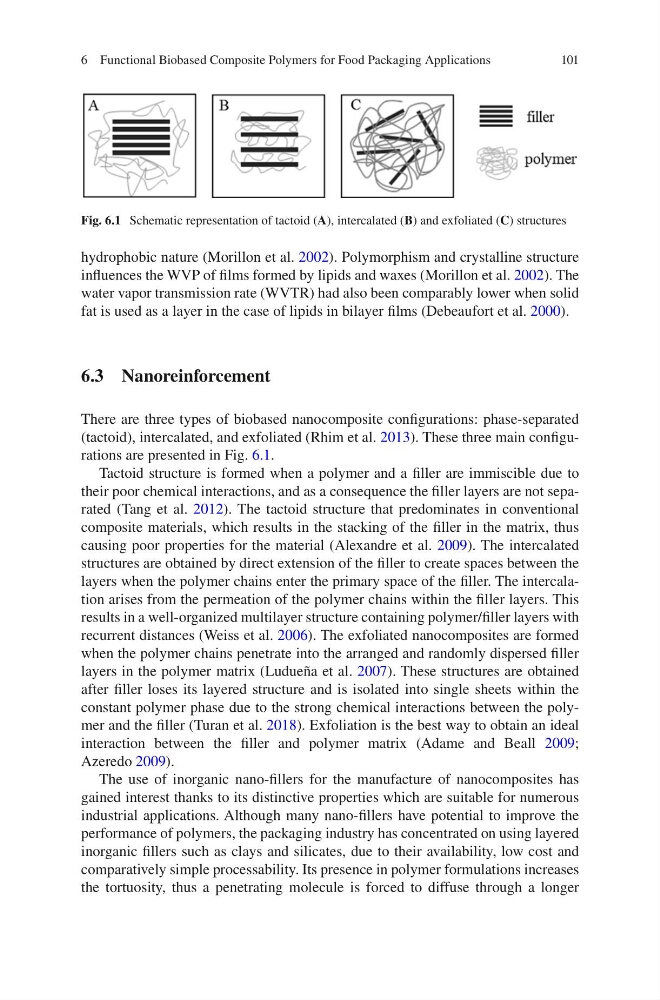
(tactoid), intercalated, and exfoliated (Rhim et al. 2013). These three main configurations are presented in Fig. 6.1.
Tactoid structure is formed when a polymer and a filler are immiscible due to
their poor chemical interactions, and as a consequence the filler layers are not separated (Tang et al. 2012). The tactoid structure that predominates in conventional
composite materials, which results in the stacking of the filler in the matrix, thus
causing poor properties for the material (Alexandre et al. 2009). The intercalated
structures are obtained by direct extension of the filler to create spaces between the
layers when the polymer chains enter the primary space of the filler. The intercalation arises from the permeation of the polymer chains within the filler layers. This
results in a well-organized multilayer structure containing polymer/filler layers with
recurrent distances (Weiss et al. 2006). The exfoliated nanocomposites are formed
when the polymer chains penetrate into the arranged and randomly dispersed filler
layers in the polymer matrix (Ludueña et al. 2007). These structures are obtained
after filler loses its layered structure and is isolated into single sheets within the
constant polymer phase due to the strong chemical interactions between the polymer and the filler (Turan et al. 2018). Exfoliation is the best way to obtain an ideal
interaction between the filler and polymer matrix (Adame and Beall 2009;
Azeredo 2009).
The use of inorganic nano-fillers for the manufacture of nanocomposites has
gained interest thanks to its distinctive properties which are suitable for numerous
industrial applications. Although many nano-fillers have potential to improve the
performance of polymers, the packaging industry has concentrated on using layered
inorganic fillers such as clays and silicates, due to their availability, low cost and
comparatively simple processability. Its presence in polymer formulations increases
the tortuosity, thus a penetrating molecule is forced to diffuse through a longer
Fig. 6.1 Schematic representation of tactoid (A), intercalated (B) and exfoliated (C) structures
6 Functional Biobased Composite Polymers for Food Packaging Applications
hydrophobic nature (Morillon et al. 2002). Polymorphism and crystalline structure
influences the WVP of films formed by lipids and waxes (Morillon et al. 2002). The
water vapor transmission rate (WVTR) had also been comparably lower when solid
fat is used as a layer in the case of lipids in bilayer films (Debeaufort et al. 2000).
6.3 Nanoreinforcement
There are three types of biobased nanocomposite configurations: phase-separated
(tactoid), intercalated, and exfoliated (Rhim et al. 2013). These three main configurations are presented in Fig. 6.1.
Tactoid structure is formed when a polymer and a filler are immiscible due to
their poor chemical interactions, and as a consequence the filler layers are not separated (Tang et al. 2012). The tactoid structure that predominates in conventional
composite materials, which results in the stacking of the filler in the matrix, thus
causing poor properties for the material (Alexandre et al. 2009). The intercalated
structures are obtained by direct extension of the filler to create spaces between the
layers when the polymer chains enter the primary space of the filler. The intercalation arises from the permeation of the polymer chains within the filler layers. This
results in a well-organized multilayer structure containing polymer/filler layers with
recurrent distances (Weiss et al. 2006). The exfoliated nanocomposites are formed
when the polymer chains penetrate into the arranged and randomly dispersed filler
layers in the polymer matrix (Ludueña et al. 2007). These structures are obtained
after filler loses its layered structure and is isolated into single sheets within the
constant polymer phase due to the strong chemical interactions between the polymer and the filler (Turan et al. 2018). Exfoliation is the best way to obtain an ideal
interaction between the filler and polymer matrix (Adame and Beall 2009;
Azeredo 2009).
The use of inorganic nano-fillers for the manufacture of nanocomposites has
gained interest thanks to its distinctive properties which are suitable for numerous
industrial applications. Although many nano-fillers have potential to improve the
performance of polymers, the packaging industry has concentrated on using layered
inorganic fillers such as clays and silicates, due to their availability, low cost and
comparatively simple processability. Its presence in polymer formulations increases
the tortuosity, thus a penetrating molecule is forced to diffuse through a longer
Fig. 6.1 Schematic representation of tactoid (A), intercalated (B) and exfoliated (C) structures
6 Functional Biobased Composite Polymers for Food Packaging Applications