

72
extraction and chemical modification of lignin (García et al. 2012; Qin et al. 2018c).
Using this knowledge, several studies have been conducted to obtain lignin with
high antioxidant activity.
García et al. (2010) studied the effects of different separation methods on the
antioxidant activities of lignins from Miscanthus sinensis. The lignin fraction
obtained by organosolv fractionating (OL) exhibited the highest free radical scavenging activity, followed by lignins obtained by autohydrolysis and alkali treatment.
The alkali treatment had more carbohydrate residues than the organosolv fractionating. Hydrogen bonds between phenolic hydroxyl groups of lignin and carbohydrates lead to low antioxidant activity. Lignin with low hydroxyl contents has a high
compatibility with the thermoplastic matrix, so it can be used as a good thermal
stabilizer for polymers. Wen et al. (2013) analyzed the structure of lignin isolated by
three different extraction processes, namely milled wood lignin (MWL), alkali lignin (AL) and dimethylsulfoxide/N-methylimidazole-dissolved lignin (DL). The
contents of β-O-4 bonds in these three samples had the following order:
DL < MWL < AL, thus indicating that DL undergoes more degradation than the
others. In the extraction process of DL, more hydroxyl groups were released because
of the cleavage of ether bonds and, therefore, the free radical scavenging ability was
improved. Li et al. (2012) reported that microwave-assisted organic acid extraction
produced lignins with good antioxidant activity. Ionic liquids such as 1-buthyl- 3methylimidazolium chloride (Lauberts et al. 2017) and supercritical CO 2 antisolvent (Lu et al. 2012) have also been used as extraction solvents, resulting in lignins
with higher antioxidant activity.
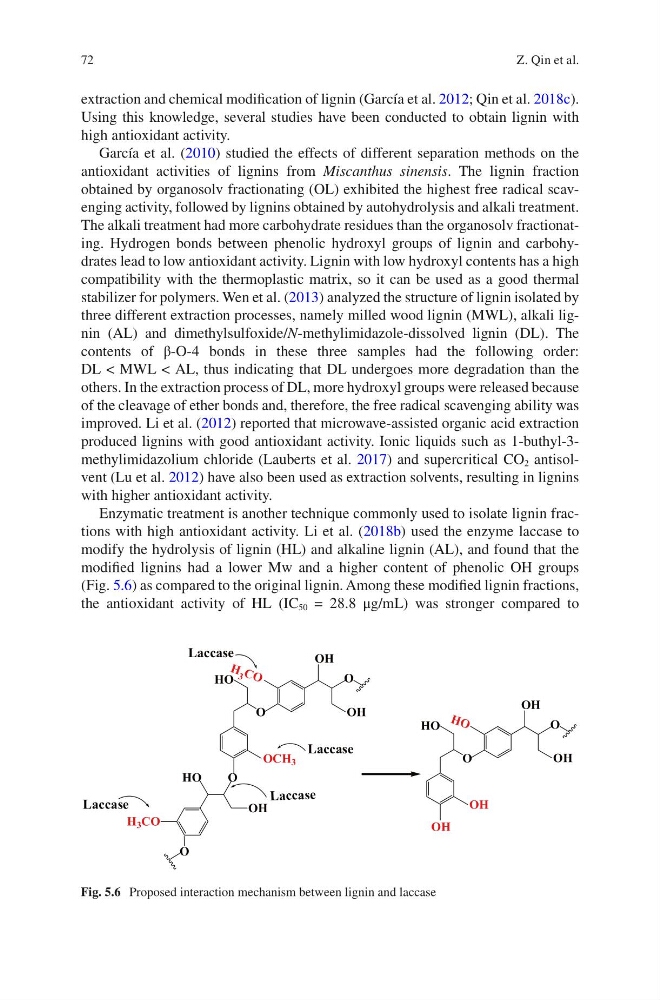
Enzymatic treatment is another technique commonly used to isolate lignin fractions with high antioxidant activity. Li et al. (2018b) used the enzyme laccase to
modify the hydrolysis of lignin (HL) and alkaline lignin (AL), and found that the
modified lignins had a lower Mw and a higher content of phenolic OH groups
(Fig. 5.6) as compared to the original lignin. Among these modified lignin fractions,
the antioxidant activity of HL (IC 50 = 28.8 μg/mL) was stronger compared to
O
HO
O
OCH 3
OH
O
Laccase
OH
H
3 C O
O
HO
OH
H 3 CO
Laccase
Laccase
Laccase
O
HO
OH
OH
O
OH
H O
OH
Fig. 5.6 Proposed interaction mechanism between lignin and laccase
Z. Qin et al.
extraction and chemical modification of lignin (García et al. 2012; Qin et al. 2018c).
Using this knowledge, several studies have been conducted to obtain lignin with
high antioxidant activity.
García et al. (2010) studied the effects of different separation methods on the
antioxidant activities of lignins from Miscanthus sinensis. The lignin fraction
obtained by organosolv fractionating (OL) exhibited the highest free radical scavenging activity, followed by lignins obtained by autohydrolysis and alkali treatment.
The alkali treatment had more carbohydrate residues than the organosolv fractionating. Hydrogen bonds between phenolic hydroxyl groups of lignin and carbohydrates lead to low antioxidant activity. Lignin with low hydroxyl contents has a high
compatibility with the thermoplastic matrix, so it can be used as a good thermal
stabilizer for polymers. Wen et al. (2013) analyzed the structure of lignin isolated by
three different extraction processes, namely milled wood lignin (MWL), alkali lignin (AL) and dimethylsulfoxide/N-methylimidazole-dissolved lignin (DL). The
contents of β-O-4 bonds in these three samples had the following order:
DL < MWL < AL, thus indicating that DL undergoes more degradation than the
others. In the extraction process of DL, more hydroxyl groups were released because
of the cleavage of ether bonds and, therefore, the free radical scavenging ability was
improved. Li et al. (2012) reported that microwave-assisted organic acid extraction
produced lignins with good antioxidant activity. Ionic liquids such as 1-buthyl- 3methylimidazolium chloride (Lauberts et al. 2017) and supercritical CO 2 antisolvent (Lu et al. 2012) have also been used as extraction solvents, resulting in lignins
with higher antioxidant activity.
Enzymatic treatment is another technique commonly used to isolate lignin fractions with high antioxidant activity. Li et al. (2018b) used the enzyme laccase to
modify the hydrolysis of lignin (HL) and alkaline lignin (AL), and found that the
modified lignins had a lower Mw and a higher content of phenolic OH groups
(Fig. 5.6) as compared to the original lignin. Among these modified lignin fractions,
the antioxidant activity of HL (IC 50 = 28.8 μg/mL) was stronger compared to
O
HO
O
OCH 3
OH
O
Laccase
OH
H
3 C O
O
HO
OH
H 3 CO
Laccase
Laccase
Laccase
O
HO
OH
OH
O
OH
H O
OH
Fig. 5.6 Proposed interaction mechanism between lignin and laccase
Z. Qin et al.