

56
In the case of mixtures and their compounds modified with GTR, silanes have
also been tested. The application of γ-methacriloxypropyltrimethoxysilane (silane
A-174) as a coupling agent on the surface of the GTR has been reported as able of
improving the interactions between GTR and non-polar matrices (as HDPE), thus
providing higher values on tensile strength than other treatment methods. As could
be expected, silane development interactions with methyl and methylene groups
that produce interpenetration with the matrix, and improve the bond between the
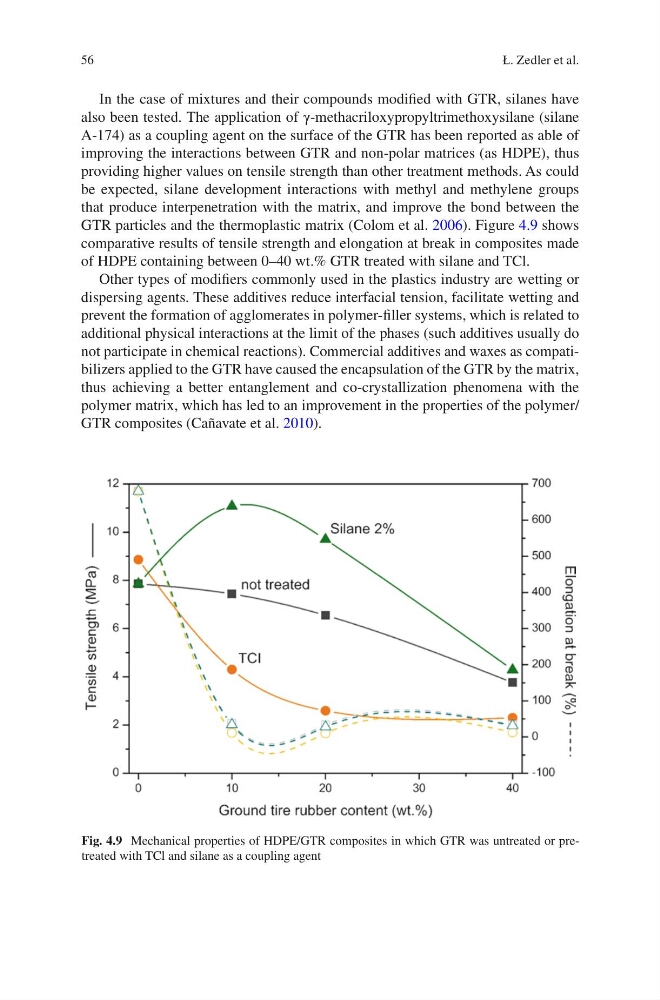
GTR particles and the thermoplastic matrix (Colom et al. 2006). Figure 4.9 shows
comparative results of tensile strength and elongation at break in composites made
of HDPE containing between 0–40 wt.% GTR treated with silane and TCl.
Other types of modifiers commonly used in the plastics industry are wetting or
dispersing agents. These additives reduce interfacial tension, facilitate wetting and
prevent the formation of agglomerates in polymer-filler systems, which is related to
additional physical interactions at the limit of the phases (such additives usually do
not participate in chemical reactions). Commercial additives and waxes as compatibilizers applied to the GTR have caused the encapsulation of the GTR by the matrix,
thus achieving a better entanglement and co-crystallization phenomena with the
polymer matrix, which has led to an improvement in the properties of the polymer/
GTR composites (Cañavate et al. 2010).
Fig. 4.9 Mechanical properties of HDPE/GTR composites in which GTR was untreated or pretreated with TCl and silane as a coupling agent
Ł. Zedler et al.
In the case of mixtures and their compounds modified with GTR, silanes have
also been tested. The application of γ-methacriloxypropyltrimethoxysilane (silane
A-174) as a coupling agent on the surface of the GTR has been reported as able of
improving the interactions between GTR and non-polar matrices (as HDPE), thus
providing higher values on tensile strength than other treatment methods. As could
be expected, silane development interactions with methyl and methylene groups
that produce interpenetration with the matrix, and improve the bond between the
GTR particles and the thermoplastic matrix (Colom et al. 2006). Figure 4.9 shows
comparative results of tensile strength and elongation at break in composites made
of HDPE containing between 0–40 wt.% GTR treated with silane and TCl.
Other types of modifiers commonly used in the plastics industry are wetting or
dispersing agents. These additives reduce interfacial tension, facilitate wetting and
prevent the formation of agglomerates in polymer-filler systems, which is related to
additional physical interactions at the limit of the phases (such additives usually do
not participate in chemical reactions). Commercial additives and waxes as compatibilizers applied to the GTR have caused the encapsulation of the GTR by the matrix,
thus achieving a better entanglement and co-crystallization phenomena with the
polymer matrix, which has led to an improvement in the properties of the polymer/
GTR composites (Cañavate et al. 2010).
Fig. 4.9 Mechanical properties of HDPE/GTR composites in which GTR was untreated or pretreated with TCl and silane as a coupling agent
Ł. Zedler et al.