

51
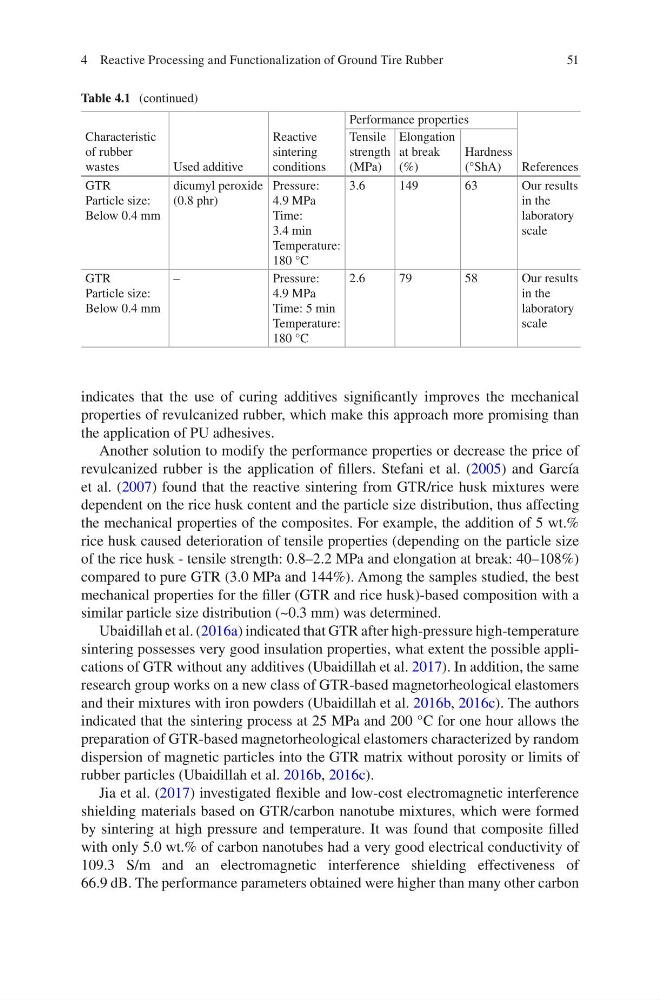
Table 4.1 (continued)
Characteristic
of rubber
wastes
Used additive
Reactive
sintering
conditions
Performance properties
References
Tensile
strength
(MPa)
Elongation
at break
(%)
Hardness
(°ShA)
GTR
Particle size:
Below 0.4 mm
dicumyl peroxide
(0.8 phr)
Pressure:
4.9 MPa
Time:
3.4 min
Temperature:
180 °C
3.6
149
63
Our results
in the
laboratory
scale
GTR
Particle size:
Below 0.4 mm
–
Pressure:
4.9 MPa
Time: 5 min
Temperature:
180 °C
2.6
79
58
Our results
in the
laboratory
scale
indicates that the use of curing additives significantly improves the mechanical
properties of revulcanized rubber, which make this approach more promising than
the application of PU adhesives.
Another solution to modify the performance properties or decrease the price of
revulcanized rubber is the application of fillers. Stefani et al. (2005) and García
et al. (2007) found that the reactive sintering from GTR/rice husk mixtures were
dependent on the rice husk content and the particle size distribution, thus affecting
the mechanical properties of the composites. For example, the addition of 5 wt.%
rice husk caused deterioration of tensile properties (depending on the particle size
of the rice husk - tensile strength: 0.8–2.2 MPa and elongation at break: 40–108%)
compared to pure GTR (3.0 MPa and 144%). Among the samples studied, the best
mechanical properties for the filler (GTR and rice husk)-based composition with a
similar particle size distribution (~0.3 mm) was determined.
Ubaidillah et al. (2016a) indicated that GTR after high-pressure high- temperature
sintering possesses very good insulation properties, what extent the possible applications of GTR without any additives (Ubaidillah et al. 2017). In addition, the same
research group works on a new class of GTR-based magnetorheological elastomers
and their mixtures with iron powders (Ubaidillah et al. 2016b, 2016c). The authors
indicated that the sintering process at 25 MPa and 200 °C for one hour allows the
preparation of GTR-based magnetorheological elastomers characterized by random
dispersion of magnetic particles into the GTR matrix without porosity or limits of
rubber particles (Ubaidillah et al. 2016b, 2016c).
Jia et al. (2017) investigated flexible and low-cost electromagnetic interference
shielding materials based on GTR/carbon nanotube mixtures, which were formed
by sintering at high pressure and temperature. It was found that composite filled
with only 5.0 wt.% of carbon nanotubes had a very good electrical conductivity of
109.3 S/m and an electromagnetic interference shielding effectiveness of
66.9 dB. The performance parameters obtained were higher than many other carbon
4 Reactive Processing and Functionalization of Ground Tire Rubber
Table 4.1 (continued)
Characteristic
of rubber
wastes
Used additive
Reactive
sintering
conditions
Performance properties
References
Tensile
strength
(MPa)
Elongation
at break
(%)
Hardness
(°ShA)
GTR
Particle size:
Below 0.4 mm
dicumyl peroxide
(0.8 phr)
Pressure:
4.9 MPa
Time:
3.4 min
Temperature:
180 °C
3.6
149
63
Our results
in the
laboratory
scale
GTR
Particle size:
Below 0.4 mm
–
Pressure:
4.9 MPa
Time: 5 min
Temperature:
180 °C
2.6
79
58
Our results
in the
laboratory
scale
indicates that the use of curing additives significantly improves the mechanical
properties of revulcanized rubber, which make this approach more promising than
the application of PU adhesives.
Another solution to modify the performance properties or decrease the price of
revulcanized rubber is the application of fillers. Stefani et al. (2005) and García
et al. (2007) found that the reactive sintering from GTR/rice husk mixtures were
dependent on the rice husk content and the particle size distribution, thus affecting
the mechanical properties of the composites. For example, the addition of 5 wt.%
rice husk caused deterioration of tensile properties (depending on the particle size
of the rice husk - tensile strength: 0.8–2.2 MPa and elongation at break: 40–108%)
compared to pure GTR (3.0 MPa and 144%). Among the samples studied, the best
mechanical properties for the filler (GTR and rice husk)-based composition with a
similar particle size distribution (~0.3 mm) was determined.
Ubaidillah et al. (2016a) indicated that GTR after high-pressure high- temperature
sintering possesses very good insulation properties, what extent the possible applications of GTR without any additives (Ubaidillah et al. 2017). In addition, the same
research group works on a new class of GTR-based magnetorheological elastomers
and their mixtures with iron powders (Ubaidillah et al. 2016b, 2016c). The authors
indicated that the sintering process at 25 MPa and 200 °C for one hour allows the
preparation of GTR-based magnetorheological elastomers characterized by random
dispersion of magnetic particles into the GTR matrix without porosity or limits of
rubber particles (Ubaidillah et al. 2016b, 2016c).
Jia et al. (2017) investigated flexible and low-cost electromagnetic interference
shielding materials based on GTR/carbon nanotube mixtures, which were formed
by sintering at high pressure and temperature. It was found that composite filled
with only 5.0 wt.% of carbon nanotubes had a very good electrical conductivity of
109.3 S/m and an electromagnetic interference shielding effectiveness of
66.9 dB. The performance parameters obtained were higher than many other carbon
4 Reactive Processing and Functionalization of Ground Tire Rubber