

44
factors. In addition, the complex physical and chemical structure of waste rubber
related to its unknown composition and the partial degradation that occurs during
the use of rubber products could also affect the limited application of the waste
generated. Environmental and economic aspects have forced scientists and industry
to make efforts focused on finding practical and cost-effective methods for efficient
recycling of waste tires.
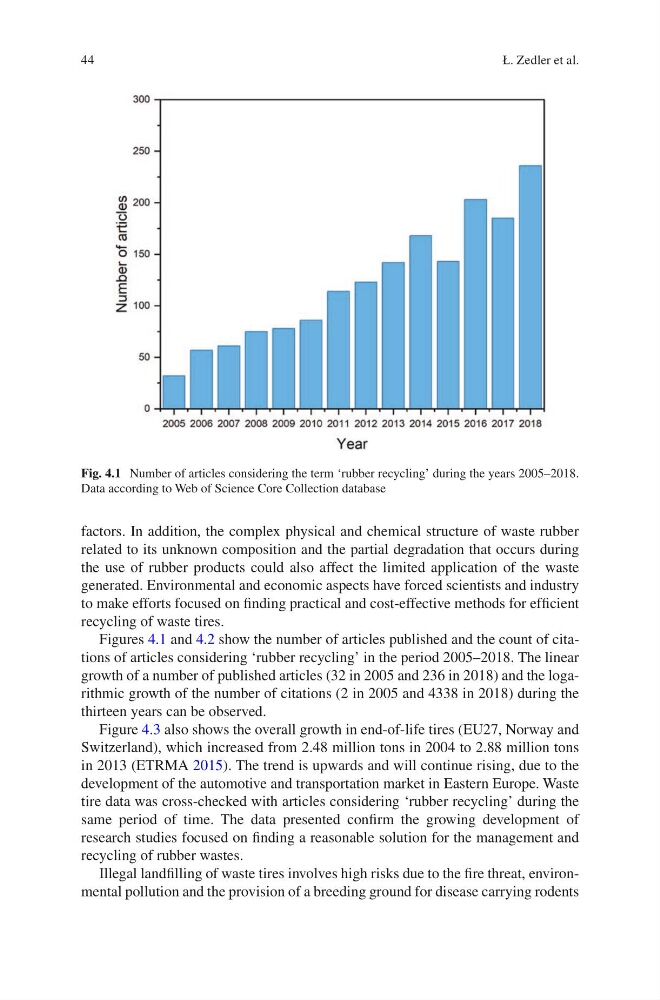
Figures 4.1 and 4.2 show the number of articles published and the count of citations of articles considering ‘rubber recycling’ in the period 2005–2018. The linear
growth of a number of published articles (32 in 2005 and 236 in 2018) and the logarithmic growth of the number of citations (2 in 2005 and 4338 in 2018) during the
thirteen years can be observed.
Figure 4.3 also shows the overall growth in end-of-life tires (EU27, Norway and
Switzerland), which increased from 2.48 million tons in 2004 to 2.88 million tons
in 2013 (ETRMA 2015). The trend is upwards and will continue rising, due to the
development of the automotive and transportation market in Eastern Europe. Waste
tire data was cross-checked with articles considering ‘rubber recycling’ during the
same period of time. The data presented confirm the growing development of
research studies focused on finding a reasonable solution for the management and
recycling of rubber wastes.
Illegal landfilling of waste tires involves high risks due to the fire threat, environmental pollution and the provision of a breeding ground for disease carrying rodents
Fig. 4.1 Number of articles considering the term ‘rubber recycling’ during the years 2005–2018.
Data according to Web of Science Core Collection database
Ł. Zedler et al.
factors. In addition, the complex physical and chemical structure of waste rubber
related to its unknown composition and the partial degradation that occurs during
the use of rubber products could also affect the limited application of the waste
generated. Environmental and economic aspects have forced scientists and industry
to make efforts focused on finding practical and cost-effective methods for efficient
recycling of waste tires.
Figures 4.1 and 4.2 show the number of articles published and the count of citations of articles considering ‘rubber recycling’ in the period 2005–2018. The linear
growth of a number of published articles (32 in 2005 and 236 in 2018) and the logarithmic growth of the number of citations (2 in 2005 and 4338 in 2018) during the
thirteen years can be observed.
Figure 4.3 also shows the overall growth in end-of-life tires (EU27, Norway and
Switzerland), which increased from 2.48 million tons in 2004 to 2.88 million tons
in 2013 (ETRMA 2015). The trend is upwards and will continue rising, due to the
development of the automotive and transportation market in Eastern Europe. Waste
tire data was cross-checked with articles considering ‘rubber recycling’ during the
same period of time. The data presented confirm the growing development of
research studies focused on finding a reasonable solution for the management and
recycling of rubber wastes.
Illegal landfilling of waste tires involves high risks due to the fire threat, environmental pollution and the provision of a breeding ground for disease carrying rodents
Fig. 4.1 Number of articles considering the term ‘rubber recycling’ during the years 2005–2018.
Data according to Web of Science Core Collection database
Ł. Zedler et al.