

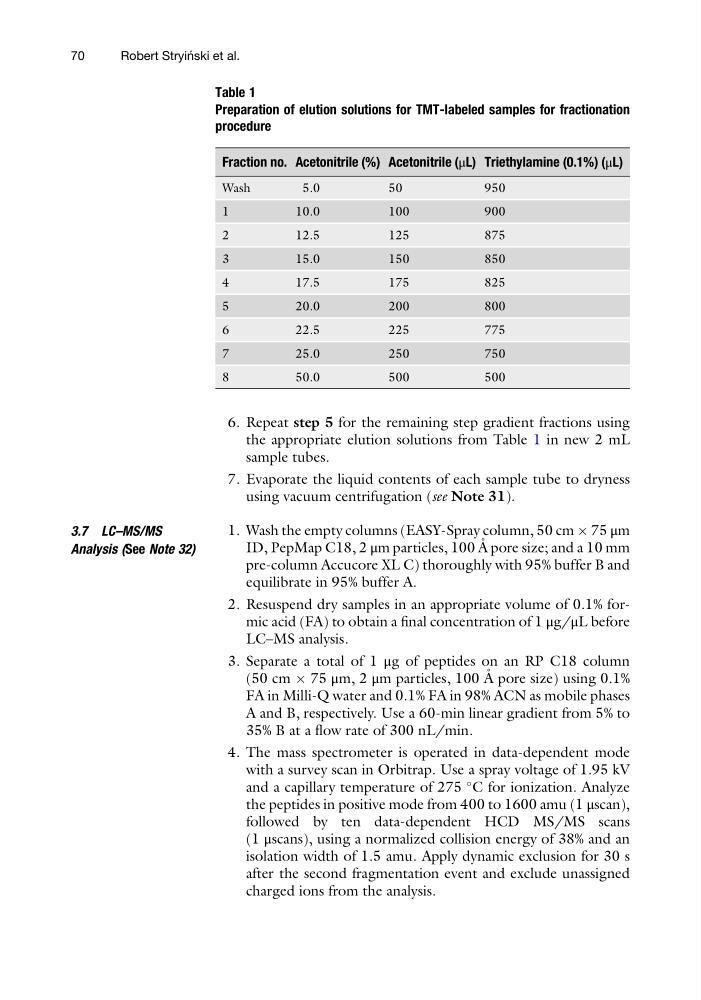
6. Repeat step 5 for the remaining step gradient fractions using
the appropriate elution solutions from Table 1 in new 2 mL
sample tubes.
7. Evaporate the liquid contents of each sample tube to dryness
using vacuum centrifugation (see Note 31).
3.7 LC–MS/MS
Analysis (See Note 32)
1. Wash the empty columns (EASY-Spray column, 50 cm  75 μm
ID, PepMap C18, 2 μm particles, 100 A ˚ pore size; and a 10 mm
pre-column Accucore XL C) thoroughly with 95% buffer B and
equilibrate in 95% buffer A.
2. Resuspend dry samples in an appropriate volume of 0.1% formic acid (FA) to obtain a final concentration of 1 μg/μL before
LC–MS analysis.
3. Separate a total of 1 μg of peptides on an RP C18 column
(50 cm  75 μm, 2 μm particles, 100 A ˚ pore size) using 0.1%
FA in Milli-Q water and 0.1% FA in 98% ACN as mobile phases
A and B, respectively. Use a 60-min linear gradient from 5% to
35% B at a flow rate of 300 nL/min.
4. The mass spectrometer is operated in data-dependent mode
with a survey scan in Orbitrap. Use a spray voltage of 1.95 kV
and a capillary temperature of 275
C for ionization. Analyze
the peptides in positive mode from 400 to 1600 amu (1 μscan),
followed by ten data-dependent HCD MS/MS scans
(1 μscans), using a normalized collision energy of 38% and an
isolation width of 1.5 amu. Apply dynamic exclusion for 30 s
after the second fragmentation event and exclude unassigned
charged ions from the analysis.
Table 1
Preparation of elution solutions for TMT-labeled samples for fractionation
procedure
Fraction no. Acetonitrile (%) Acetonitrile (μL) Triethylamine (0.1%) (μL)
Wash
5.0
50
950
1
10.0
100
900
2
12.5
125
875
3
15.0
150
850
4
17.5
175
825
5
20.0
200
800
6
22.5
225
775
7
25.0
250
750
8
50.0
500
500
70
Robert Stryin ´ ski et al.
the appropriate elution solutions from Table 1 in new 2 mL
sample tubes.
7. Evaporate the liquid contents of each sample tube to dryness
using vacuum centrifugation (see Note 31).
3.7 LC–MS/MS
Analysis (See Note 32)
1. Wash the empty columns (EASY-Spray column, 50 cm  75 μm
ID, PepMap C18, 2 μm particles, 100 A ˚ pore size; and a 10 mm
pre-column Accucore XL C) thoroughly with 95% buffer B and
equilibrate in 95% buffer A.
2. Resuspend dry samples in an appropriate volume of 0.1% formic acid (FA) to obtain a final concentration of 1 μg/μL before
LC–MS analysis.
3. Separate a total of 1 μg of peptides on an RP C18 column
(50 cm  75 μm, 2 μm particles, 100 A ˚ pore size) using 0.1%
FA in Milli-Q water and 0.1% FA in 98% ACN as mobile phases
A and B, respectively. Use a 60-min linear gradient from 5% to
35% B at a flow rate of 300 nL/min.
4. The mass spectrometer is operated in data-dependent mode
with a survey scan in Orbitrap. Use a spray voltage of 1.95 kV
and a capillary temperature of 275
C for ionization. Analyze
the peptides in positive mode from 400 to 1600 amu (1 μscan),
followed by ten data-dependent HCD MS/MS scans
(1 μscans), using a normalized collision energy of 38% and an
isolation width of 1.5 amu. Apply dynamic exclusion for 30 s
after the second fragmentation event and exclude unassigned
charged ions from the analysis.
Table 1
Preparation of elution solutions for TMT-labeled samples for fractionation
procedure
Fraction no. Acetonitrile (%) Acetonitrile (μL) Triethylamine (0.1%) (μL)
Wash
5.0
50
950
1
10.0
100
900
2
12.5
125
875
3
15.0
150
850
4
17.5
175
825
5
20.0
200
800
6
22.5
225
775
7
25.0
250
750
8
50.0
500
500
70
Robert Stryin ´ ski et al.