

of Tris and transfer to the beaker, add water to a volume of
900 mL, and mix with a the magnetic stir bar till it dissolves.
Add 5 mM sodium ascorbate (1 g) and mix till it dissolves.
Adjust pH with acetic acid. Add 2 mM CaCl 2 and 0.2 M KCl
(peach) or 0.5 M KCl (apricot) and mix. Make up to 1 L with
water. Keep it at 4
C for no longer than 2 weeks [13].
10. Several methods can be used to assess the cytosolic contamination of apoplast extracts. The activity of cellular enzymes such
as malate dehydrogenase or Glc-6-phosphate dehydrogenase
are commonly used [11, 13–15]. Also, nonenzymatic tests
such as ion conductivity and confocal microscopy of propidium
iodide (PI)-stained cells were already described and shown to
be highly sensitive to determine cellular integrity [16].
Acknowledgments
We would like to thank Msc. Joana Figueiredo and Msc. Ana Rita
Cavaco for their work in developing and testing this protocol on
grapevine leaves. We acknowledge the Portuguese Foundation for
Science and Technology (FCT, Portugal) for the funded support of
the Research Units, BioISI (UIDB/04046/2020 and UIDP/
04046/2020) and LEAF (UID/AGR/04129/2019), and of the
project PTDC/BIABQM/28539/2017. Andreia Figueiredo was
also supported by the investigator FCT program IF/00819/2015.
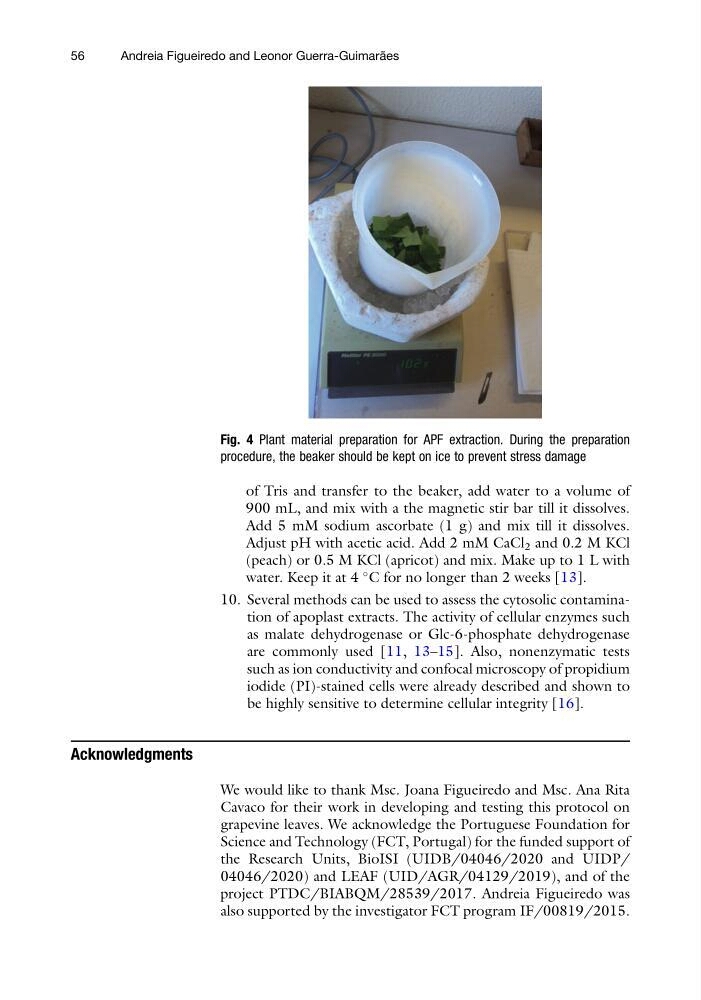
Fig. 4 Plant material preparation for APF extraction. During the preparation
procedure, the beaker should be kept on ice to prevent stress damage
56
Andreia Figueiredo and Leonor Guerra-Guimara ˜ es
900 mL, and mix with a the magnetic stir bar till it dissolves.
Add 5 mM sodium ascorbate (1 g) and mix till it dissolves.
Adjust pH with acetic acid. Add 2 mM CaCl 2 and 0.2 M KCl
(peach) or 0.5 M KCl (apricot) and mix. Make up to 1 L with
water. Keep it at 4
C for no longer than 2 weeks [13].
10. Several methods can be used to assess the cytosolic contamination of apoplast extracts. The activity of cellular enzymes such
as malate dehydrogenase or Glc-6-phosphate dehydrogenase
are commonly used [11, 13–15]. Also, nonenzymatic tests
such as ion conductivity and confocal microscopy of propidium
iodide (PI)-stained cells were already described and shown to
be highly sensitive to determine cellular integrity [16].
Acknowledgments
We would like to thank Msc. Joana Figueiredo and Msc. Ana Rita
Cavaco for their work in developing and testing this protocol on
grapevine leaves. We acknowledge the Portuguese Foundation for
Science and Technology (FCT, Portugal) for the funded support of
the Research Units, BioISI (UIDB/04046/2020 and UIDP/
04046/2020) and LEAF (UID/AGR/04129/2019), and of the
project PTDC/BIABQM/28539/2017. Andreia Figueiredo was
also supported by the investigator FCT program IF/00819/2015.
Fig. 4 Plant material preparation for APF extraction. During the preparation
procedure, the beaker should be kept on ice to prevent stress damage
56
Andreia Figueiredo and Leonor Guerra-Guimara ˜ es