

(IPEGAL
® ) detergent, 0.4 mM Na 3 VO 4 , 1 mM PMSF, 1Â
Protease Inhibitor Cocktail) with ratio of 20 Â 10
6 cells to
1 mL of lysis buffer.
2. Gently pipette to mechanically lyse the cells. Avoid the formation of foam.
OPTIONAL: In case the complexes of interest are DNA or
RNA bound, we recommend to apply a nuclease (e.g., Benzonase), to extract chromatin bound complexes [27] (see
Note 3).
3.3 SEC Sample
Preparation
1. Cell debris which can lead to clogging of the SEC column are
removed by ultracentrifugation. Transfer the lysate to thickwall
polycarbonate tubes and balance Æ10 mg, and clarify lysate by
ultracentrifugation at 100,000 Â g for 15 min in a precooled
ultracentrifuge at 4
C.
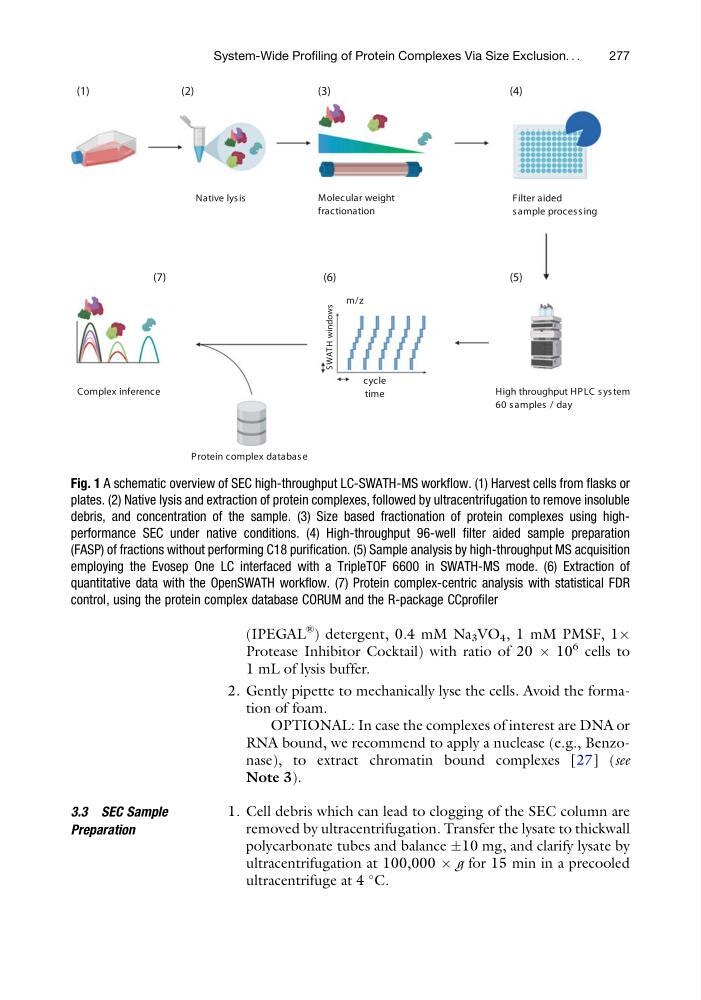
Fig. 1 A schematic overview of SEC high-throughput LC-SWATH-MS workflow. (1) Harvest cells from flasks or
plates. (2) Native lysis and extraction of protein complexes, followed by ultracentrifugation to remove insoluble
debris, and concentration of the sample. (3) Size based fractionation of protein complexes using highperformance SEC under native conditions. (4) High-throughput 96-well filter aided sample preparation
(FASP) of fractions without performing C18 purification. (5) Sample analysis by high-throughput MS acquisition
employing the Evosep One LC interfaced with a TripleTOF 6600 in SWATH-MS mode. (6) Extraction of
quantitative data with the OpenSWATH workflow. (7) Protein complex-centric analysis with statistical FDR
control, using the protein complex database CORUM and the R-package CCprofiler
System-Wide Profiling of Protein Complexes Via Size Exclusion. . .
277
® ) detergent, 0.4 mM Na 3 VO 4 , 1 mM PMSF, 1Â
Protease Inhibitor Cocktail) with ratio of 20 Â 10
6 cells to
1 mL of lysis buffer.
2. Gently pipette to mechanically lyse the cells. Avoid the formation of foam.
OPTIONAL: In case the complexes of interest are DNA or
RNA bound, we recommend to apply a nuclease (e.g., Benzonase), to extract chromatin bound complexes [27] (see
Note 3).
3.3 SEC Sample
Preparation
1. Cell debris which can lead to clogging of the SEC column are
removed by ultracentrifugation. Transfer the lysate to thickwall
polycarbonate tubes and balance Æ10 mg, and clarify lysate by
ultracentrifugation at 100,000 Â g for 15 min in a precooled
ultracentrifuge at 4
C.
Fig. 1 A schematic overview of SEC high-throughput LC-SWATH-MS workflow. (1) Harvest cells from flasks or
plates. (2) Native lysis and extraction of protein complexes, followed by ultracentrifugation to remove insoluble
debris, and concentration of the sample. (3) Size based fractionation of protein complexes using highperformance SEC under native conditions. (4) High-throughput 96-well filter aided sample preparation
(FASP) of fractions without performing C18 purification. (5) Sample analysis by high-throughput MS acquisition
employing the Evosep One LC interfaced with a TripleTOF 6600 in SWATH-MS mode. (6) Extraction of
quantitative data with the OpenSWATH workflow. (7) Protein complex-centric analysis with statistical FDR
control, using the protein complex database CORUM and the R-package CCprofiler
System-Wide Profiling of Protein Complexes Via Size Exclusion. . .
277