

3. Different LC-MS instruments from different commercial
brands may require specific parameters for peptide ionization
and fragmentation.
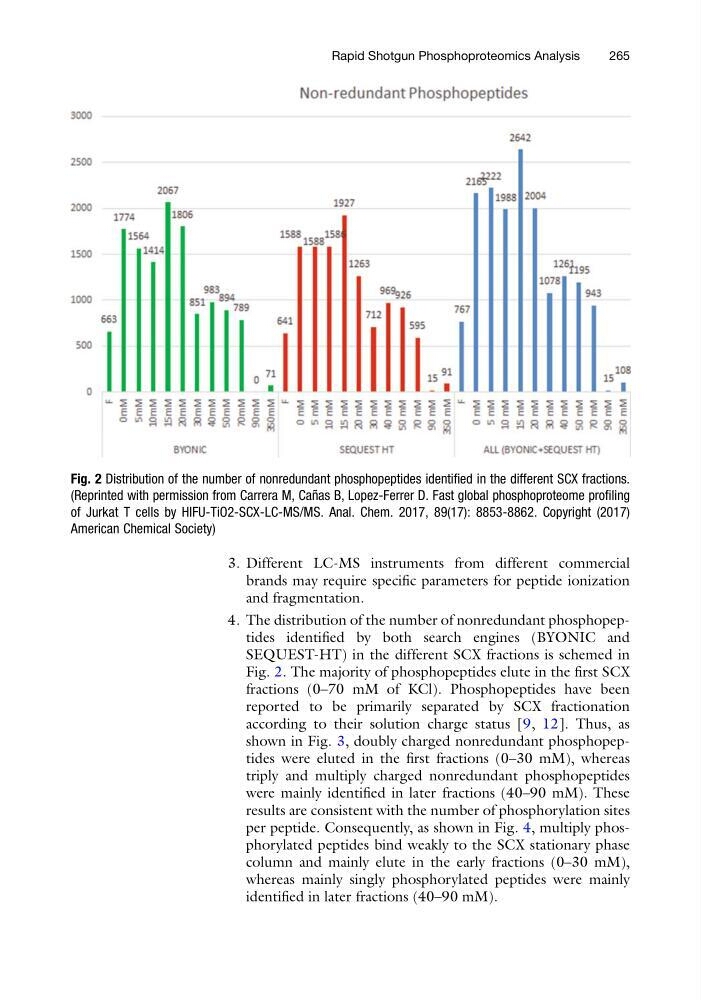
4. The distribution of the number of nonredundant phosphopeptides identified by both search engines (BYONIC and
SEQUEST-HT) in the different SCX fractions is schemed in
Fig. 2. The majority of phosphopeptides elute in the first SCX
fractions (0–70 mM of KCl). Phosphopeptides have been
reported to be primarily separated by SCX fractionation
according to their solution charge status [9, 12]. Thus, as
shown in Fig. 3, doubly charged nonredundant phosphopeptides were eluted in the first fractions (0–30 mM), whereas
triply and multiply charged nonredundant phosphopeptides
were mainly identified in later fractions (40–90 mM). These
results are consistent with the number of phosphorylation sites
per peptide. Consequently, as shown in Fig. 4, multiply phosphorylated peptides bind weakly to the SCX stationary phase
column and mainly elute in the early fractions (0–30 mM),
whereas mainly singly phosphorylated peptides were mainly
identified in later fractions (40–90 mM).
Fig. 2 Distribution of the number of nonredundant phosphopeptides identified in the different SCX fractions.
(Reprinted with permission from Carrera M, Can ˜ as B, Lopez-Ferrer D. Fast global phosphoproteome profiling
of Jurkat T cells by HIFU-TiO2-SCX-LC-MS/MS. Anal. Chem. 2017, 89(17): 8853-8862. Copyright (2017)
American Chemical Society)
Rapid Shotgun Phosphoproteomics Analysis
265
brands may require specific parameters for peptide ionization
and fragmentation.
4. The distribution of the number of nonredundant phosphopeptides identified by both search engines (BYONIC and
SEQUEST-HT) in the different SCX fractions is schemed in
Fig. 2. The majority of phosphopeptides elute in the first SCX
fractions (0–70 mM of KCl). Phosphopeptides have been
reported to be primarily separated by SCX fractionation
according to their solution charge status [9, 12]. Thus, as
shown in Fig. 3, doubly charged nonredundant phosphopeptides were eluted in the first fractions (0–30 mM), whereas
triply and multiply charged nonredundant phosphopeptides
were mainly identified in later fractions (40–90 mM). These
results are consistent with the number of phosphorylation sites
per peptide. Consequently, as shown in Fig. 4, multiply phosphorylated peptides bind weakly to the SCX stationary phase
column and mainly elute in the early fractions (0–30 mM),
whereas mainly singly phosphorylated peptides were mainly
identified in later fractions (40–90 mM).
Fig. 2 Distribution of the number of nonredundant phosphopeptides identified in the different SCX fractions.
(Reprinted with permission from Carrera M, Can ˜ as B, Lopez-Ferrer D. Fast global phosphoproteome profiling
of Jurkat T cells by HIFU-TiO2-SCX-LC-MS/MS. Anal. Chem. 2017, 89(17): 8853-8862. Copyright (2017)
American Chemical Society)
Rapid Shotgun Phosphoproteomics Analysis
265