

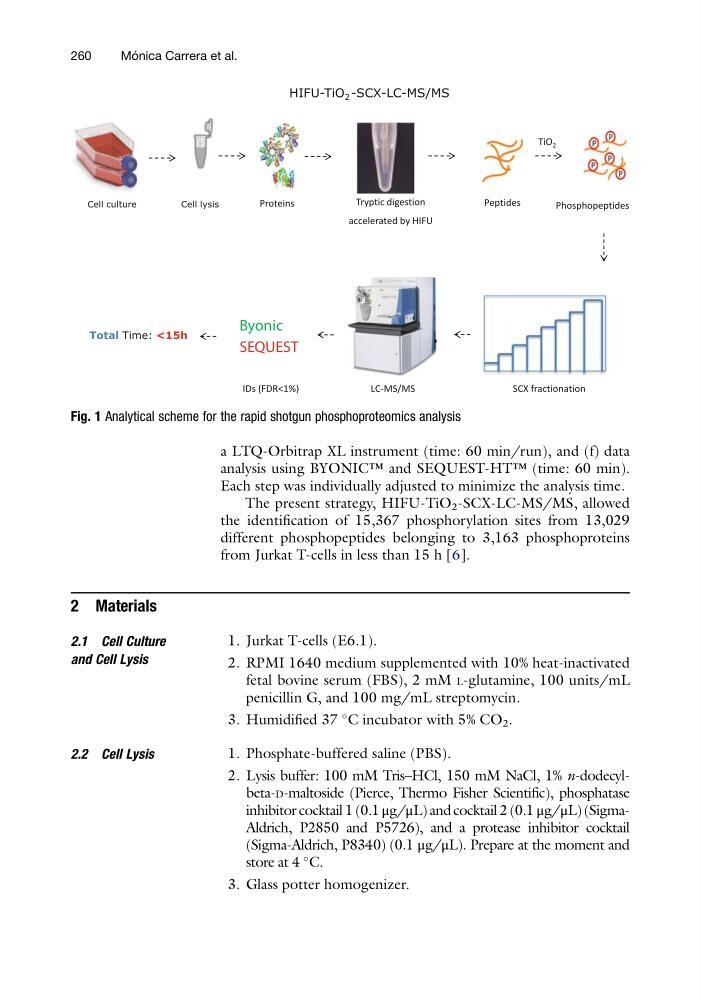
a LTQ-Orbitrap XL instrument (time: 60 min/run), and (f) data
analysis using BYONIC™ and SEQUEST-HT™ (time: 60 min).
Each step was individually adjusted to minimize the analysis time.
The present strategy, HIFU-TiO 2 -SCX-LC-MS/MS, allowed
the identification of 15,367 phosphorylation sites from 13,029
different phosphopeptides belonging to 3,163 phosphoproteins
from Jurkat T-cells in less than 15 h [6].
2 Materials
2.1 Cell Culture
and Cell Lysis
1. Jurkat T-cells (E6.1).
2. RPMI 1640 medium supplemented with 10% heat-inactivated
fetal bovine serum (FBS), 2 mM L-glutamine, 100 units/mL
penicillin G, and 100 mg/mL streptomycin.
3. Humidified 37
C incubator with 5% CO 2 .
2.2 Cell Lysis
1. Phosphate-buffered saline (PBS).
2. Lysis buffer: 100 mM Tris–HCl, 150 mM NaCl, 1% n-dodecylbeta-D-maltoside (Pierce, Thermo Fisher Scientific), phosphatase
inhibitor cocktail 1 (0.1 μg/μL) and cocktail 2 (0.1 μg/μL) (SigmaAldrich, P2850 and P5726), and a protease inhibitor cocktail
(Sigma-Aldrich, P8340) (0.1 μg/μL). Prepare at the moment and
store at 4
C.
3. Glass potter homogenizer.
Cell lysis
HIFU-TiO 2 -SCX-LC-MS/MS
Proteins
Cell culture
Peptides
Tryptic digestion
accelerated by HIFU
Phosphopeptides
TiO 2
LC-MS/MS
IDs (FDR<1%)
SCX fractionation
Total Time: <15h
Byonic
SEQUEST
Fig. 1 Analytical scheme for the rapid shotgun phosphoproteomics analysis
260
Mo ´ nica Carrera et al.
analysis using BYONIC™ and SEQUEST-HT™ (time: 60 min).
Each step was individually adjusted to minimize the analysis time.
The present strategy, HIFU-TiO 2 -SCX-LC-MS/MS, allowed
the identification of 15,367 phosphorylation sites from 13,029
different phosphopeptides belonging to 3,163 phosphoproteins
from Jurkat T-cells in less than 15 h [6].
2 Materials
2.1 Cell Culture
and Cell Lysis
1. Jurkat T-cells (E6.1).
2. RPMI 1640 medium supplemented with 10% heat-inactivated
fetal bovine serum (FBS), 2 mM L-glutamine, 100 units/mL
penicillin G, and 100 mg/mL streptomycin.
3. Humidified 37
C incubator with 5% CO 2 .
2.2 Cell Lysis
1. Phosphate-buffered saline (PBS).
2. Lysis buffer: 100 mM Tris–HCl, 150 mM NaCl, 1% n-dodecylbeta-D-maltoside (Pierce, Thermo Fisher Scientific), phosphatase
inhibitor cocktail 1 (0.1 μg/μL) and cocktail 2 (0.1 μg/μL) (SigmaAldrich, P2850 and P5726), and a protease inhibitor cocktail
(Sigma-Aldrich, P8340) (0.1 μg/μL). Prepare at the moment and
store at 4
C.
3. Glass potter homogenizer.
Cell lysis
HIFU-TiO 2 -SCX-LC-MS/MS
Proteins
Cell culture
Peptides
Tryptic digestion
accelerated by HIFU
Phosphopeptides
TiO 2
LC-MS/MS
IDs (FDR<1%)
SCX fractionation
Total Time: <15h
Byonic
SEQUEST
Fig. 1 Analytical scheme for the rapid shotgun phosphoproteomics analysis
260
Mo ´ nica Carrera et al.