

normalized collision energy and an isolation width of 2 Da.
Former target ions were excluded for 30 s (see Note 73).
9. Identify carbonylated protein by using PEAKS DB software or
similar (see Note 74).
4 Notes
1. We use ProteoBlock™ Protease Inhibitor Cocktail (Thermo
Fisher Scientific Inc.), which comprised a mixture of 100 mM
4-(2-aminoethyl)benzenesulfonyl fluoride (AEBSF), 80 mM
aprotinin, 5 mM bestatin, 1.5 mM E64, 2 mM leupeptin, and
1 mM pepstatin. Any other similar protease inhibitor cocktail
could be used instead.
2. Check the pH of the solution and adjust if necessary.
3. The volume gap is to allow for the addition of
concentrated HCl.
4. Protein extractions can be alternatively done by using an ultrasonic probe (sonicator).
5. Other methods for protein quantification such as the bicinchoninic acid assay (BCA) may be also used.
6. This PB buffer is the same PB buffer described for the extraction of proteins soluble at low ionic strength.
7. Prepare just before using. Cover the tube (normally a
0.2–0.5 mL microtube) with aluminum foil because FTSC
itself and all solutions made with it should be protected from
light to avoid decomposition of its fluorescent properties.
8. Use carrier ampholytes that span the pH range of the IPG strip
selected.
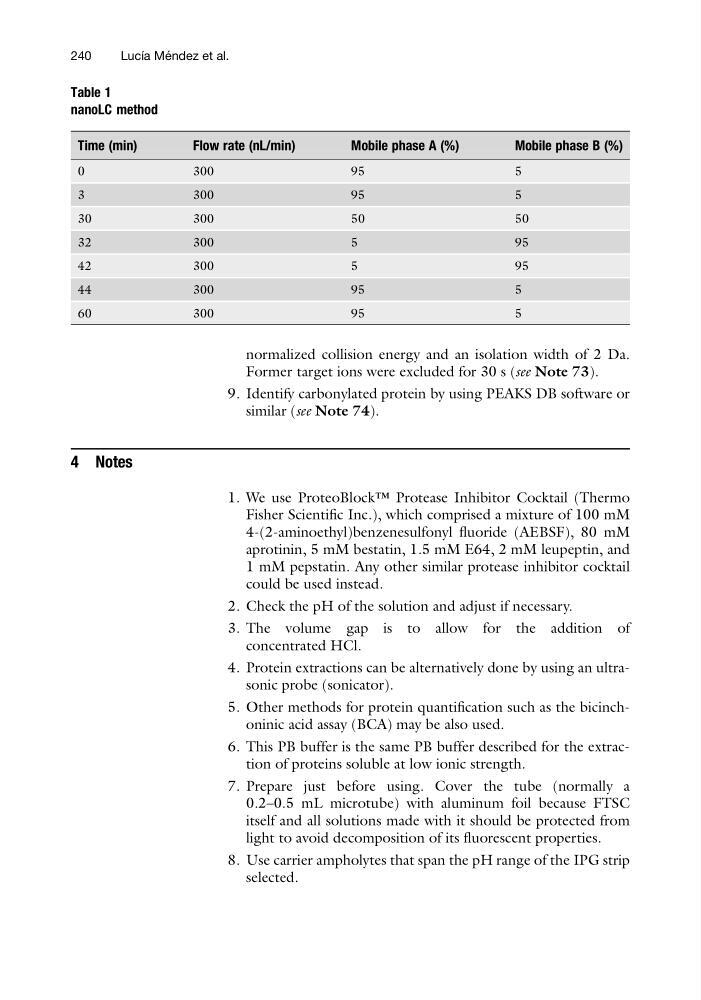
Table 1
nanoLC method
Time (min)
Flow rate (nL/min)
Mobile phase A (%)
Mobile phase B (%)
0
300
95
5
3
300
95
5
30
300
50
50
32
300
5
95
42
300
5
95
44
300
95
5
60
300
95
5
240
Lucı ´a Me ´ ndez et al.
Former target ions were excluded for 30 s (see Note 73).
9. Identify carbonylated protein by using PEAKS DB software or
similar (see Note 74).
4 Notes
1. We use ProteoBlock™ Protease Inhibitor Cocktail (Thermo
Fisher Scientific Inc.), which comprised a mixture of 100 mM
4-(2-aminoethyl)benzenesulfonyl fluoride (AEBSF), 80 mM
aprotinin, 5 mM bestatin, 1.5 mM E64, 2 mM leupeptin, and
1 mM pepstatin. Any other similar protease inhibitor cocktail
could be used instead.
2. Check the pH of the solution and adjust if necessary.
3. The volume gap is to allow for the addition of
concentrated HCl.
4. Protein extractions can be alternatively done by using an ultrasonic probe (sonicator).
5. Other methods for protein quantification such as the bicinchoninic acid assay (BCA) may be also used.
6. This PB buffer is the same PB buffer described for the extraction of proteins soluble at low ionic strength.
7. Prepare just before using. Cover the tube (normally a
0.2–0.5 mL microtube) with aluminum foil because FTSC
itself and all solutions made with it should be protected from
light to avoid decomposition of its fluorescent properties.
8. Use carrier ampholytes that span the pH range of the IPG strip
selected.
Table 1
nanoLC method
Time (min)
Flow rate (nL/min)
Mobile phase A (%)
Mobile phase B (%)
0
300
95
5
3
300
95
5
30
300
50
50
32
300
5
95
42
300
5
95
44
300
95
5
60
300
95
5
240
Lucı ´a Me ´ ndez et al.