

named HDMS
E acquisition [20–22]. Ion mobility spectrometry is
based on the separation of ions according their shape and size,
using their drift time (dt), as they cross the gas chamber at different
rates. Thus, as the ions move through a gas ion optics chamber
under positive pressure and an electric field, their mobility will not
only depend on their mass-to-charge ratio but also on the conformation of the ions, as molecules with a larger surface area will
interact and lose kinetic energy, then moving slowly through the
gas chamber [23, 24].
Although the HDMS
E method present advantages relative to
the amount of identified peptides, some precursor ions may remain
unfragmented, since the collision energy increases linearly during
the high collision energy phase. Thus, the adjustment of collision
energy parameters to an optimum nonlinear gradient of energy to a
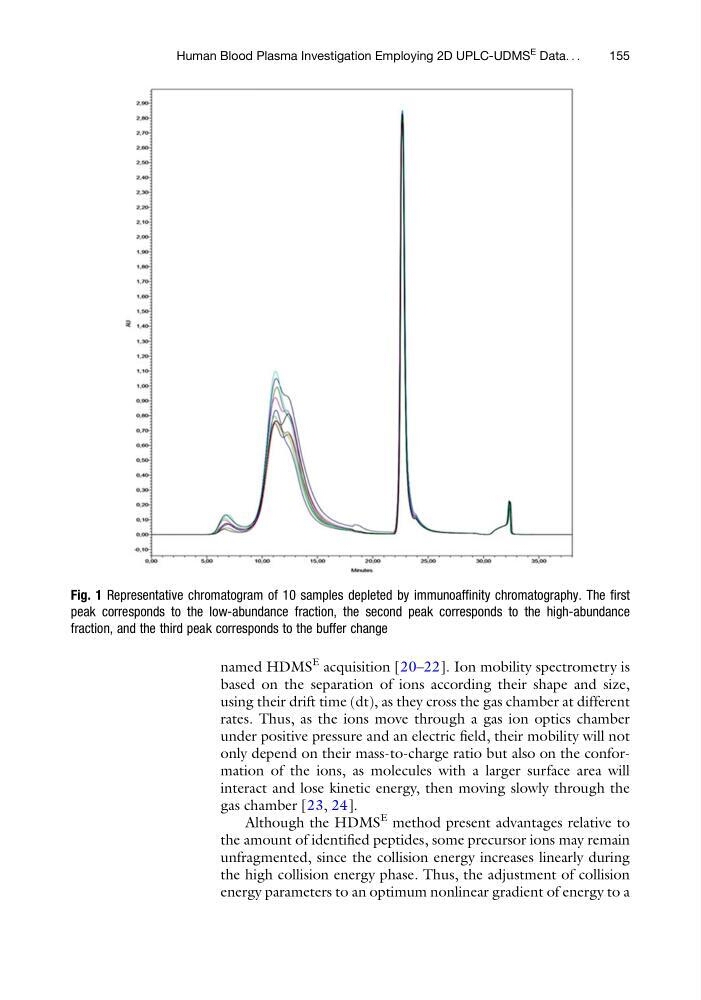
Fig. 1 Representative chromatogram of 10 samples depleted by immunoaffinity chromatography. The first
peak corresponds to the low-abundance fraction, the second peak corresponds to the high-abundance
fraction, and the third peak corresponds to the buffer change
Human Blood Plasma Investigation Employing 2D UPLC-UDMS
E Data. . .
155
E acquisition [20–22]. Ion mobility spectrometry is
based on the separation of ions according their shape and size,
using their drift time (dt), as they cross the gas chamber at different
rates. Thus, as the ions move through a gas ion optics chamber
under positive pressure and an electric field, their mobility will not
only depend on their mass-to-charge ratio but also on the conformation of the ions, as molecules with a larger surface area will
interact and lose kinetic energy, then moving slowly through the
gas chamber [23, 24].
Although the HDMS
E method present advantages relative to
the amount of identified peptides, some precursor ions may remain
unfragmented, since the collision energy increases linearly during
the high collision energy phase. Thus, the adjustment of collision
energy parameters to an optimum nonlinear gradient of energy to a
Fig. 1 Representative chromatogram of 10 samples depleted by immunoaffinity chromatography. The first
peak corresponds to the low-abundance fraction, the second peak corresponds to the high-abundance
fraction, and the third peak corresponds to the buffer change
Human Blood Plasma Investigation Employing 2D UPLC-UDMS
E Data. . .
155