

Moreover, it is important to note that (1) differences in the
sample matrix, (2) chromatographic characteristics, (3) time of
sample acquisitions, and other factors can contribute to modified
chromatographic alignment. It implies the need to calibrate and
normalize all the peptides present in the library through retention
time, in our case. In SWATH-MS/DIA-MS data analysis, commonly retention time of several peptides from the library file is
used to perform a peptide retention time (RT) calibration
[25, 121]. It can be considered as scoring of the confidence for
the assignment of a given peak group to a peptide sequence from
the library. Other authors can use an internal peptide retention time
(RT) standards that must be detectable across all the individual
samples and all along with the chromatogram duration.
Finally, it is important to mention that if a greater number of
individual samples are analyzed, it is necessary to have a carefully
executed quality control, such as randomized control samples to
minimize the possible bias of the sample analysis.
3.6.2 Spectral Library
Building and Data
Generation [119, 120, 122]
Spectral ion libraries are most commonly generated using traditional shotgun analysis in DDA/IDA mode. In some cases, it is
possible to use spectral ion libraries previously generated that were
available in public repositories loaded by some labs [123–127]; see
also Table 3 in Anjo et al. [1]. In this chapter, it is shown how it is
possible to create new spectral ion libraries from DDA/IDA analysis from proteolytic digestions of different biological samples. A lot
of information about the spectral ion libraries generation is found
in Schubert et al. [126].
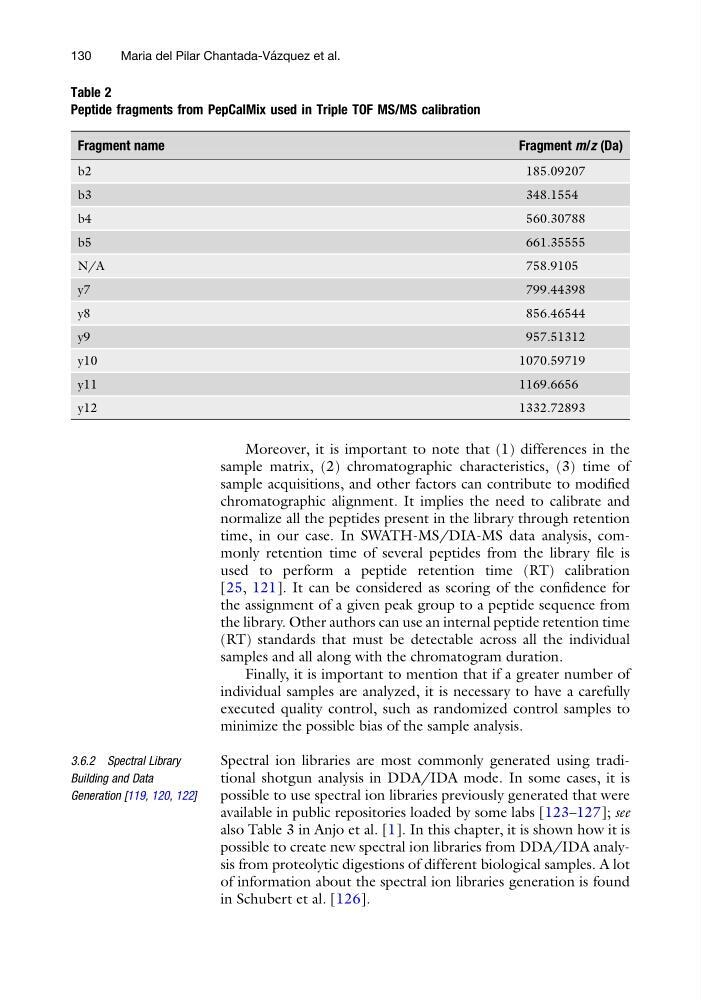
Table 2
Peptide fragments from PepCalMix used in Triple TOF MS/MS calibration
Fragment name
Fragment m/z (Da)
b2
185.09207
b3
348.1554
b4
560.30788
b5
661.35555
N/A
758.9105
y7
799.44398
y8
856.46544
y9
957.51312
y10
1070.59719
y11
1169.6656
y12
1332.72893
130
Maria del Pilar Chantada-Va ´ zquez et al.
sample matrix, (2) chromatographic characteristics, (3) time of
sample acquisitions, and other factors can contribute to modified
chromatographic alignment. It implies the need to calibrate and
normalize all the peptides present in the library through retention
time, in our case. In SWATH-MS/DIA-MS data analysis, commonly retention time of several peptides from the library file is
used to perform a peptide retention time (RT) calibration
[25, 121]. It can be considered as scoring of the confidence for
the assignment of a given peak group to a peptide sequence from
the library. Other authors can use an internal peptide retention time
(RT) standards that must be detectable across all the individual
samples and all along with the chromatogram duration.
Finally, it is important to mention that if a greater number of
individual samples are analyzed, it is necessary to have a carefully
executed quality control, such as randomized control samples to
minimize the possible bias of the sample analysis.
3.6.2 Spectral Library
Building and Data
Generation [119, 120, 122]
Spectral ion libraries are most commonly generated using traditional shotgun analysis in DDA/IDA mode. In some cases, it is
possible to use spectral ion libraries previously generated that were
available in public repositories loaded by some labs [123–127]; see
also Table 3 in Anjo et al. [1]. In this chapter, it is shown how it is
possible to create new spectral ion libraries from DDA/IDA analysis from proteolytic digestions of different biological samples. A lot
of information about the spectral ion libraries generation is found
in Schubert et al. [126].
Table 2
Peptide fragments from PepCalMix used in Triple TOF MS/MS calibration
Fragment name
Fragment m/z (Da)
b2
185.09207
b3
348.1554
b4
560.30788
b5
661.35555
N/A
758.9105
y7
799.44398
y8
856.46544
y9
957.51312
y10
1070.59719
y11
1169.6656
y12
1332.72893
130
Maria del Pilar Chantada-Va ´ zquez et al.