

Therefore, characterization of protein corona could allow the
detection of minor changes in protein concentration at the very
early stages of disease development or even after chemotherapy or
surgery (i.e., when an alteration in circulating level of proteins
could be undetectable by blood tests). Keeping in mind that each
disease is characterized by different plasma/serum proteomes,
inducing the formation of different PCs on the same nanomaterial,
Mahmoudi et al. introduced the novel concept of “personalized
protein corona” (PPC) [107]. More specifically, depending on the
type, period, and severity of the disease (which determines the
serum/plasma alterations), each patient may have a personalized
protein corona.
In recent years, noble metal NPs have gained great interest
because their diverse material properties hold promising potential
in advancing current diagnostic and therapeutic technologies [108–
110].
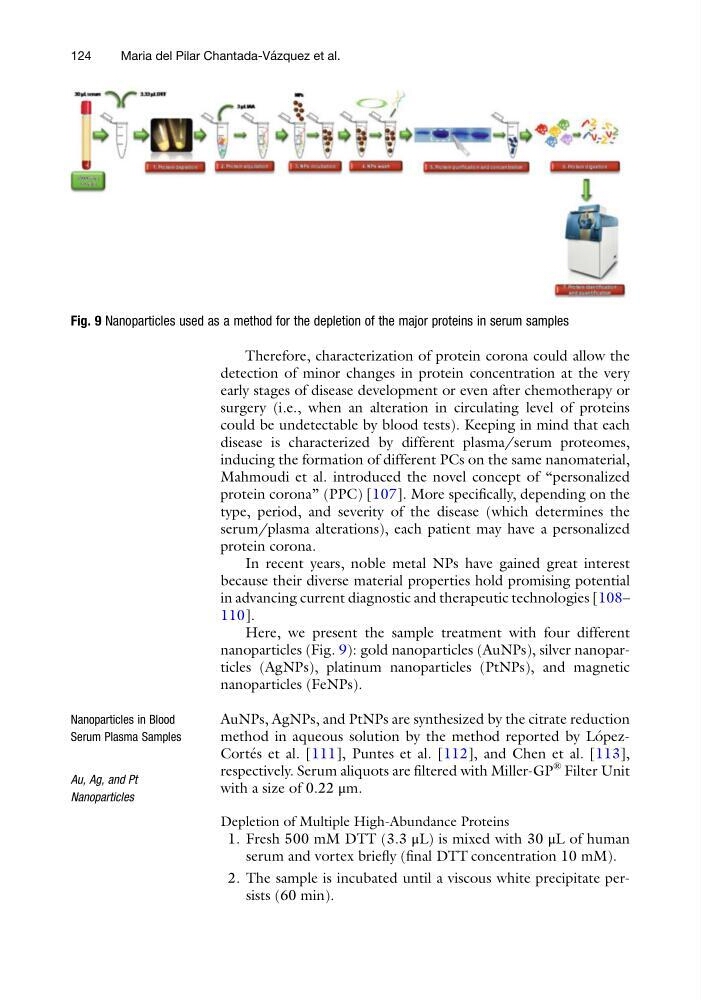
Here, we present the sample treatment with four different
nanoparticles (Fig. 9): gold nanoparticles (AuNPs), silver nanoparticles (AgNPs), platinum nanoparticles (PtNPs), and magnetic
nanoparticles (FeNPs).
Nanoparticles in Blood
Serum Plasma Samples
Au, Ag, and Pt
Nanoparticles
AuNPs, AgNPs, and PtNPs are synthesized by the citrate reduction
method in aqueous solution by the method reported by Lo ´ pezCorte ´s et al. [111], Puntes et al. [112], and Chen et al. [113],
respectively. Serum aliquots are filtered with Miller-GP
® Filter Unit
with a size of 0.22 μm.
Depletion of Multiple High-Abundance Proteins
1. Fresh 500 mM DTT (3.3 μL) is mixed with 30 μL of human
serum and vortex briefly (final DTT concentration 10 mM).
2. The sample is incubated until a viscous white precipitate persists (60 min).
Fig. 9 Nanoparticles used as a method for the depletion of the major proteins in serum samples
124
Maria del Pilar Chantada-Va ´ zquez et al.
detection of minor changes in protein concentration at the very
early stages of disease development or even after chemotherapy or
surgery (i.e., when an alteration in circulating level of proteins
could be undetectable by blood tests). Keeping in mind that each
disease is characterized by different plasma/serum proteomes,
inducing the formation of different PCs on the same nanomaterial,
Mahmoudi et al. introduced the novel concept of “personalized
protein corona” (PPC) [107]. More specifically, depending on the
type, period, and severity of the disease (which determines the
serum/plasma alterations), each patient may have a personalized
protein corona.
In recent years, noble metal NPs have gained great interest
because their diverse material properties hold promising potential
in advancing current diagnostic and therapeutic technologies [108–
110].
Here, we present the sample treatment with four different
nanoparticles (Fig. 9): gold nanoparticles (AuNPs), silver nanoparticles (AgNPs), platinum nanoparticles (PtNPs), and magnetic
nanoparticles (FeNPs).
Nanoparticles in Blood
Serum Plasma Samples
Au, Ag, and Pt
Nanoparticles
AuNPs, AgNPs, and PtNPs are synthesized by the citrate reduction
method in aqueous solution by the method reported by Lo ´ pezCorte ´s et al. [111], Puntes et al. [112], and Chen et al. [113],
respectively. Serum aliquots are filtered with Miller-GP
® Filter Unit
with a size of 0.22 μm.
Depletion of Multiple High-Abundance Proteins
1. Fresh 500 mM DTT (3.3 μL) is mixed with 30 μL of human
serum and vortex briefly (final DTT concentration 10 mM).
2. The sample is incubated until a viscous white precipitate persists (60 min).
Fig. 9 Nanoparticles used as a method for the depletion of the major proteins in serum samples
124
Maria del Pilar Chantada-Va ´ zquez et al.