

pathological conditions, the typical protein concentration
described of saliva is 0.7–2.4 mg/mL [33]. Saliva has been used
in numerous studies in the search for biomarkers in different
human pathologies and using different proteomics approaches; see
Table 3 from Cso ˝sz et al. [29].
Saliva Collection
Saliva is spat into a plastic tube with protease inhibitors (see Note
3). After collection, all samples are kept on ice and immediately
transported to the laboratory. The saliva samples are immediately
centrifuged at 16,128 Â g for 15 min at 4
C to remove all debris,
such as insoluble material, cell debris, and food debris. The supernatant from each sample is collected, treated with a protease inhibitor mixture, divided into smaller fractions (100 μL), and frozen at
À80
C until analysis [34, 35]. To know more about other sample
collection methods, see Tobari et al. [36].
In order to know the protein concentration, the protein quantification can be performed using RC DC™ Protein Assay using
bovine serum albumin (BSA) as standard (see Note 5).
Saliva Sample Preparation
100 μL of saliva (ca. 100 μg of protein) is precipitated for removing
DNA and RNA (and their fragments) and lipids. It can be made
using different techniques: (1) alcohol, (2) salting-out, (3) applying
strong acids (trichloroacetic acid), (4) using acetone, and (5) using
ACN, etc. [36, 37].
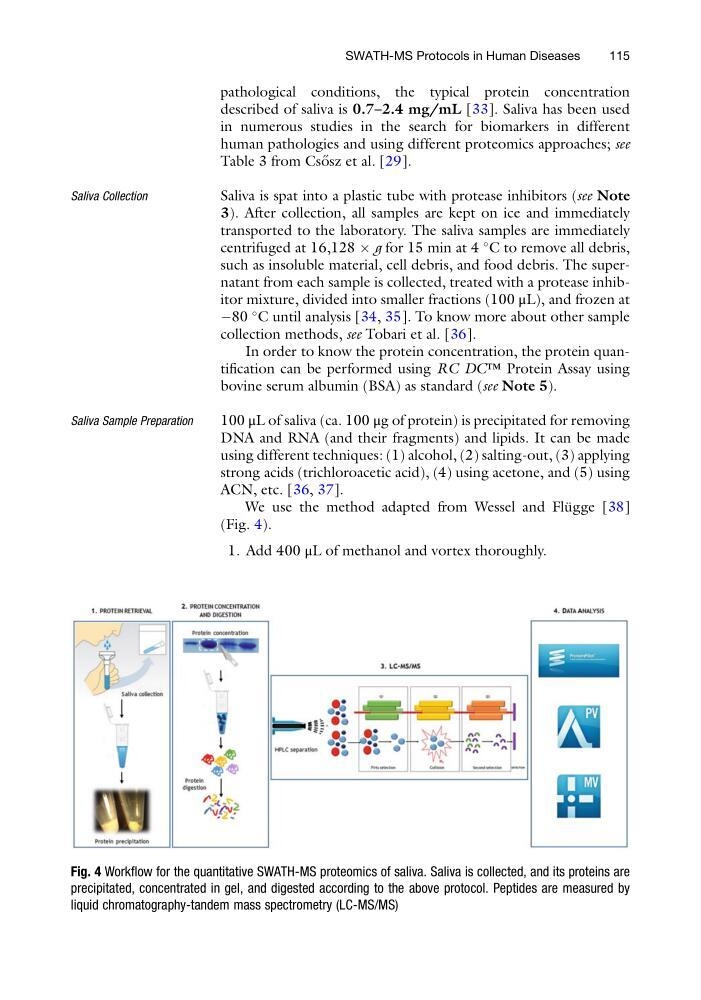
We use the method adapted from Wessel and Flu ¨gge [38]
(Fig. 4).
1. Add 400 μL of methanol and vortex thoroughly.
Fig. 4 Workflow for the quantitative SWATH-MS proteomics of saliva. Saliva is collected, and its proteins are
precipitated, concentrated in gel, and digested according to the above protocol. Peptides are measured by
liquid chromatography-tandem mass spectrometry (LC-MS/MS)
SWATH-MS Protocols in Human Diseases
115
described of saliva is 0.7–2.4 mg/mL [33]. Saliva has been used
in numerous studies in the search for biomarkers in different
human pathologies and using different proteomics approaches; see
Table 3 from Cso ˝sz et al. [29].
Saliva Collection
Saliva is spat into a plastic tube with protease inhibitors (see Note
3). After collection, all samples are kept on ice and immediately
transported to the laboratory. The saliva samples are immediately
centrifuged at 16,128 Â g for 15 min at 4
C to remove all debris,
such as insoluble material, cell debris, and food debris. The supernatant from each sample is collected, treated with a protease inhibitor mixture, divided into smaller fractions (100 μL), and frozen at
À80
C until analysis [34, 35]. To know more about other sample
collection methods, see Tobari et al. [36].
In order to know the protein concentration, the protein quantification can be performed using RC DC™ Protein Assay using
bovine serum albumin (BSA) as standard (see Note 5).
Saliva Sample Preparation
100 μL of saliva (ca. 100 μg of protein) is precipitated for removing
DNA and RNA (and their fragments) and lipids. It can be made
using different techniques: (1) alcohol, (2) salting-out, (3) applying
strong acids (trichloroacetic acid), (4) using acetone, and (5) using
ACN, etc. [36, 37].
We use the method adapted from Wessel and Flu ¨gge [38]
(Fig. 4).
1. Add 400 μL of methanol and vortex thoroughly.
Fig. 4 Workflow for the quantitative SWATH-MS proteomics of saliva. Saliva is collected, and its proteins are
precipitated, concentrated in gel, and digested according to the above protocol. Peptides are measured by
liquid chromatography-tandem mass spectrometry (LC-MS/MS)
SWATH-MS Protocols in Human Diseases
115