

intervention [4]. In the last 20 years, the FDA approved more than
100 protein markers, some of them cancer biomarkers [5–7]. However, only a low percentage of these proteins were used in the
clinical practice. It could be due to their identification by
MS/MS, and this technology is not available in all hospitals. It
means that there is a need for a more efficient search in disease
biomarkers using quantitative proteomics assays [8].
Since a few years ago, mass spectrometry technology has been
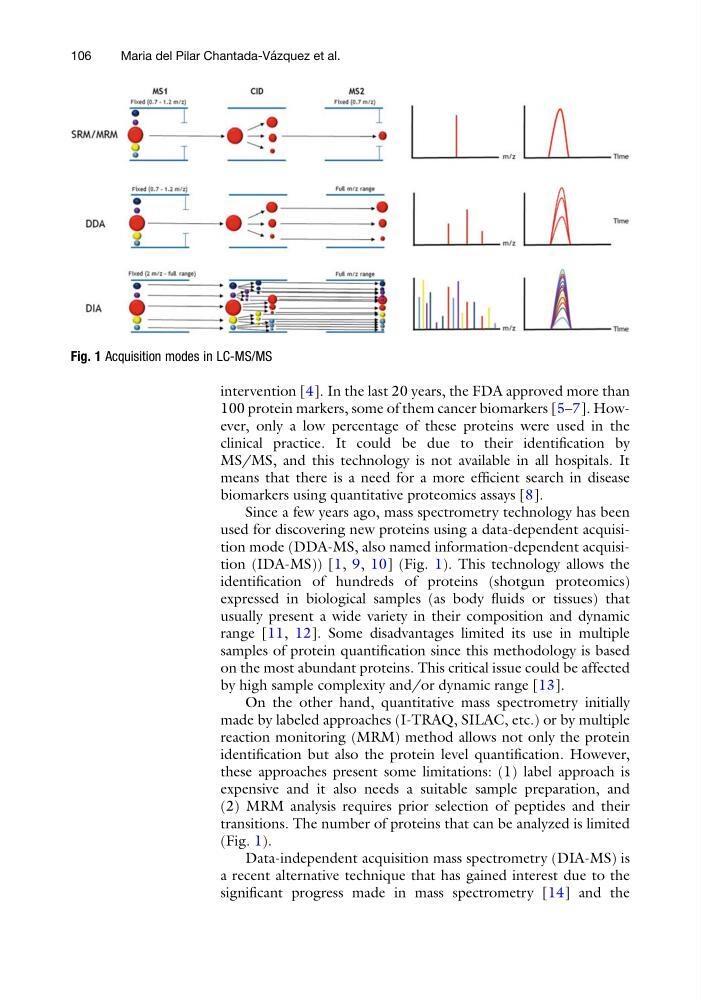
used for discovering new proteins using a data-dependent acquisition mode (DDA-MS, also named information-dependent acquisition (IDA-MS)) [1, 9, 10] (Fig. 1). This technology allows the
identification of hundreds of proteins (shotgun proteomics)
expressed in biological samples (as body fluids or tissues) that
usually present a wide variety in their composition and dynamic
range [11, 12]. Some disadvantages limited its use in multiple
samples of protein quantification since this methodology is based
on the most abundant proteins. This critical issue could be affected
by high sample complexity and/or dynamic range [13].
On the other hand, quantitative mass spectrometry initially
made by labeled approaches (I-TRAQ, SILAC, etc.) or by multiple
reaction monitoring (MRM) method allows not only the protein
identification but also the protein level quantification. However,
these approaches present some limitations: (1) label approach is
expensive and it also needs a suitable sample preparation, and
(2) MRM analysis requires prior selection of peptides and their
transitions. The number of proteins that can be analyzed is limited
(Fig. 1).
Data-independent acquisition mass spectrometry (DIA-MS) is
a recent alternative technique that has gained interest due to the
significant progress made in mass spectrometry [14] and the
Fig. 1 Acquisition modes in LC-MS/MS
106
Maria del Pilar Chantada-Va ´ zquez et al.
100 protein markers, some of them cancer biomarkers [5–7]. However, only a low percentage of these proteins were used in the
clinical practice. It could be due to their identification by
MS/MS, and this technology is not available in all hospitals. It
means that there is a need for a more efficient search in disease
biomarkers using quantitative proteomics assays [8].
Since a few years ago, mass spectrometry technology has been
used for discovering new proteins using a data-dependent acquisition mode (DDA-MS, also named information-dependent acquisition (IDA-MS)) [1, 9, 10] (Fig. 1). This technology allows the
identification of hundreds of proteins (shotgun proteomics)
expressed in biological samples (as body fluids or tissues) that
usually present a wide variety in their composition and dynamic
range [11, 12]. Some disadvantages limited its use in multiple
samples of protein quantification since this methodology is based
on the most abundant proteins. This critical issue could be affected
by high sample complexity and/or dynamic range [13].
On the other hand, quantitative mass spectrometry initially
made by labeled approaches (I-TRAQ, SILAC, etc.) or by multiple
reaction monitoring (MRM) method allows not only the protein
identification but also the protein level quantification. However,
these approaches present some limitations: (1) label approach is
expensive and it also needs a suitable sample preparation, and
(2) MRM analysis requires prior selection of peptides and their
transitions. The number of proteins that can be analyzed is limited
(Fig. 1).
Data-independent acquisition mass spectrometry (DIA-MS) is
a recent alternative technique that has gained interest due to the
significant progress made in mass spectrometry [14] and the
Fig. 1 Acquisition modes in LC-MS/MS
106
Maria del Pilar Chantada-Va ´ zquez et al.