

[10, 13]. The cultures should be washed once with phosphate buffer
for the disaggregation of cell clusters [18].
8. There are also other dyes that can be used for fluorescence
staining of lipids in microalgae, most notably Nile red (NR),
which is treated in a separate chapter in this book. A comparison
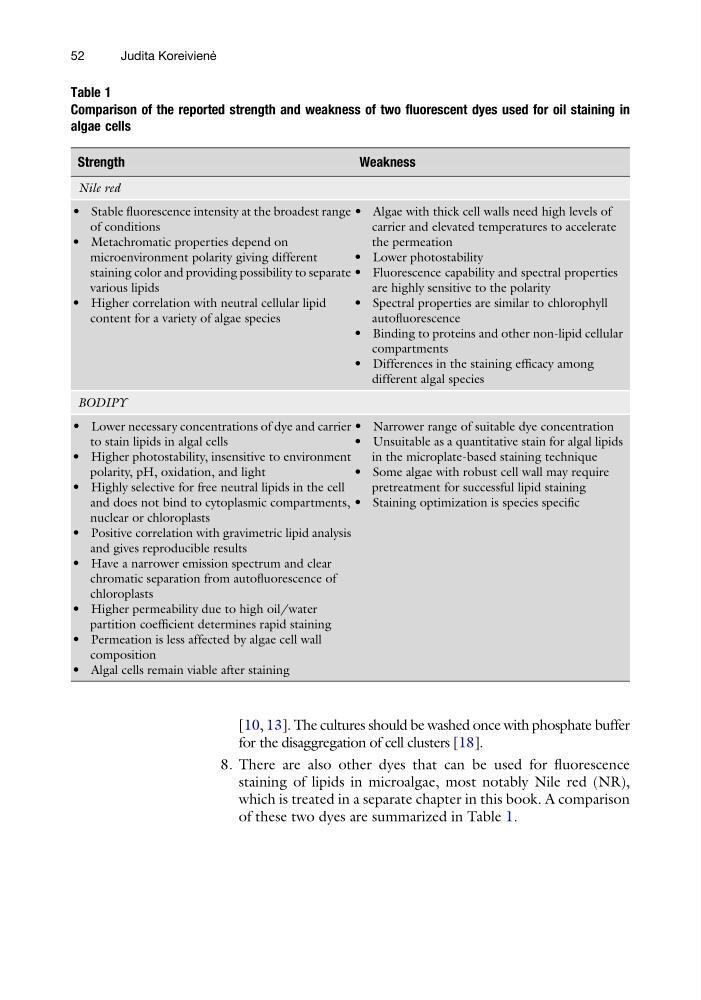
of these two dyes are summarized in Table 1.
Table 1
Comparison of the reported strength and weakness of two fluorescent dyes used for oil staining in
algae cells
Strength
Weakness
Nile red
l
Stable fluorescence intensity at the broadest range
of conditions
l
Metachromatic properties depend on
microenvironment polarity giving different
staining color and providing possibility to separate
various lipids
l
Higher correlation with neutral cellular lipid
content for a variety of algae species
l
Algae with thick cell walls need high levels of
carrier and elevated temperatures to accelerate
the permeation
l
Lower photostability
l
Fluorescence capability and spectral properties
are highly sensitive to the polarity
l
Spectral properties are similar to chlorophyll
autofluorescence
l
Binding to proteins and other non-lipid cellular
compartments
l
Differences in the staining efficacy among
different algal species
BODIPY
l
Lower necessary concentrations of dye and carrier
to stain lipids in algal cells
l
Higher photostability, insensitive to environment
polarity, pH, oxidation, and light
l
Highly selective for free neutral lipids in the cell
and does not bind to cytoplasmic compartments,
nuclear or chloroplasts
l
Positive correlation with gravimetric lipid analysis
and gives reproducible results
l
Have a narrower emission spectrum and clear
chromatic separation from autofluorescence of
chloroplasts
l
Higher permeability due to high oil/water
partition coefficient determines rapid staining
l
Permeation is less affected by algae cell wall
composition
l
Algal cells remain viable after staining
l
Narrower range of suitable dye concentration
l
Unsuitable as a quantitative stain for algal lipids
in the microplate-based staining technique
l
Some algae with robust cell wall may require
pretreatment for successful lipid staining
l
Staining optimization is species specific
52
Judita Koreiviene ˙
for the disaggregation of cell clusters [18].
8. There are also other dyes that can be used for fluorescence
staining of lipids in microalgae, most notably Nile red (NR),
which is treated in a separate chapter in this book. A comparison
of these two dyes are summarized in Table 1.
Table 1
Comparison of the reported strength and weakness of two fluorescent dyes used for oil staining in
algae cells
Strength
Weakness
Nile red
l
Stable fluorescence intensity at the broadest range
of conditions
l
Metachromatic properties depend on
microenvironment polarity giving different
staining color and providing possibility to separate
various lipids
l
Higher correlation with neutral cellular lipid
content for a variety of algae species
l
Algae with thick cell walls need high levels of
carrier and elevated temperatures to accelerate
the permeation
l
Lower photostability
l
Fluorescence capability and spectral properties
are highly sensitive to the polarity
l
Spectral properties are similar to chlorophyll
autofluorescence
l
Binding to proteins and other non-lipid cellular
compartments
l
Differences in the staining efficacy among
different algal species
BODIPY
l
Lower necessary concentrations of dye and carrier
to stain lipids in algal cells
l
Higher photostability, insensitive to environment
polarity, pH, oxidation, and light
l
Highly selective for free neutral lipids in the cell
and does not bind to cytoplasmic compartments,
nuclear or chloroplasts
l
Positive correlation with gravimetric lipid analysis
and gives reproducible results
l
Have a narrower emission spectrum and clear
chromatic separation from autofluorescence of
chloroplasts
l
Higher permeability due to high oil/water
partition coefficient determines rapid staining
l
Permeation is less affected by algae cell wall
composition
l
Algal cells remain viable after staining
l
Narrower range of suitable dye concentration
l
Unsuitable as a quantitative stain for algal lipids
in the microplate-based staining technique
l
Some algae with robust cell wall may require
pretreatment for successful lipid staining
l
Staining optimization is species specific
52
Judita Koreiviene ˙