

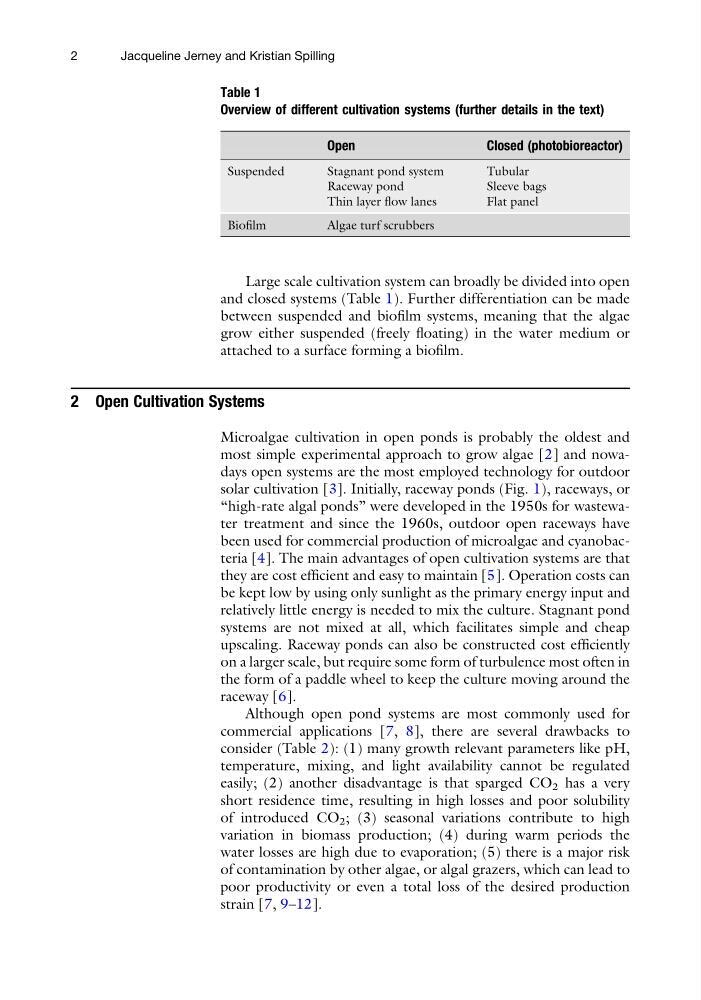
Large scale cultivation system can broadly be divided into open
and closed systems (Table 1). Further differentiation can be made
between suspended and biofilm systems, meaning that the algae
grow either suspended (freely floating) in the water medium or
attached to a surface forming a biofilm.
2 Open Cultivation Systems
Microalgae cultivation in open ponds is probably the oldest and
most simple experimental approach to grow algae [2] and nowadays open systems are the most employed technology for outdoor
solar cultivation [3]. Initially, raceway ponds (Fig. 1), raceways, or
“high-rate algal ponds” were developed in the 1950s for wastewater treatment and since the 1960s, outdoor open raceways have
been used for commercial production of microalgae and cyanobacteria [4]. The main advantages of open cultivation systems are that
they are cost efficient and easy to maintain [5]. Operation costs can
be kept low by using only sunlight as the primary energy input and
relatively little energy is needed to mix the culture. Stagnant pond
systems are not mixed at all, which facilitates simple and cheap
upscaling. Raceway ponds can also be constructed cost efficiently
on a larger scale, but require some form of turbulence most often in
the form of a paddle wheel to keep the culture moving around the
raceway [6].
Although open pond systems are most commonly used for
commercial applications [7, 8], there are several drawbacks to
consider (Table 2): (1) many growth relevant parameters like pH,
temperature, mixing, and light availability cannot be regulated
easily; (2) another disadvantage is that sparged CO 2 has a very
short residence time, resulting in high losses and poor solubility
of introduced CO 2 ; (3) seasonal variations contribute to high
variation in biomass production; (4) during warm periods the
water losses are high due to evaporation; (5) there is a major risk
of contamination by other algae, or algal grazers, which can lead to
poor productivity or even a total loss of the desired production
strain [7, 9–12].
Table 1
Overview of different cultivation systems (further details in the text)
Open
Closed (photobioreactor)
Suspended
Stagnant pond system
Tubular
Raceway pond
Sleeve bags
Thin layer flow lanes
Flat panel
Biofilm
Algae turf scrubbers
2
Jacqueline Jerney and Kristian Spilling
and closed systems (Table 1). Further differentiation can be made
between suspended and biofilm systems, meaning that the algae
grow either suspended (freely floating) in the water medium or
attached to a surface forming a biofilm.
2 Open Cultivation Systems
Microalgae cultivation in open ponds is probably the oldest and
most simple experimental approach to grow algae [2] and nowadays open systems are the most employed technology for outdoor
solar cultivation [3]. Initially, raceway ponds (Fig. 1), raceways, or
“high-rate algal ponds” were developed in the 1950s for wastewater treatment and since the 1960s, outdoor open raceways have
been used for commercial production of microalgae and cyanobacteria [4]. The main advantages of open cultivation systems are that
they are cost efficient and easy to maintain [5]. Operation costs can
be kept low by using only sunlight as the primary energy input and
relatively little energy is needed to mix the culture. Stagnant pond
systems are not mixed at all, which facilitates simple and cheap
upscaling. Raceway ponds can also be constructed cost efficiently
on a larger scale, but require some form of turbulence most often in
the form of a paddle wheel to keep the culture moving around the
raceway [6].
Although open pond systems are most commonly used for
commercial applications [7, 8], there are several drawbacks to
consider (Table 2): (1) many growth relevant parameters like pH,
temperature, mixing, and light availability cannot be regulated
easily; (2) another disadvantage is that sparged CO 2 has a very
short residence time, resulting in high losses and poor solubility
of introduced CO 2 ; (3) seasonal variations contribute to high
variation in biomass production; (4) during warm periods the
water losses are high due to evaporation; (5) there is a major risk
of contamination by other algae, or algal grazers, which can lead to
poor productivity or even a total loss of the desired production
strain [7, 9–12].
Table 1
Overview of different cultivation systems (further details in the text)
Open
Closed (photobioreactor)
Suspended
Stagnant pond system
Tubular
Raceway pond
Sleeve bags
Thin layer flow lanes
Flat panel
Biofilm
Algae turf scrubbers
2
Jacqueline Jerney and Kristian Spilling