

A more complex version of system expansion is called consequential approach. A consequential LCA aims at considering the
future consequences of marginal changes [59, 60]. When these
changes affect the market of a good, all the suppliers and competitors should be taken into account. For example, if seaweed is used
as protein supplement, it will compete with all the other protein
suppliers on the market that match the seaweed quality. Therefore,
the analysis will take in consideration the potential scenario occurring: equal reduction among all the suppliers, only one supplier
particularly affected, shift in prices, change in total demand, etc.
Several models are available to describe the market behavior [61]
and, combined with limitation of data, make this assessment more
uncertain [62] but more realistic [60]. Consequential approaches
are mostly used to define policy since the marginal effects can play a
role on a regional or global level.
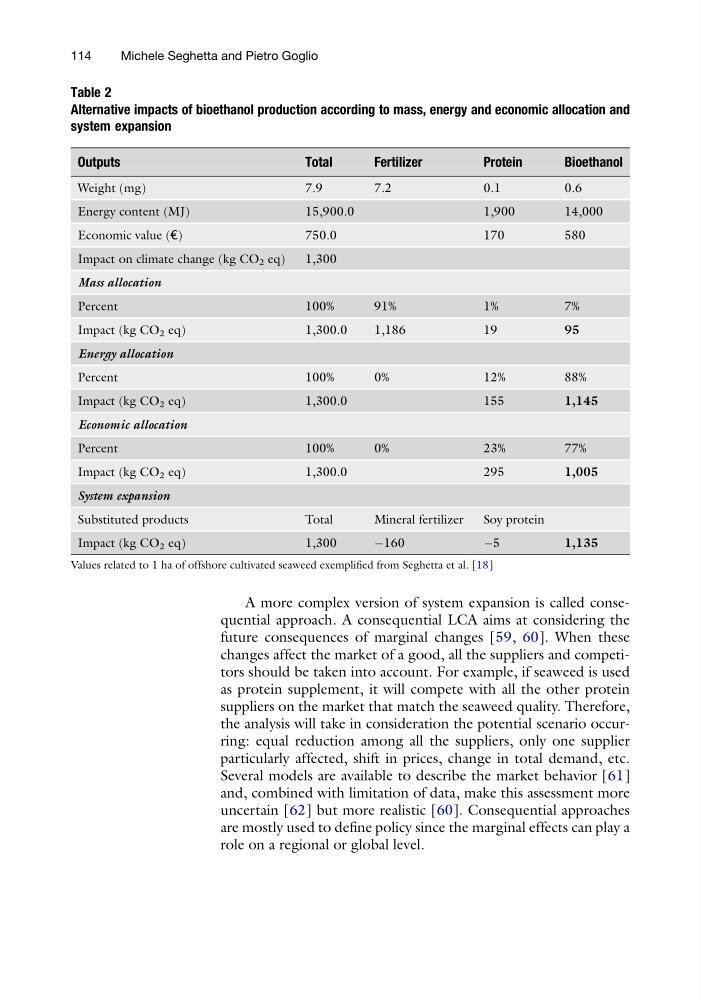
Table 2
Alternative impacts of bioethanol production according to mass, energy and economic allocation and
system expansion
Outputs
Total
Fertilizer
Protein
Bioethanol
Weight (mg)
7.9
7.2
0.1
0.6
Energy content (MJ)
15,900.0
1,900
14,000
Economic value (€)
750.0
170
580
Impact on climate change (kg CO 2 eq)
1,300
Mass allocation
Percent
100%
91%
1%
7%
Impact (kg CO 2 eq)
1,300.0
1,186
19
95
Energy allocation
Percent
100%
0%
12%
88%
Impact (kg CO 2 eq)
1,300.0
155
1,145
Economic allocation
Percent
100%
0%
23%
77%
Impact (kg CO 2 eq)
1,300.0
295
1,005
System expansion
Substituted products
Total
Mineral fertilizer
Soy protein
Impact (kg CO 2 eq)
1,300
À160
À5
1,135
Values related to 1 ha of offshore cultivated seaweed exemplified from Seghetta et al. [18]
114
Michele Seghetta and Pietro Goglio
future consequences of marginal changes [59, 60]. When these
changes affect the market of a good, all the suppliers and competitors should be taken into account. For example, if seaweed is used
as protein supplement, it will compete with all the other protein
suppliers on the market that match the seaweed quality. Therefore,
the analysis will take in consideration the potential scenario occurring: equal reduction among all the suppliers, only one supplier
particularly affected, shift in prices, change in total demand, etc.
Several models are available to describe the market behavior [61]
and, combined with limitation of data, make this assessment more
uncertain [62] but more realistic [60]. Consequential approaches
are mostly used to define policy since the marginal effects can play a
role on a regional or global level.
Table 2
Alternative impacts of bioethanol production according to mass, energy and economic allocation and
system expansion
Outputs
Total
Fertilizer
Protein
Bioethanol
Weight (mg)
7.9
7.2
0.1
0.6
Energy content (MJ)
15,900.0
1,900
14,000
Economic value (€)
750.0
170
580
Impact on climate change (kg CO 2 eq)
1,300
Mass allocation
Percent
100%
91%
1%
7%
Impact (kg CO 2 eq)
1,300.0
1,186
19
95
Energy allocation
Percent
100%
0%
12%
88%
Impact (kg CO 2 eq)
1,300.0
155
1,145
Economic allocation
Percent
100%
0%
23%
77%
Impact (kg CO 2 eq)
1,300.0
295
1,005
System expansion
Substituted products
Total
Mineral fertilizer
Soy protein
Impact (kg CO 2 eq)
1,300
À160
À5
1,135
Values related to 1 ha of offshore cultivated seaweed exemplified from Seghetta et al. [18]
114
Michele Seghetta and Pietro Goglio