

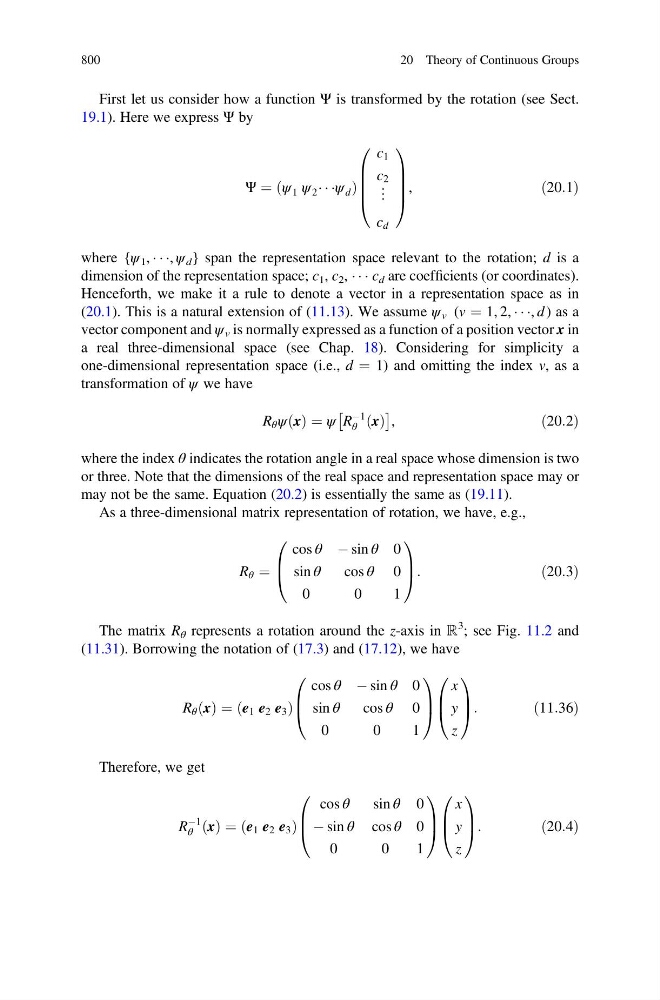
First let us consider how a function Ψ is transformed by the rotation (see Sect.
19.1). Here we express Ψ by
Ψ ¼ ψ 1 ψ 2 Á Á Áψ d
ð
Þ
c 1
c 2
⋮
c d
0
B
B
B
@
1
C
C
C
A
,
ð20:1Þ
where {ψ 1 , Á Á Á, ψ d } span the representation space relevant to the rotation; d is a
dimension of the representation space; c 1 , c 2 , Á Á Á c d are coefficients (or coordinates).
Henceforth, we make it a rule to denote a vector in a representation space as in
(20.1). This is a natural extension of (11.13). We assume ψ v (v ¼ 1, 2, Á Á Á, d ) as a
vector component and ψ v is normally expressed as a function of a position vector x in
a real three-dimensional space (see Chap. 18). Considering for simplicity a
one-dimensional representation space (i.e., d ¼ 1) and omitting the index v, as a
transformation of ψ we have
R θ ψ x
ð Þ ¼ ψ R
À1
θ x
ð Þ
Â
Ã
,
ð20:2Þ
where the index θ indicates the rotation angle in a real space whose dimension is two
or three. Note that the dimensions of the real space and representation space may or
may not be the same. Equation (20.2) is essentially the same as (19.11).
As a three-dimensional matrix representation of rotation, we have, e.g.,
R θ ¼
cos θ À sin θ 0
sin θ
cos θ 0
0
0
1
0
B
@
1
C
A:
ð20:3Þ
The matrix R θ represents a rotation around the z-axis in ℝ
3 ; see Fig. 11.2 and
(11.31). Borrowing the notation of (17.3) and (17.12), we have
R θ x
ð Þ ¼ e 1 e 2 e 3
ð
Þ
cos θ À sin θ 0
sin θ
cos θ 0
0
0
1
0
B
@
1
C
A
x
y
z
0
B
@
1
C
A:
ð11:36Þ
Therefore, we get
R
À1
θ x
ð Þ ¼ e 1 e 2 e 3
ð
Þ
cos θ
sin θ 0
À sin θ cos θ 0
0
0
1
0
B
@
1
C
A
x
y
z
0
B
@
1
C
A:
ð20:4Þ
800
20 Theory of Continuous Groups