

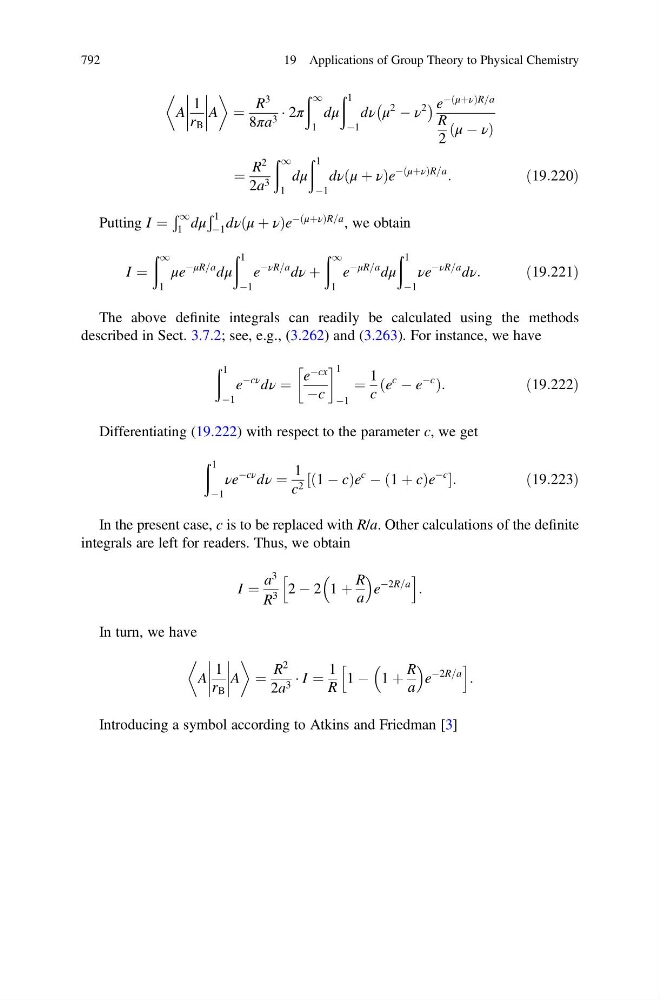
A
1
r B
A
(
)
¼
R
3
8πa 3 Á 2π
ð 1
1
dμ
ð 1
À1
dν μ
2
À ν
2
À
Á e
À μþν
ð
ÞR=a
R
2
μ À ν
ð
Þ
¼
R
2
2a 3
ð 1
1
dμ
ð 1
À1
dν μ þ ν
ð
Þe
À μþν
ð
ÞR=a
:
ð19:220Þ
Putting I ¼
Ð 1
1 dμ
Ð 1
À1 dν μ þ ν
ð
Þe
À μþν
ð
ÞR=a , we obtain
I ¼
ð 1
1
μe
ÀμR=a dμ
ð 1
À1
e
ÀνR=a dν þ
ð 1
1
e
ÀμR=a dμ
ð 1
À1
νe
ÀνR=a dν:
ð19:221Þ
The above definite integrals can readily be calculated using the methods
described in Sect. 3.7.2; see, e.g., (3.262) and (3.263). For instance, we have
ð 1
À1
e
Àcν dν ¼
e
Àcx
Àc
! 1
À1
¼
1
c
e
c
À e
Àc
ð
Þ :
ð19:222Þ
Differentiating (19.222) with respect to the parameter c, we get
ð 1
À1
νe
Àcν dν ¼
1
c 2 1 À c
ð
Þe
c
À 1 þ c
ð
Þe
Àc
½
:
ð19:223Þ
In the present case, c is to be replaced with R/a. Other calculations of the definite
integrals are left for readers. Thus, we obtain
I ¼
a
3
R
3
2 À 2 1 þ
R
a
e
À2R=a
h
i
:
In turn, we have
A
1
r B
A
(
)
¼
R
2
2a 3 Á I ¼
1
R
1 À 1 þ
R
a
e
À2R=a
h
i
:
Introducing a symbol according to Atkins and Friedman [3]
792
19 Applications of Group Theory to Physical Chemistry
1
r B
A
(
)
¼
R
3
8πa 3 Á 2π
ð 1
1
dμ
ð 1
À1
dν μ
2
À ν
2
À
Á e
À μþν
ð
ÞR=a
R
2
μ À ν
ð
Þ
¼
R
2
2a 3
ð 1
1
dμ
ð 1
À1
dν μ þ ν
ð
Þe
À μþν
ð
ÞR=a
:
ð19:220Þ
Putting I ¼
Ð 1
1 dμ
Ð 1
À1 dν μ þ ν
ð
Þe
À μþν
ð
ÞR=a , we obtain
I ¼
ð 1
1
μe
ÀμR=a dμ
ð 1
À1
e
ÀνR=a dν þ
ð 1
1
e
ÀμR=a dμ
ð 1
À1
νe
ÀνR=a dν:
ð19:221Þ
The above definite integrals can readily be calculated using the methods
described in Sect. 3.7.2; see, e.g., (3.262) and (3.263). For instance, we have
ð 1
À1
e
Àcν dν ¼
e
Àcx
Àc
! 1
À1
¼
1
c
e
c
À e
Àc
ð
Þ :
ð19:222Þ
Differentiating (19.222) with respect to the parameter c, we get
ð 1
À1
νe
Àcν dν ¼
1
c 2 1 À c
ð
Þe
c
À 1 þ c
ð
Þe
Àc
½
:
ð19:223Þ
In the present case, c is to be replaced with R/a. Other calculations of the definite
integrals are left for readers. Thus, we obtain
I ¼
a
3
R
3
2 À 2 1 þ
R
a
e
À2R=a
h
i
:
In turn, we have
A
1
r B
A
(
)
¼
R
2
2a 3 Á I ¼
1
R
1 À 1 þ
R
a
e
À2R=a
h
i
:
Introducing a symbol according to Atkins and Friedman [3]
792
19 Applications of Group Theory to Physical Chemistry