

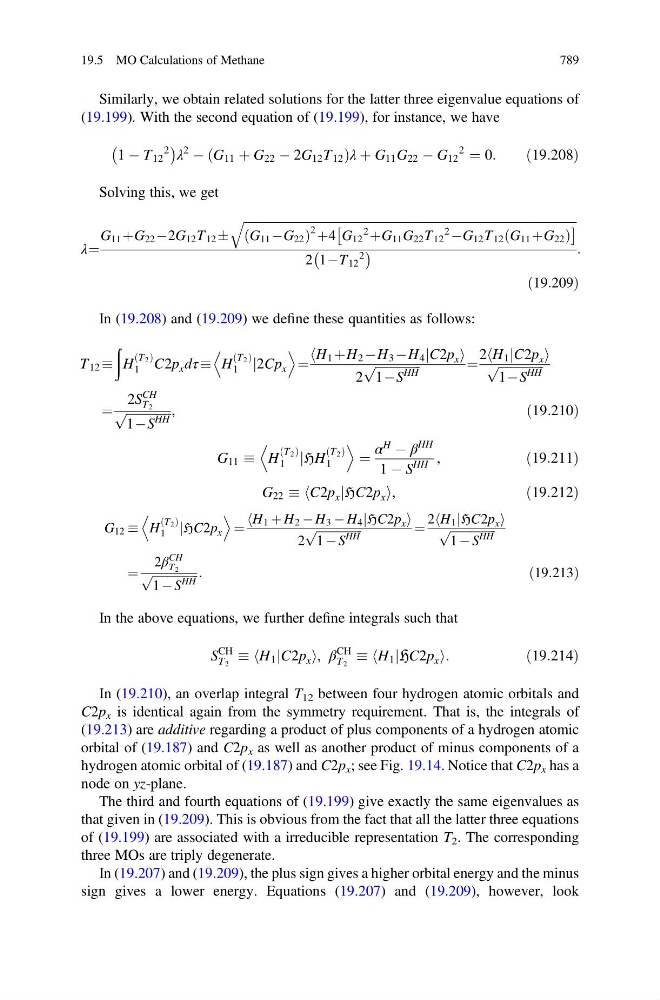
Similarly, we obtain related solutions for the latter three eigenvalue equations of
(19.199). With the second equation of (19.199), for instance, we have
1 À T 12
2
À
Á λ
2
À G 11 þ G 22 À 2G 12 T 12
ð
Þ λ þ G 11 G 22 À G 12
2
¼ 0:
ð19:208Þ
Solving this, we get
λ¼
G 11 þG 22 À2G 12 T 12 Æ
ffiffiffiffiffiffiffiffiffiffiffiffiffiffiffiffiffiffiffiffiffiffiffiffiffiffiffiffiffiffiffiffiffiffiffiffiffiffiffiffiffiffiffiffiffiffiffiffiffiffiffiffiffiffiffiffiffiffiffiffiffiffiffiffiffiffiffiffiffiffiffiffiffiffiffiffiffiffiffiffiffiffiffiffiffiffiffiffiffiffiffiffiffiffiffiffiffiffiffiffiffiffiffiffiffiffiffiffiffiffi
G 11 ÀG 22
ð
Þ
2 þ4 G 12
2
þG 11 G 22 T 12
2
ÀG 12 T 12 G 11 þG 22
ð
Þ
Â
Ã
q
2 1ÀT 12
2
À
Á
:
ð19:209Þ
In (19.208) and (19.209) we define these quantities as follows:
T 12
ð
H
T 2
ð Þ
1 C2p x dτ H
T 2
ð Þ
1 j2Cp x
D
E
¼
hH 1 þH 2 ÀH 3 ÀH 4 C2p x
j
i
2
ffiffiffiffiffiffiffiffiffiffiffiffiffiffi ffi
1ÀS
HH
p
¼
2hH 1 C2p x
j
i
ffiffiffiffiffiffiffiffiffiffiffiffiffiffi ffi
1ÀS
HH
p
¼
2S
CH
T 2
ffiffiffiffiffiffiffiffiffiffiffiffiffiffi ffi
1ÀS
HH
p
,
ð19:210Þ
G 11 H
T 2
ð Þ
1 jHH
T 2
ð Þ
1
D
E
¼
α
H
À β
HH
1 À S
HH ,
ð19:211Þ
G 22 C2p x jHC2p x
h
i ,
ð19:212Þ
G 12 H
T2
ð Þ
1 jHC2p x
D
E
¼
H 1 þ H 2 À H 3 À H 4 jHC2p x
h
i
2
ffiffiffiffiffiffiffiffiffiffiffiffiffiffiffi ffi
1 À S
HH
p
¼
2 H 1 jHC2p x
h
i
ffiffiffiffiffiffiffiffiffiffiffiffiffiffiffi ffi
1 À S
HH
p
¼
2β
CH
T 2
ffiffiffiffiffiffiffiffiffiffiffiffiffiffiffi ffi
1 À S
HH
p
:
ð19:213Þ
In the above equations, we further define integrals such that
S
CH
T 2
H 1 C2p x
j
h
i , β
CH
T 2
H 1
h jℌC2p x i:
ð19:214Þ
In (19.210), an overlap integral T 12 between four hydrogen atomic orbitals and
C2p x is identical again from the symmetry requirement. That is, the integrals of
(19.213) are additive regarding a product of plus components of a hydrogen atomic
orbital of (19.187) and C2p x as well as another product of minus components of a
hydrogen atomic orbital of (19.187) and C2p x ; see Fig. 19.14. Notice that C2p x has a
node on yz-plane.
The third and fourth equations of (19.199) give exactly the same eigenvalues as
that given in (19.209). This is obvious from the fact that all the latter three equations
of (19.199) are associated with a irreducible representation T 2 . The corresponding
three MOs are triply degenerate.
In (19.207) and (19.209), the plus sign gives a higher orbital energy and the minus
sign gives a lower energy. Equations (19.207) and (19.209), however, look
19.5 MO Calculations of Methane
789